




.avif)

Wie ein führendes Versicherungsunternehmen das Mitarbeiterengagement mithilfe modernster Gamification-Techniken signifikant steigerte

Gamification for HR Benefits Awareness at an Insurance Company
Every large employer has the same quiet problem with its benefits. The programs exist, they are often good, and a substantial share of employees do not know what is available to them. The information is not hidden. It sits in a policy document, an intranet page, and an annual email, all of which are read by the people who were already going to find out.
This case study covers how a leading insurance company approached that problem as an engagement design question rather than a communication one, and what it built instead of another benefits document. The program was recognized with Silver in the 2017 Horizon Interactive Awards.
The background
Employee engagement is one of the more demanding parts of the HR and HCM remit, and L&D teams increasingly reach for gamification and personalization to get results that a broadcast will not deliver. The insurance company had two objectives running together. It wanted employees to be genuinely aware of the HR benefits available to them, and it wanted its HR team to be seen as a progressive, employee-oriented function rather than an administrative one.
The second objective is the one that shaped the design. Awareness alone can be handled with a better email. Reputation cannot.
The design problem
Benefits content resists conventional treatment. It is a list. There is no narrative in it, no sequence a learner has to follow, and no consequence for skipping a section. Turned into a course, it becomes a set of screens describing entitlements, which is the document again with navigation added.
There is also no obligation attached. Nobody is required to complete benefits awareness training, which means the design has to earn attention rather than assume it. If the experience is dull, employees simply will not open it, and no completion deadline exists to rescue the numbers.
How our team approached the solution
An awareness campaign before anything launched
The program was preceded by an awareness campaign to build interest before the portal opened. For a voluntary program, this is not promotional decoration. It is the part of the design that determines whether anyone shows up, and it belonged in the plan from the start rather than being left to whatever announcement HR sent on launch day.
A gamified portal with levels, points, and badges
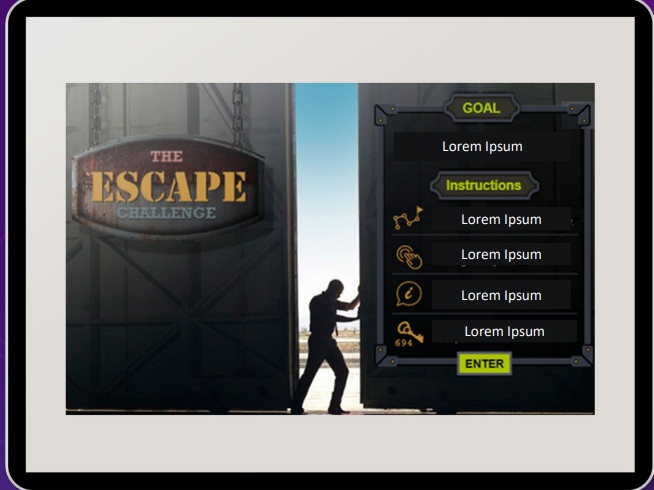
Our team built a gamified portal structured as a game the employee progresses through. Learners work through levels, earning points and badges for completing each one, which creates an environment of competition and challenge in a subject that offers neither on its own. Progression gives the content the sequence it does not naturally have, and the badges give employees a reason to reach the levels covering benefits they might otherwise never have looked up.
Two characters carrying the content
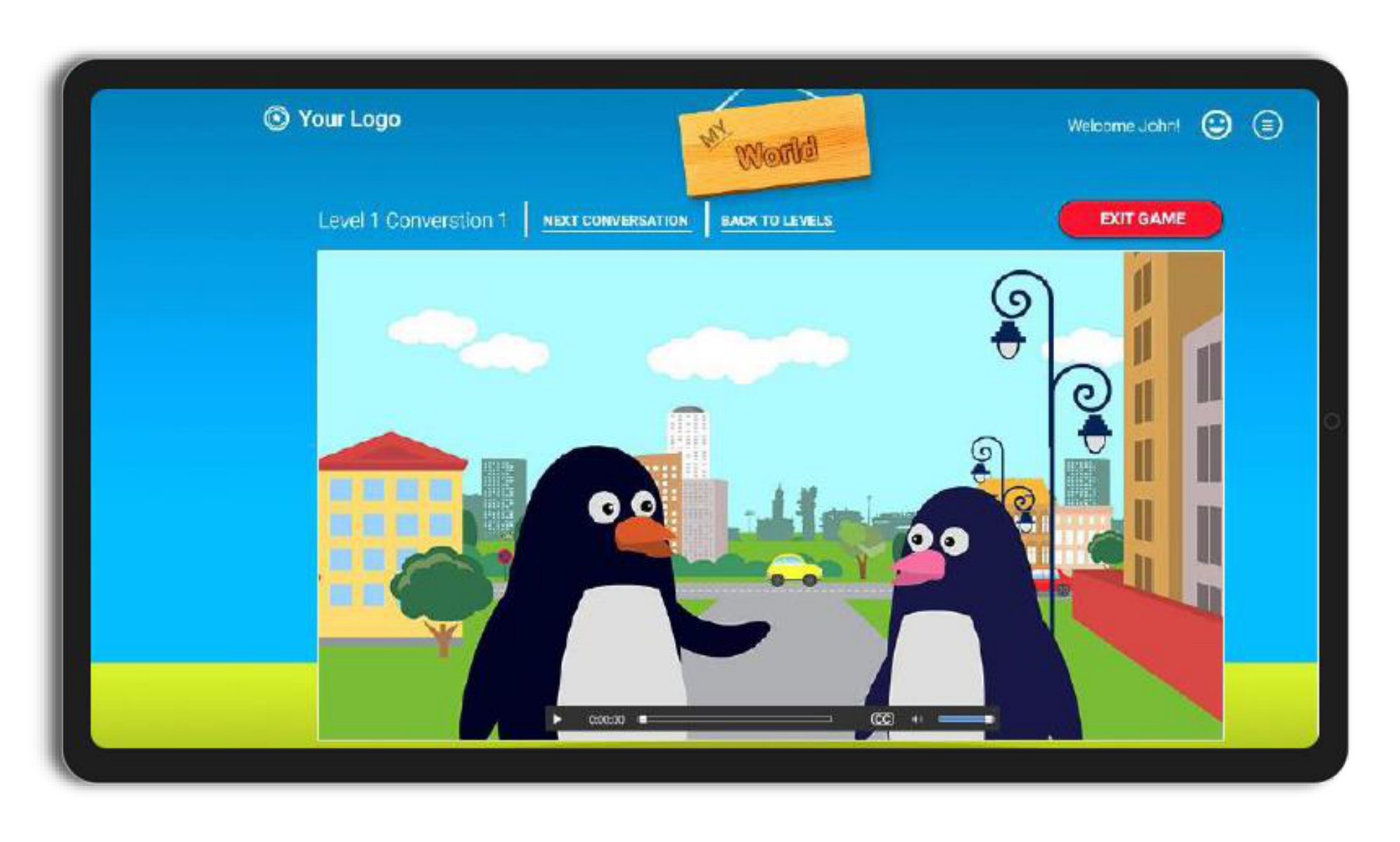
Learning within each level is driven by conversations between two marquee characters, a pair of penguins who appear throughout the program. Putting the content in a conversation between characters does something a benefits page cannot. It shows one colleague telling another what is available, which is how most people actually find out about benefits, and it lets the program raise a topic without addressing the employee in the second person.
Questions that reward attention
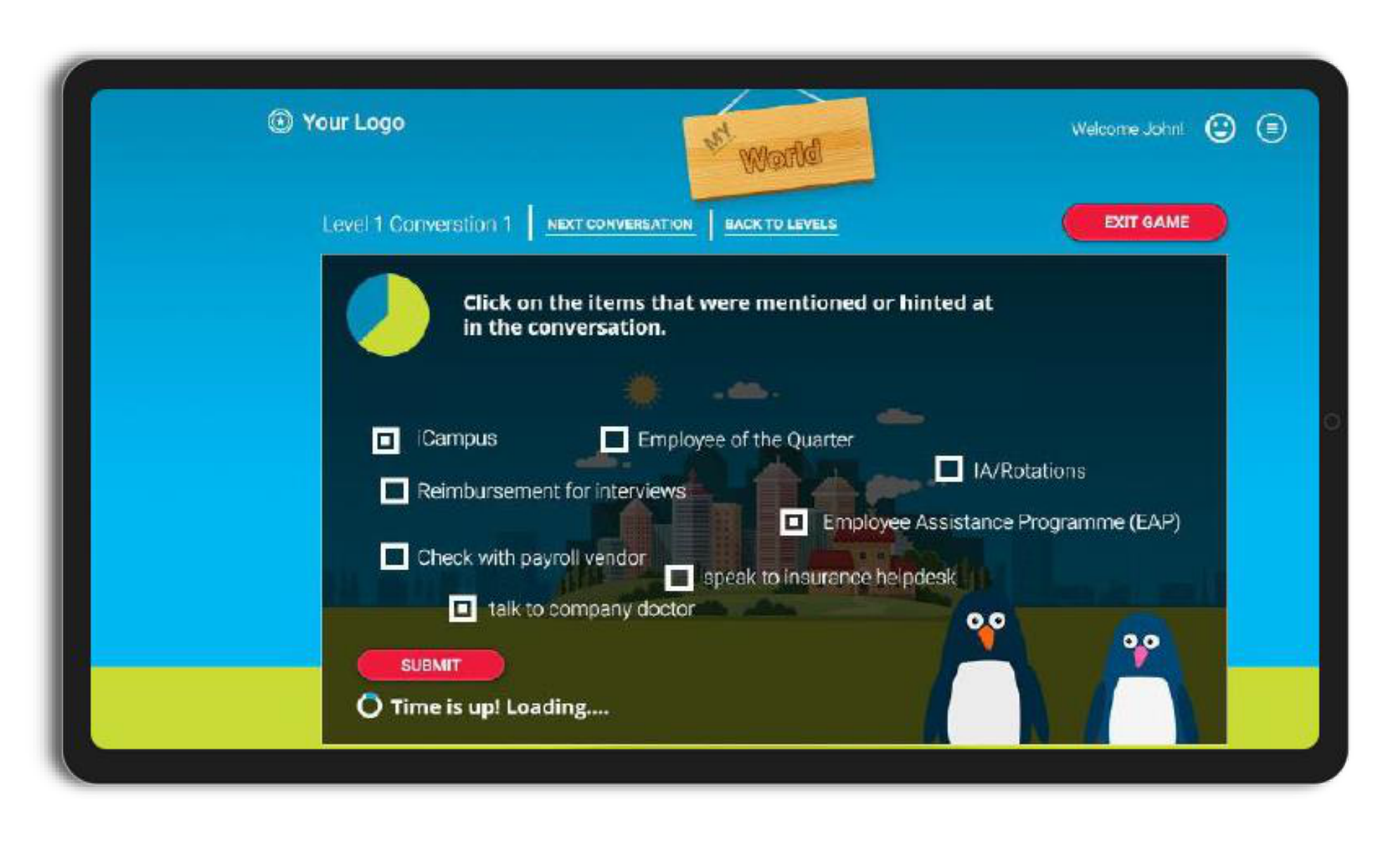
After each conversation, learners face challenging questions that check what they picked up. The recall activity asks which items were mentioned or hinted at in the exchange, against a timer, which is a different task from answering a multiple-choice question about a policy. It rewards having listened, and it puts the specific names of the benefits in front of the learner at the moment they are trying to remember them.
An admin panel and in-game notifications
An admin panel let the HR team track participation across the program. It also carried notifications, presented in-game as advertisements for HR initiatives and benefits, so the portal could keep surfacing new material rather than going quiet after launch. That turns a one-time campaign into a channel the HR team owns.
Mobile and personalized, delivered through a learning portal
Delivery ran as mobile and personalized learning through the learning portal. For a voluntary program competing with everything else in an employee’s day, mobile access is not a convenience feature. It is the difference between something taken in a spare ten minutes and something that waits for a free hour that never arrives.
The impact
- Learners were able to articulate an understanding of the various HR initiatives without having to work through exhaustive documents or resources.
- Management was able to build a reputation for the local HR team as an employee-oriented body.
The second outcome is the one that was hardest to buy and the one the design was really aimed at. A benefits portal that employees enjoy using changes how the function that built it is regarded, which no amount of internal communication about being employee-oriented will do.
What this case study shows
Gamification is often applied to content that already has a reason to be completed, where it adds motivation to something mandatory. This case is the more interesting use. The content had no deadline, no assessment, and no consequence for ignoring it, so the game was not an enhancement. It was the only reason to turn up.
It also shows the value of characters in corporate content. Two penguins having a conversation about employee assistance and payroll sounds like a strange answer to a benefits awareness brief, and it is exactly the reason employees opened it.
If you have benefits, policies, or initiatives that employees are not engaging with, Liberate can help you design something they will choose to spend time on.

Ihre Anmeldung!
