







.avif)

Wie eine Universität mithilfe von szenariobasiertem Lernen Empathie und Verbundenheit unter den Lernenden förderte, um das Bewusstsein für Kindesmissbrauch zu schärfen


Scenario Based Learning for Child Protection Training at a University
Safeguarding training carries a burden that most workplace learning does not. The person completing it may one day be the only adult who notices something, and what they do in that moment depends less on whether they can list the categories of abuse than on whether they recognize what they are seeing and feel able to act on it.
Many universities run a social responsibility function that trains learners and volunteers across a range of subjects. One distinguished university asked our team to build training on recognizing and reporting child abuse, a subject of global concern and one where the gap between knowing and acting is unusually consequential.
The Challenge
The brief called for training that carried empathy and connection rather than information alone. Learners had to be able to relate to the situations they were shown and empathize with them, because that is what makes appropriate action possible at the moment it is needed.
The subject itself made that difficult. The concept, the sensitivity of the material, and the seriousness of what was at stake all had to be held together in a design that neither softened the content into something comfortable nor handled it so bluntly that learners disengaged from it. Getting that balance right was the hardest part of the work.
How the Solution Was Built
Our primary aim was a design that generated an immediate sense of connection, and we approached it in two ways at once, through the visual design and through interactive storytelling.
Scenarios written with subject matter experts
We partnered with subject matter experts to craft scenarios drawn from real-life situations of child abuse, then connected the underlying concepts through a single narrative running across the course. On a subject like this the expert partnership is not optional. Scenarios written without that grounding tend to be either implausible or unintentionally harmful, and learners who work in safeguarding recognize the difference immediately.
Children as the characters who carry the content
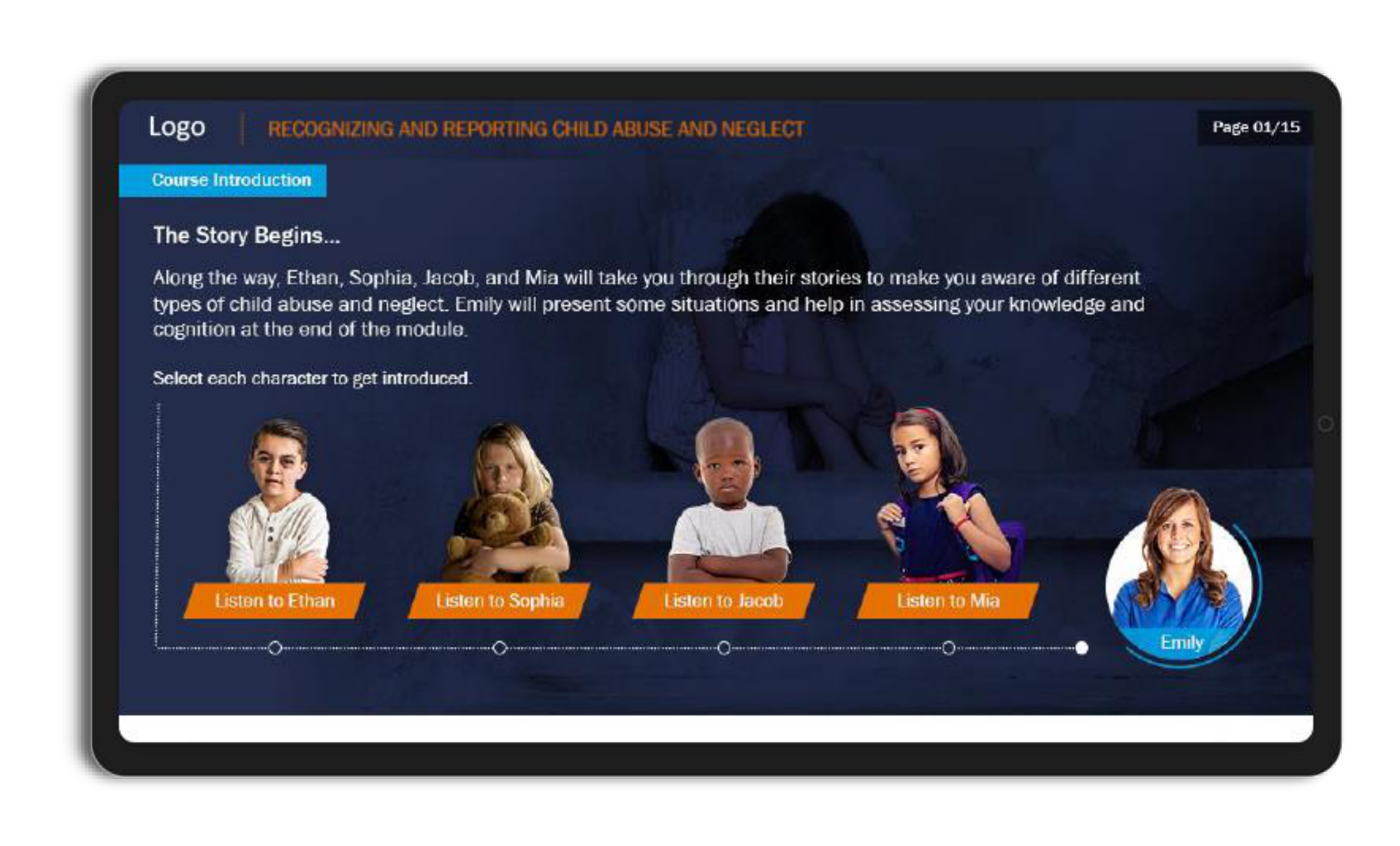
The decision that shapes the whole course is that children anchor it. The course opens by introducing four young characters, Ethan, Sophia, Jacob, and Mia, each of whom takes the learner through their own story to build awareness of different types of abuse and neglect. A fifth character, Emily, presents situations to the learner and assesses their understanding at the end of the module.
Letting each child speak in the first person is what produces the connection the brief asked for. A description of a category of neglect is something a learner processes. A child explaining their own situation is something a learner responds to, and the response is closer to what will be needed if they encounter the real thing.
The structure also spreads the material across several distinct stories rather than concentrating it into one, which matters on a subject where a single sustained account would be harder for learners to stay with.
Visual design doing part of the work
The visual treatment is deliberately restrained, with a dark, quiet palette and a great deal of space around each character. Design of this kind carries meaning on a serious subject in a way that decoration cannot. It signals to the learner how the material is meant to be received, and it avoids the mismatch that occurs when difficult content is presented in a bright, energetic interface built for something else.
The Strategies Behind the Design
Six strategies power the solution.
- Scenario Based Learning
- Learning Journey
- Story Based Learning
- Social Learning
- Active Decision Making
- Experiential Learning
Delivery combined mobile learning, microlearning, and personalized learning served through the university LMS and LXP, so learners and volunteers could work through the course in their own time.
The Impact
Learner response was overwhelmingly positive, and the specific point made was that learners were able to connect with the training despite it being virtual and self-paced. That qualification matters here. Safeguarding training is usually delivered in a room with a facilitator precisely because the subject is thought to need one, and the feedback indicates the design carried that weight without a person in the room.
In follow-up feedback, learners reported making informed decisions when the situation required it, compared with how they had responded previously. This is the outcome the program exists to produce, and it is the only one that ultimately matters on this subject.
The university also recorded an increase in registration requests after feedback from the pilot batch circulated. Voluntary demand rising through word of mouth is a strong signal for training that people are not obliged to take.
Build Training That Prepares People to Act
Sensitive subjects are often handled by making the training careful rather than making it effective, and the two are not the same thing. This course worked because the scenarios were built with subject matter experts, because children carried the content in their own voices, and because the visual design treated the material with the seriousness it warranted. If you need training on a difficult subject that prepares people to act rather than simply to comply, Liberate can help you design it. Get in touch to talk it through.

Ihre Anmeldung!
