






.avif)

Wie ein Versicherungsriese mithilfe von sozialem Lernen und Gamification das Gesundheitsbewusstsein förderte


A Virtual Walkathon That Turned Health Awareness Into a Team Game
Most of what gets built in corporate learning is training in the ordinary sense, with objectives, assessments, and a completion record at the end. Occasionally the request is different. Someone in HR wants employees to do something rather than know something, and the usual course structure has nothing useful to offer.
A leading insurance company came to our team with a request of that kind. HR had initiated an employee engagement program and wanted it gamified, with the objective of spreading awareness among employees about health issues and the benefits of walking in the most enjoyable and effective way possible.
The Challenge
Health awareness is a subject nobody disputes and almost nobody acts on. Employees already know that moving more is good for them, so a program built around telling them again would have had no effect on anything. What the organization needed was participation rather than comprehension.
That reframes the design problem entirely. Awareness content can be pushed to an audience, but behavior of this kind has to be pulled from them, and the thing doing the pulling has to be strong enough to compete with a working day spent at a desk.
How the Solution Was Built
Our first step was to build something other than a course. We created a fun and interactive virtual walkathon portal that let employees record their steps using their own wearable devices, so the program ran on activity people were already generating rather than on time they had to set aside.
A journey across the globe rather than a target to hit
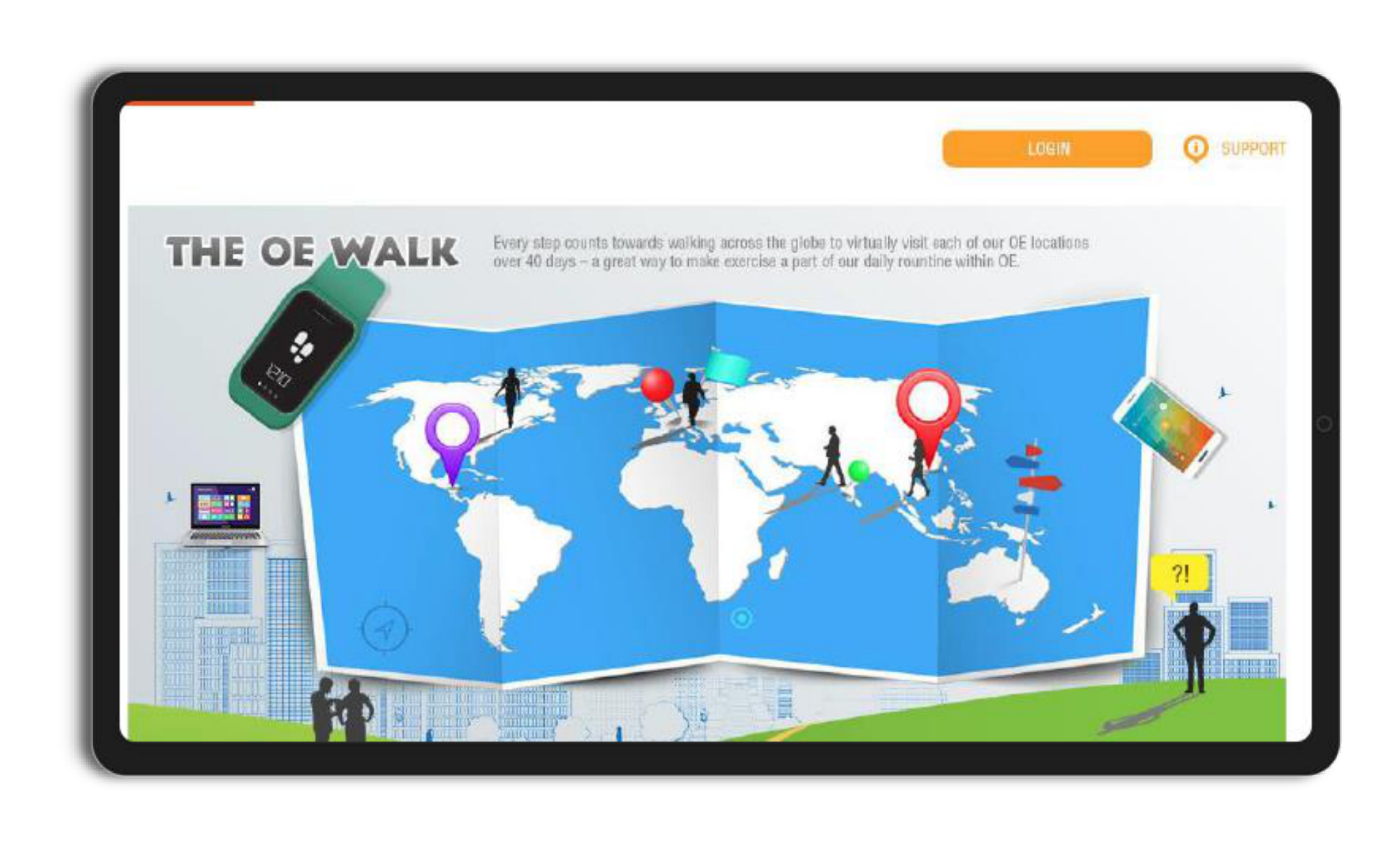
The portal presents the program as a walk across the world, with every step counting towards virtually visiting each of the organization’s office locations over a 40 day period. Progress is shown on a folding world map with markers at each destination, so participants can see where they have reached rather than only how many steps they have logged.
Framing a step count as a journey is what makes it hold attention across six weeks. A number climbing towards a target is the same information, but it gives the participant nothing to look at and nowhere to be.
Teams, challenges, and a reason to talk to each other
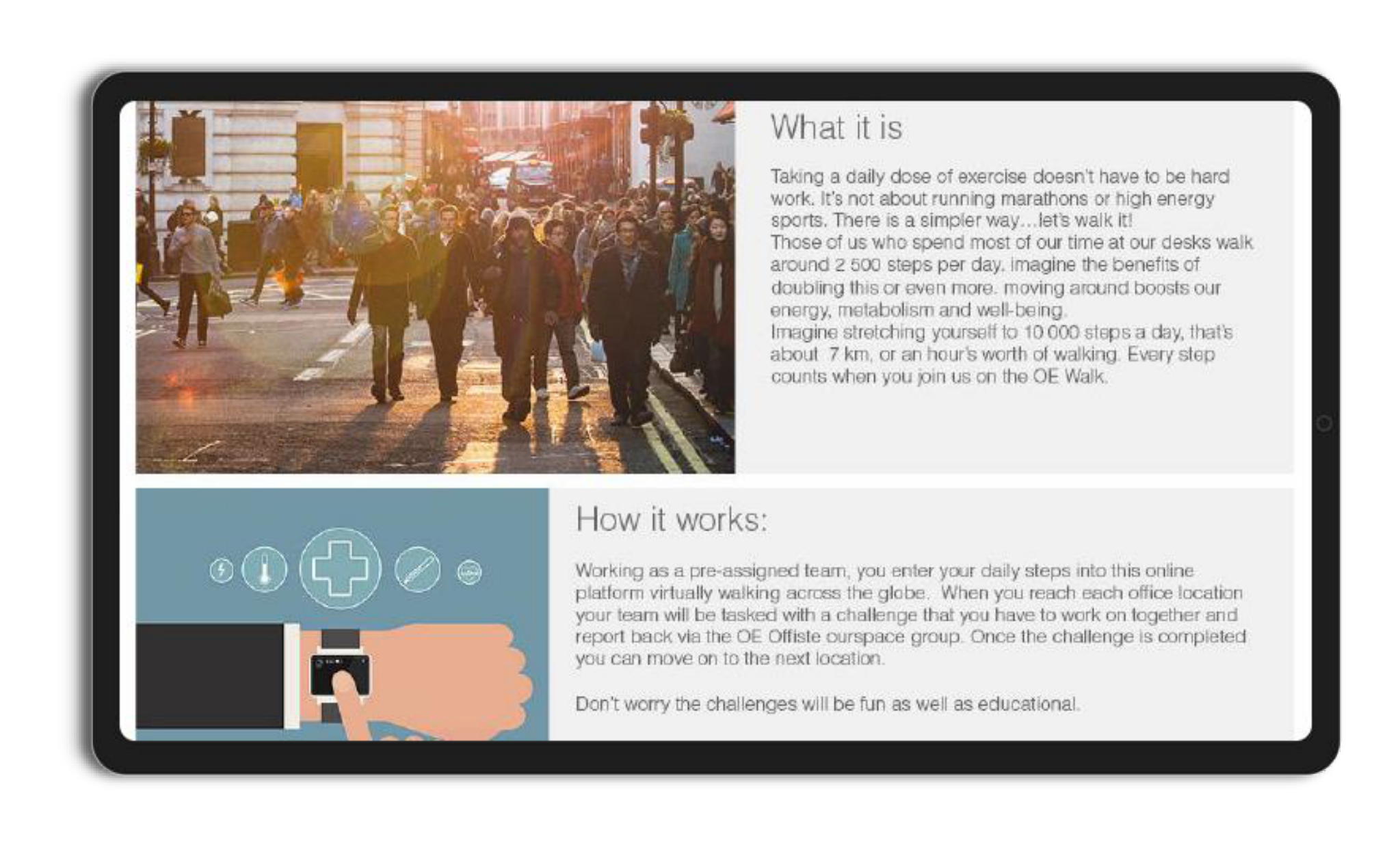
Participants are placed in pre-assigned teams and enter their daily steps into the platform, walking across the globe together. Reaching each office location triggers a challenge the team has to work on jointly and then report back on through the organization’s internal social group, and only once that challenge is completed does the team move on to the next destination.
This is where the social learning does its work. A team cannot progress on individual effort alone, which means the quieter participants get pulled along by the others, and the reporting requirement puts the program into a channel colleagues already use rather than leaving it stranded on a portal nobody visits.
The supporting content explains the reasoning plainly, noting that people who spend most of their time at a desk walk far fewer steps than they might, and setting out what a higher daily figure looks like in distance and time. Provisions were also made for learners to take part in offline team activities through the program, so participation was not confined to what a device could count.
Leaderboards at two levels
To create an environment of competition and challenge, comprehensive leaderboards were built at both individual and group level, fostering social learning through gamification. Running both matters more than it sounds, because an individual board rewards the people who were going to participate anyway, while a group board gives everyone a stake in colleagues who are not.
A comprehensive admin panel sat behind all of it, handling users, groups, notifications, and progress tracking, which is what allowed HR to run the program rather than simply commission it.
The Strategies Behind the Design
Six strategies power the solution.
- Gamification
- Personalized Learning
- Social Learning
- Exploration Based Learning
- Action-oriented Learning
- Learning Journey
Next generation strategies and performance support tools sit behind these, with delivery combining personalized learning, microlearning, and mobile learning served through a learning portal.
The Impact
Employees recognized the program as a strong platform for engagement, which was the brief HR started with. It also built team spirit alongside awareness of health issues, and both of those were named objectives at the outset rather than incidental benefits.
The most durable result is the one that outlasted the walkathon itself. The organization came away with a framework it could reuse to build similar gamification activities for personal development and other HR initiatives, which turns a single campaign into a capability. For a program of this kind, being asked to run it again in a different form is a more meaningful endorsement than any completion figure.
Use Gamification Where Training Would Not Work
Some organizational goals are about participation rather than knowledge, and a course is the wrong instrument for them. This program worked because it ran on activity people were already doing, gave them a journey to follow rather than a target to hit, made teams depend on each other to progress, and put the conversation into a channel colleagues already used. If you have an engagement or wellbeing goal that training cannot reach, Liberate can help you design something that will. Get in touch to talk it through.

Ihre Anmeldung!
