


.avif)

Stärkung des Vertriebsteams eines Giganten der Verpackungsindustrie durch eine mobile App auf Basis bedarfsorientierter Schulungen


Mobile App Based Sales Training for a Packaging Manufacturer
Product training for a field sales team runs into a scheduling problem that nobody ever solves. The people who most need to know the product range are the people least available to sit through anything about it. They are in a car, at a customer site, or between the two, and the window in which they would actually welcome a refresher is the twenty minutes before a meeting, not a Tuesday afternoon in a training room.
This case study covers how a packaging industry giant handled that, and why the answer was a mobile app rather than an eLearning course that happens to open on a phone.
The background
The company needed engaging and effective awareness training for all new and existing sales teams. The objective was direct enough: sales reps needed to know the specific features and highlights of the products well enough to hit their targets.
What made it pressing was timing. Sales targets had recently been revised, and the training was aimed at equipping the team to meet the new numbers. That changes the nature of the brief. This was not a general capability program with a long horizon. It had to land quickly, with a team already under pressure from the targets it was meant to help them reach.
The design problem
Product knowledge training has an obvious failure mode, which is the catalog. Features get listed, the course gets long, and a rep who needs one detail about one product line has no way to reach it without working through everything else.
The audience made that worse. Sales teams are occupied and on the move, and the traditional assumption behind a course, that the learner sits down and begins at the beginning, does not hold. Anything requiring a sustained block of attention was going to show good enrollment and poor completion.
There was also a tone problem worth naming. Training that arrives immediately after targets have been raised can read as pressure rather than support. Get the register wrong and the program becomes another thing the company is doing to the sales team rather than for them.
How our team approached the solution
A mobile app, not a course on a phone
Our team built the training as a mobile app, on the reasoning that flexible on-demand access was the actual requirement rather than a convenience. The distinction matters more than it might appear. An app sits on the home screen and gets opened in a spare moment. A course lives behind a login and gets opened when someone remembers they are supposed to.
Bite-sized nuggets for just-in-time use
The content was built as bite-sized learning nuggets so concepts could be consumed just in time. For a sales audience this is the whole design, not a format preference. A rep with ten minutes before a customer meeting can take one nugget about one product line and walk in with it, which is a completely different proposition from a course they need to schedule around.
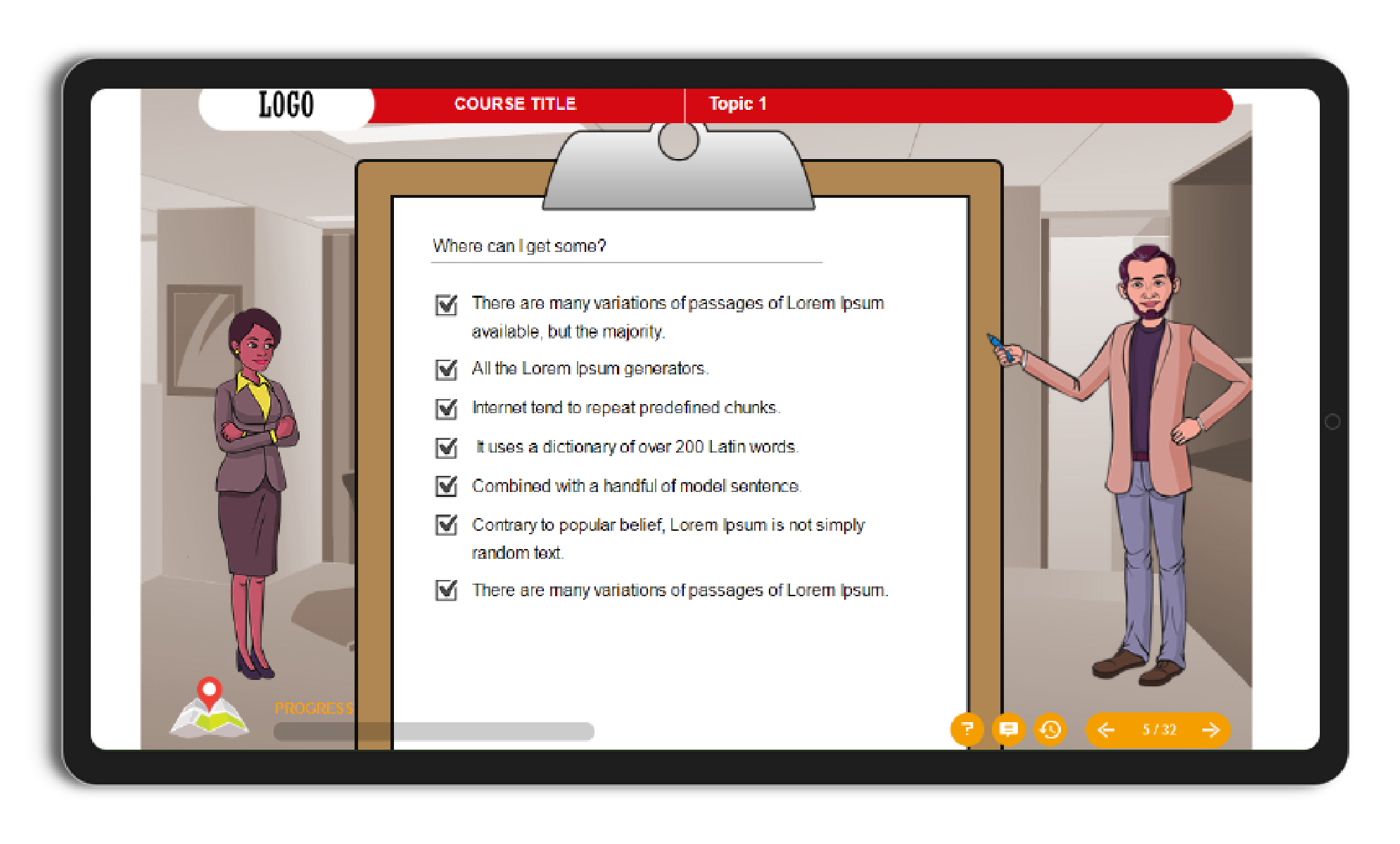
Comic strip illustration to keep it light
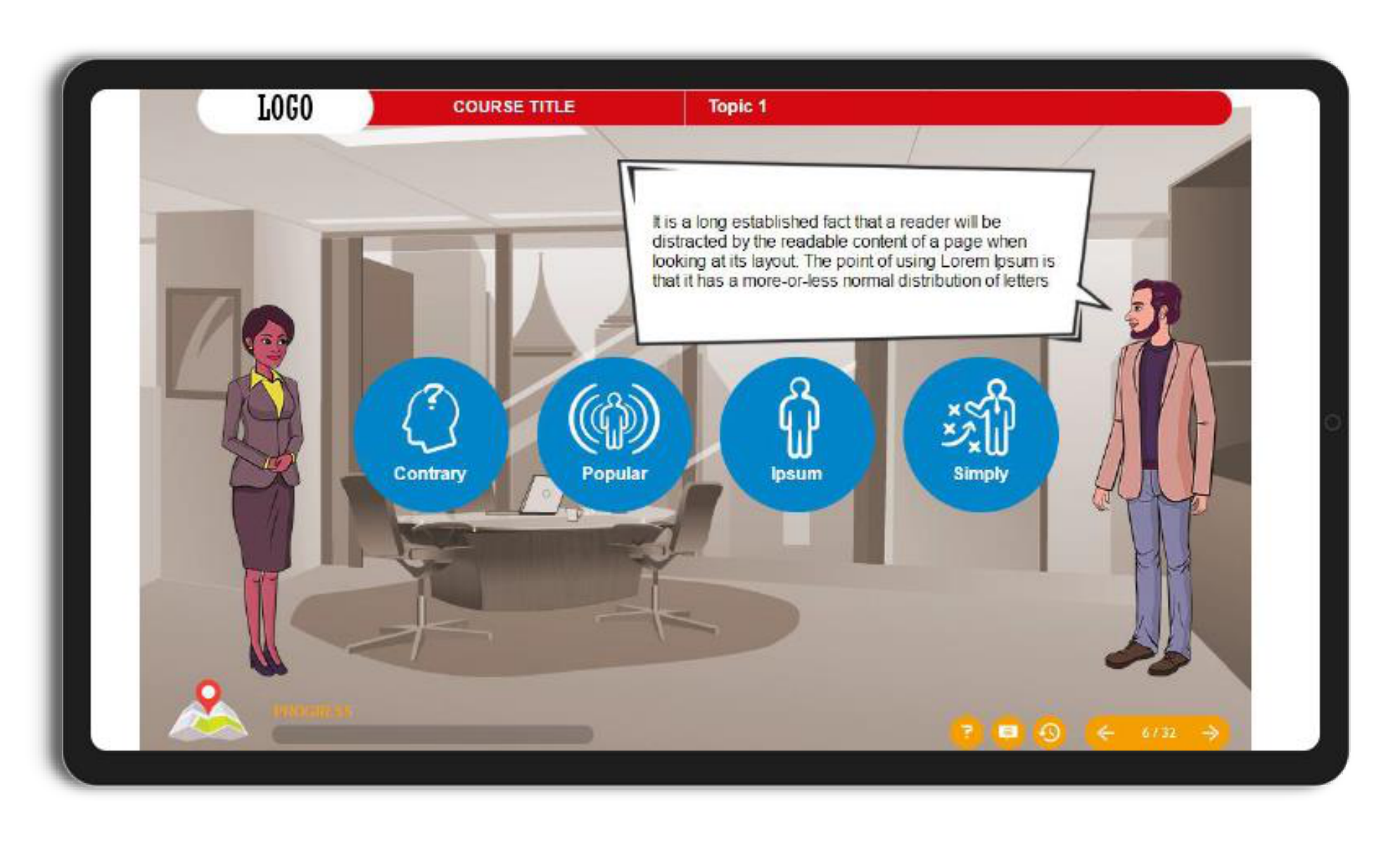
Illustration-based visuals with a comic strip look and feel kept the graphics fresh and vibrant. The style choice is doing more than decoration. Illustrated characters in a recognizable workplace make product training feel approachable, and for a team that had just had its targets raised, approachable was the right register.
An expert Q&A in an informal setting
The content was framed as an expert-driven Q&A in an informal setting, which our team considered the bonus feature of the design and which contributed directly to successful completions. Questions and answers suit this material better than exposition, because a rep’s relationship with product knowledge is a series of questions. What does this do, who is it for, what do I say when a customer asks about the alternative.
Gamification, scenarios, and personalization
Gamification, scenario-based learning, and animated video carried the interaction design, with personalization shaping what each learner encountered. Scenarios put product features into sales conversations rather than leaving them as specifications, which is the step that turns knowing a feature into being able to use it in front of a customer.
Delivered through the LMS and LXP
The program was delivered as microlearning and mobile learning through the client’s LMS and LXP, so participation was visible to the business while the experience stayed app-first for the learner.
The impact
- Learners reported finding the training relevant and useful, which they attributed to the way it was designed.
- Learners were able to apply what they had learned in actual selling situations without difficulty.
- The approach produced on-time completion and, with it, improvement in direct sales.
The completion result is the one to hold onto. On-time completion from a field sales team is genuinely hard to achieve, and it is the point at which the format choice stops being a design preference and starts showing up in the numbers.
What this case study shows
The instinct when sales targets rise is to deliver more training. This program did close to the opposite. It broke the material into the smallest useful pieces, put them where a rep already looks, and made each one usable in the gap before a customer meeting.
The tone decisions deserve as much credit as the format. A comic strip treatment and an informal Q&A sound like surface choices, and for an audience that had just been handed higher targets they were the difference between a program that felt like help and one that felt like scrutiny.
If you need product knowledge to reach a field sales team that has no time for a course, Liberate can help you build something they will open between meetings.

Ihre Anmeldung!
Verwandte Fallstudien