



.avif)

Kundendienstteams durch praktische und lehrreiche Herausforderungen zur Lösung ethischer Dilemmata befähigen


Ethical Decision-Making Training for Customer Service Teams: A Hospitality Case Study
Most ethics training answers a question nobody was really asking. Employees generally know that fraud is wrong and that discrimination is unacceptable. What they do not always know is what to do when a situation is genuinely unclear, when the right call depends on details, and when everyone around them is reading it differently.
A global tourism company asked our team to build training for its customer service employees on ethical conduct in their day-to-day work. The brief went beyond awareness. The company wanted its people to develop the ability to make ethical decisions and to apply its core beliefs across the varied situations customer service throws up.
The Challenge
The core objective was to empower employees to navigate ethical dilemmas confidently while making the right decisions. Both halves of that matter, and confidence is the one training usually neglects. An employee who knows the policy but hesitates in the moment produces the same outcome as one who never took the course.
Customer service adds a further difficulty. The dilemmas arrive without warning, in front of a guest, with no time to consult anyone. Whatever the training builds has to be available instantly, which means it has to be practiced rather than merely understood.
How the Solution Was Built
Starting with the dilemmas people actually face
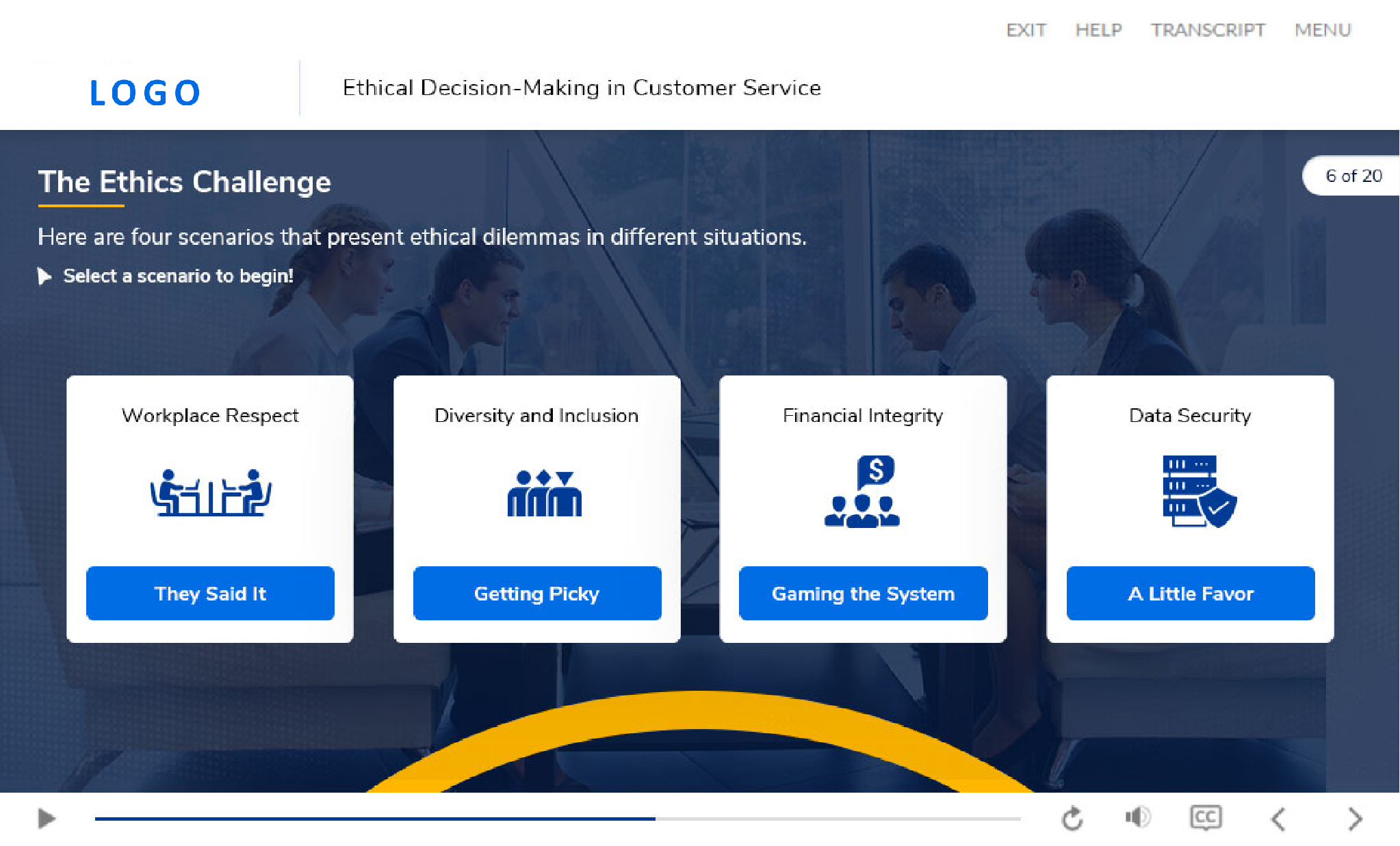
We worked hand in hand with the client subject matter experts to identify the key ethical dilemmas customer service teams encounter, then built realistic scenarios woven into stories around each one. The program presents these as four challenges covering workplace respect, diversity and inclusion, financial integrity, and data security, and lets learners choose where to begin.
Identifying the dilemmas first is what separates this from generic ethics content. The scenarios came from the situations these teams actually meet rather than from a standard library, which is why learners recognize them.
Scenarios where every reaction is plausible
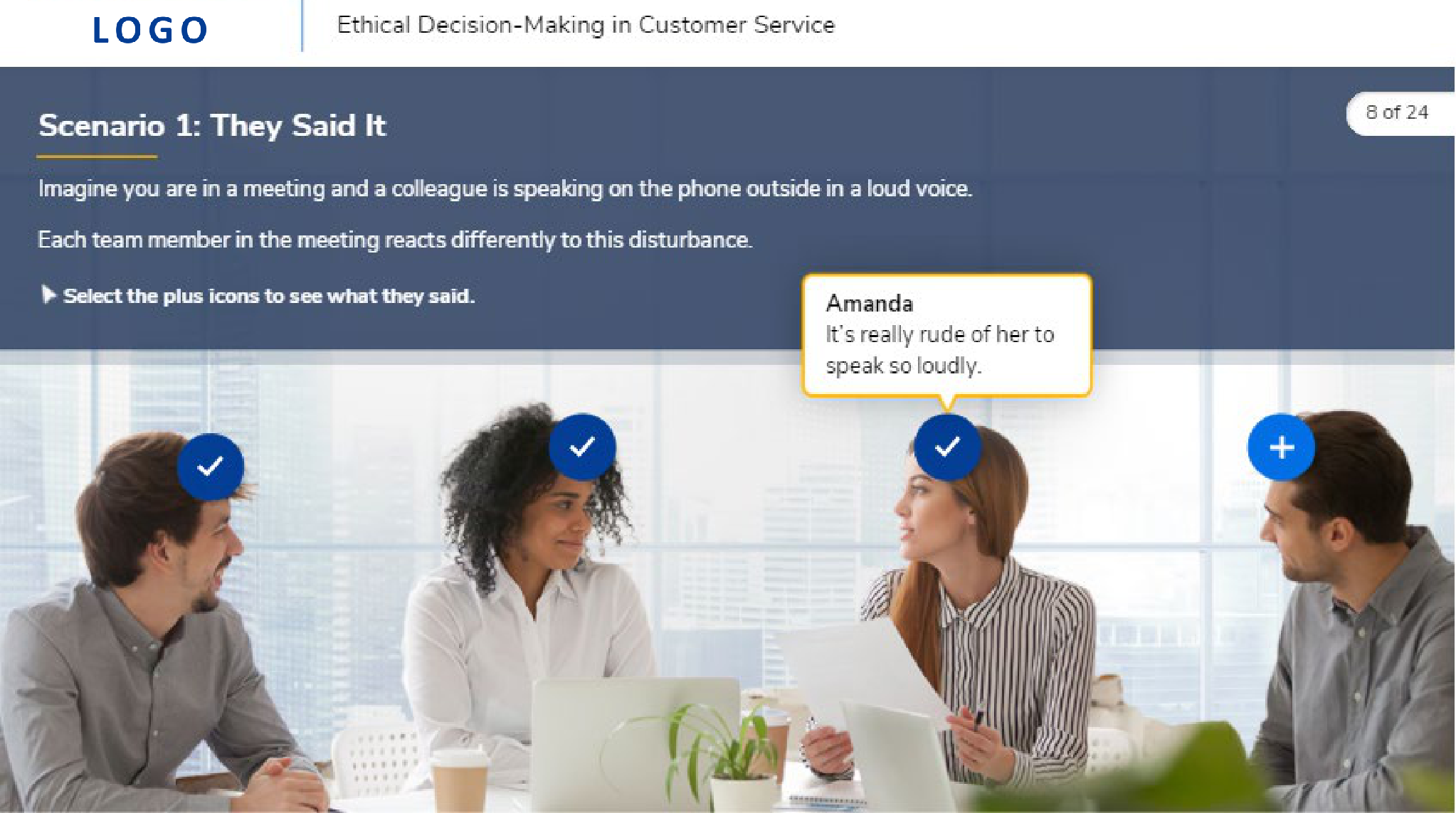
Each scenario places learners inside a situation and shows them how different people respond to it. In the first challenge, a colleague is speaking loudly on the phone outside a meeting, and each team member in the room reacts differently. Learners select each person to hear what they said.
The design choice worth noting is that none of the reactions is obviously wrong. Each one is something a reasonable person might say, which is exactly the condition that makes real ethical judgment difficult and which most training removes by making the incorrect answer conspicuous.
Personalized diagnostic feedback
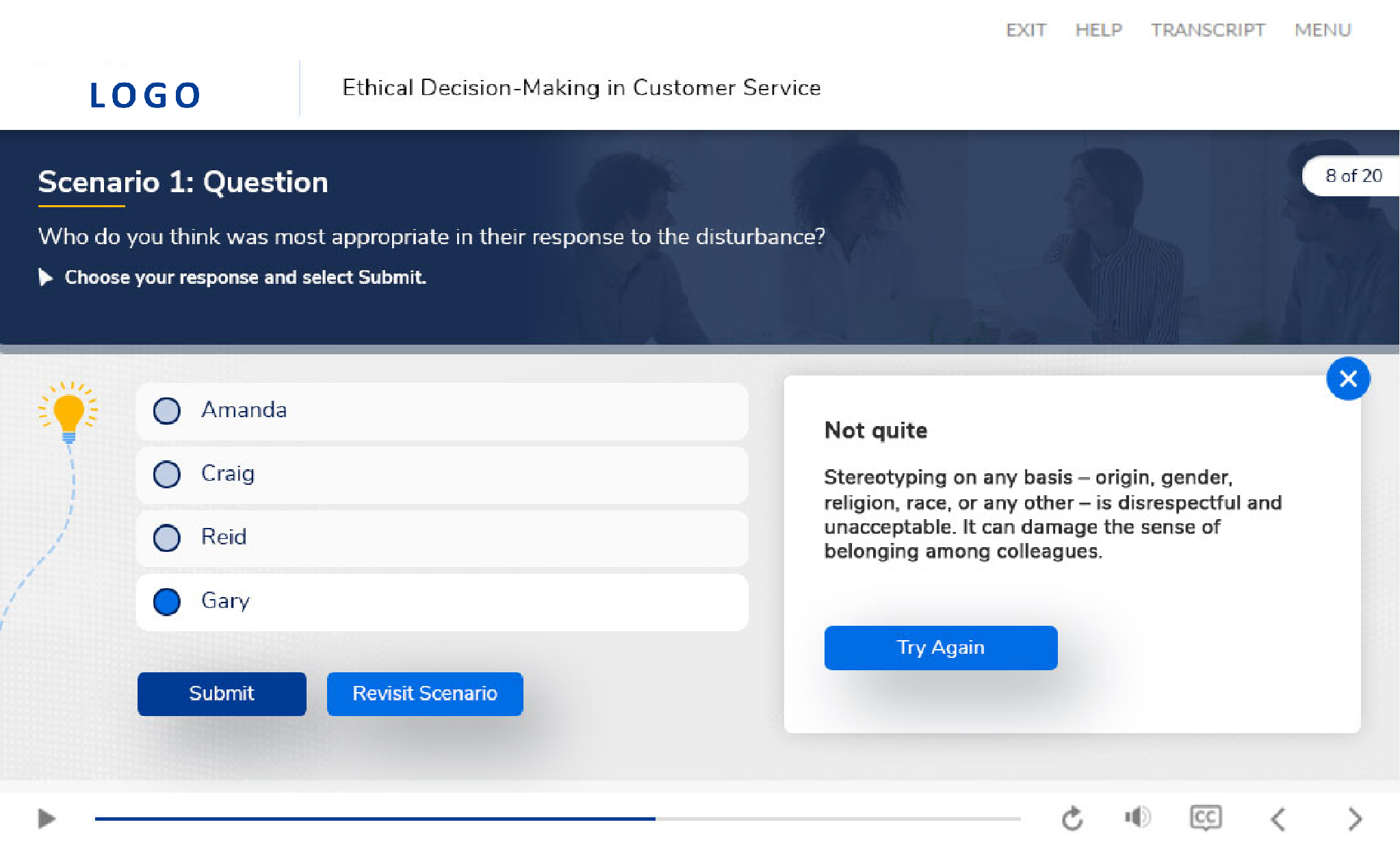
Learners are then asked to judge which response was most appropriate, and the feedback they receive explains the reasoning rather than simply marking the answer. A learner who chooses a response that carries a stereotype is told why stereotyping on any basis is disrespectful and how it damages the sense of belonging among colleagues, and is invited to try again or revisit the scenario.
Diagnostic feedback of this kind is what makes the exercise worth doing. The value is not in reaching the correct answer but in understanding why an answer that felt reasonable was not.
A safe place to get it wrong
The simulated environment allowed learners to practice and sharpen their decision-making skills safely while preparing them for comparable real situations. Relevant characters and considered visual elements carry the experience throughout. On ethics, the safety of the environment is the point. Nobody learns to handle a difficult judgment well by encountering it for the first time in front of a guest.
The Strategies Behind the Design
Five strategies power the solution.
- Scenario Based Learning
- Story Based Learning
- Personalized Learning
- Simulated Learning
- Custom Visual Design
Branching simulations underpin the scenarios, and delivery combines personalized learning with mobile learning through the client LMS and LXP.
The Impact
Learners reported complete engagement in the initial survey feedback and were able to assimilate the concepts easily.
The customer service department then saw increased awareness of and vigilance toward ethical situations. The measure the client pointed to is worth explaining carefully, because it runs against instinct. The number of cases reported for ethical misconduct went up, and so did the volume of ethics queries reaching the compliance team.
That rise reflects reporting rather than conduct. Ethical problems in a customer service operation are rarely absent before training. They are unrecognized, or recognized and left alone because nobody is sure the situation warrants raising. A program that teaches people to notice a dilemma and gives them the confidence to ask about it will always increase reported cases first. The client read the increase as evidence that the training had produced the intended effect, which is the right reading.
At an organizational level the program was treated as a benchmark, and further customized deliveries were discussed for other departments.
Build Ethics Training That Works in the Moment
Ethics training earns its place when it prepares people for the situations that are genuinely unclear rather than the ones that are obviously wrong. This program did that by drawing its dilemmas from the work itself, presenting reactions that were all defensible, and explaining the reasoning behind every judgment. If you need ethics or conduct training that holds up when an employee has seconds to decide, Liberate can help you build it. Get in touch to talk it through.

Ihre Anmeldung!
Verwandte Fallstudien