




.avif)

Verbesserung der Compliance und des Risikomanagements in einem globalen Investmentbanking-Unternehmen durch Gamification


Gamified Risk Management Training That Reduced Incidents at an Investment Bank
Compliance training exists to secure conformance with rules and guidelines set by governments and regulators, which makes it consequential for every organization and unavoidable for a bank. The difficulty is that the stakes attached to the subject rarely transfer to the course built around it, and employees work through material about serious risk in a state of mild boredom.
A large investment banking firm came to our team needing a program that would make employees aware of risk management in an innovative and engaging way. What made the brief specific was the history behind it. The bank had already suffered the consequences of poorly designed online compliance courses, and it needed training capable of producing behavioral change that held over the long term.
The Challenge
Two things follow from a failed previous attempt. The audience has learned what to expect from compliance training at this organization, and the business has evidence that awareness alone does not change conduct. A course that simply presented the risk management policies more attractively would have addressed neither.
The requirement was therefore behavioral rather than informational. Employees needed to leave the training making different decisions in situations where risk is present, and the effect had to persist rather than fade once the completion was recorded.
How the Solution Was Built
To make the course compelling, our team built it as a gamified, task-oriented, simulation-based experience. The learner is given a role and a job to do rather than a syllabus to work through, and the risk management content is what they need in order to do it.
A task, not a topic
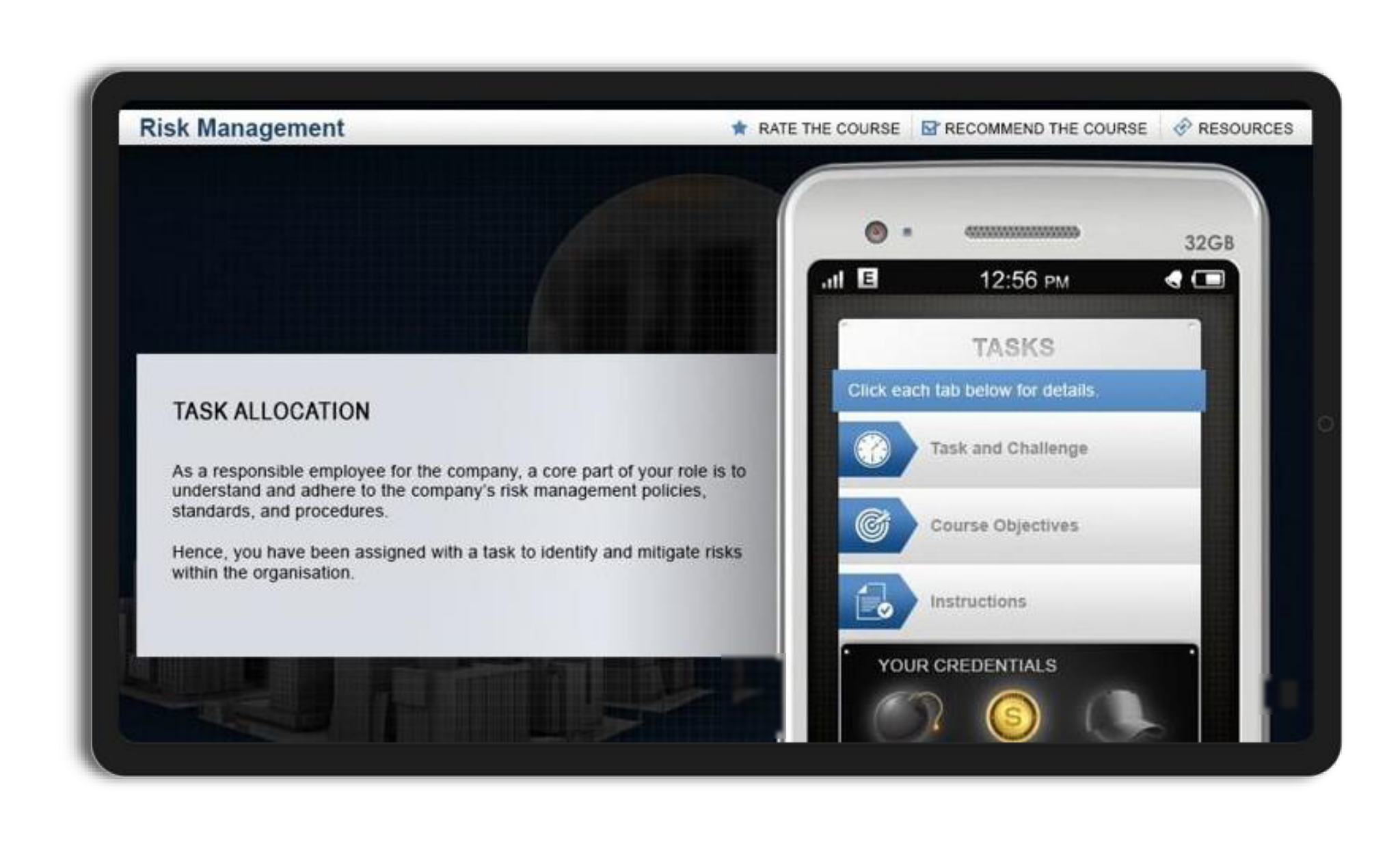
The framing is established in the opening screens. The learner is told that as a responsible employee, a core part of their role is to understand and adhere to the company’s risk management policies, standards, and procedures, and that they have accordingly been assigned a task to identify and mitigate risks within the organization.
Alongside the task allocation, a mobile panel holds the task and challenge details, the course objectives, the instructions, and a set of credentials the learner accumulates. Placing the supporting information in a phone interface rather than a menu keeps the course inside its own fiction, which is what allows the learner to treat the assignment as an assignment.
Challenges at every stage with decisions that carry
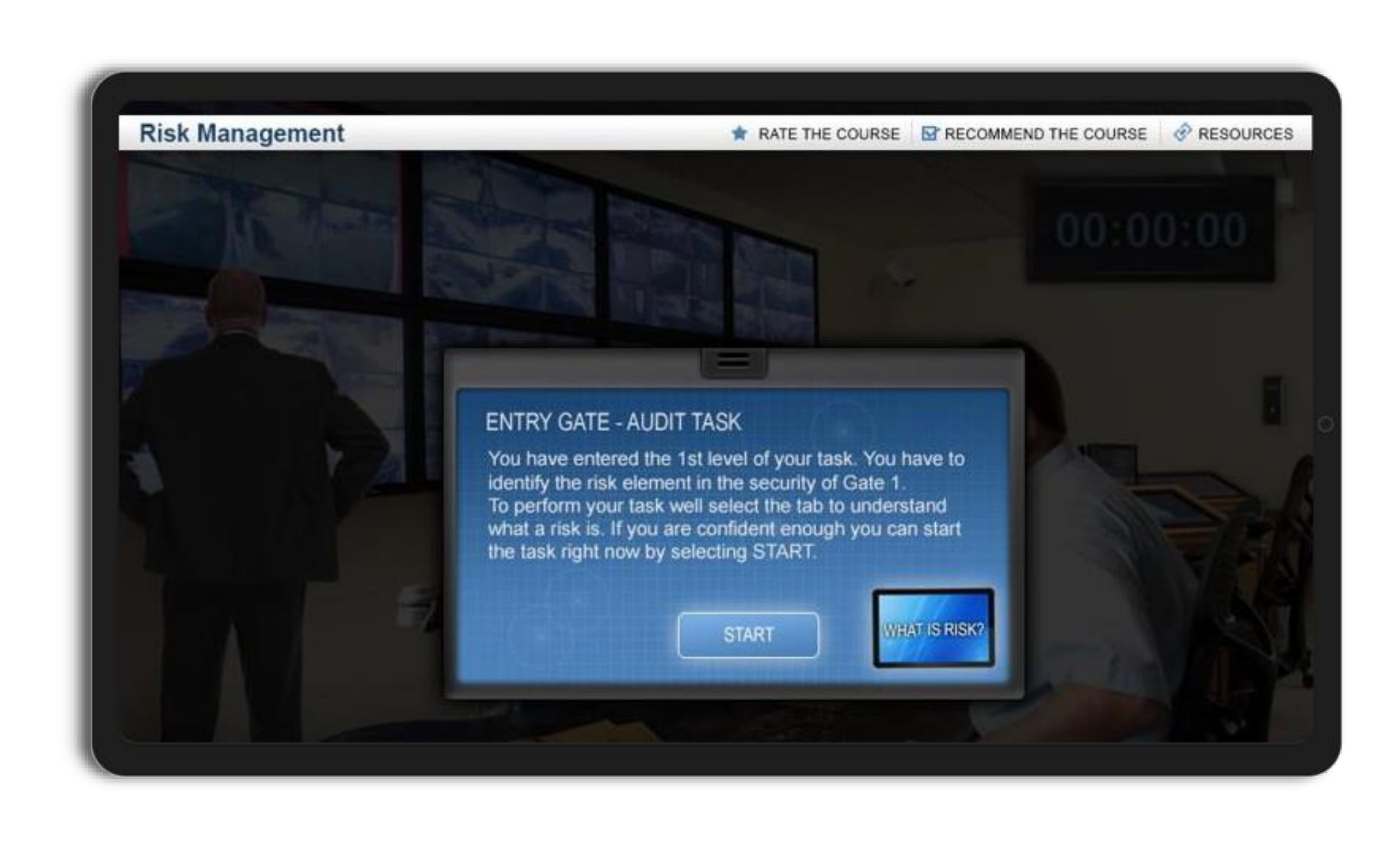
Challenges are posed at every stage of the game, and each one gives the learner ample opportunity for simulated decision making. The first level places them at a security gate and asks them to identify the risk element present there, with a timer running and the option to begin immediately or to review what a risk is before starting.
That small choice does more work than it appears to. A learner who is confident can proceed and find out whether the confidence was warranted, and a learner who is not can take the supporting content first. Both routes lead to the same task, so the course accommodates different starting points without splitting into different courses.
Incremental learning and support on demand
To maintain engagement, incremental learning is released after each challenge is overcome, so the content arrives as a reward for progress rather than as a prerequisite for it. Learners could also seek help as they worked through their tasks, which meant extensive support remained available right through to completion.
Branching simulations underpin the decision points, and story based learning carries the situations, with the whole program accessible from a device of the learner’s choosing.
The Strategies Behind the Design
Five strategies power the solution.
- Gamification
- Personalized Learning
- Scenario-Based Learning
- Story-Based Learning
- mLearning
Branching simulations sit behind these as a stated learning strategy, with delivery combining mobile learning, personalized learning, and microlearning served through a learning portal.
The Impact
Learners credited the flexibility of the program with helping them complete the training on time and with the right focus, which matters in an environment where compliance deadlines compete with client work.
The organization recorded a much higher engagement quotient and better completion rates, attributed to the innovative formats used. Against a background of previous courses that had failed, an improvement measured on the bank’s own prior attempts is the relevant comparison.
The result that separates this case study from most compliance work is the last one. Fewer risk management incidents were reported after the training than before it. That is a change in conduct rather than a change in sentiment, and it is the outcome the bank set out to achieve when it asked for training capable of shifting behavior over the long run.
Make Risk Training Change What People Do
A compliance course that has already failed once will not be fixed by better presentation of the same material. This one worked because the learner was given a job rather than a syllabus, because every stage asked for a decision with a consequence attached, and because support and content arrived as the learner needed them rather than all at once up front. If your risk and compliance programs are being completed without changing conduct, Liberate can help you rebuild them. Get in touch to talk it through.

Ihre Anmeldung!
Verwandte Fallstudien