



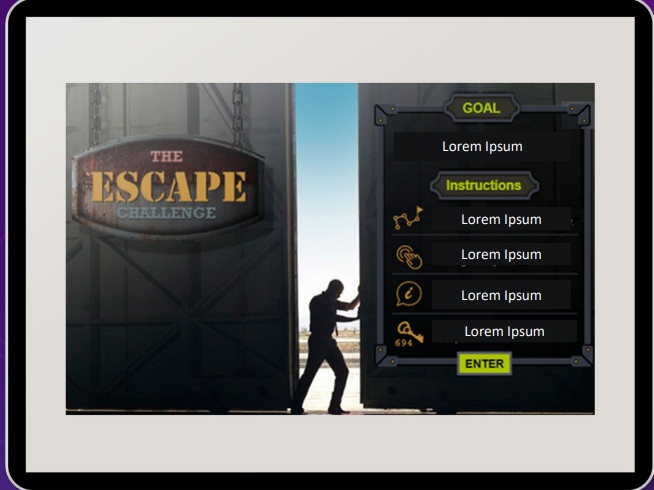

.avif)

Battling Undue Pressure and Stress With Concise, Personalized, and Contextual Training


Undue pressure is difficult to train on because it rarely announces itself. It arrives as a manager who is disappointed rather than instructing, or a deadline that makes the right decision look like an expensive one. The employee is left to work out on their own whether what they are feeling is ordinary demand or something they should raise.
A pioneering company in the aviation space asked our team to address stress directly, a topic it described as critical but less discussed. It wanted employees to understand what stress is, what causes it, and what effect it has on them, and to have practical options for managing high levels of it.
The Challenge
The training had to be extremely relevant, contextual, and relatable, which on this subject means specific. Generic advice about pressure at work would have been worse than nothing, because employees would recognize it as a box being ticked.
At the same time the content had to be sensitive to several stakeholder groups, and the language had to be inclusive, interesting, and appropriate throughout. That constraint is real and it pulls against specificity. Scenarios sharp enough to be recognizable risk implicating particular teams or managers, and language careful enough to avoid that risk tends toward the vague.
How the Solution Was Built
An innovative approach was needed to cover a wide range of topics without the course becoming unwieldy. A mentor-led structure with systematic grouping of the material, sleek and relatable design, customized interactions, vivid imagery, and crisp, precise content became the tools for building it.
Scenarios where the pressure is recognizable
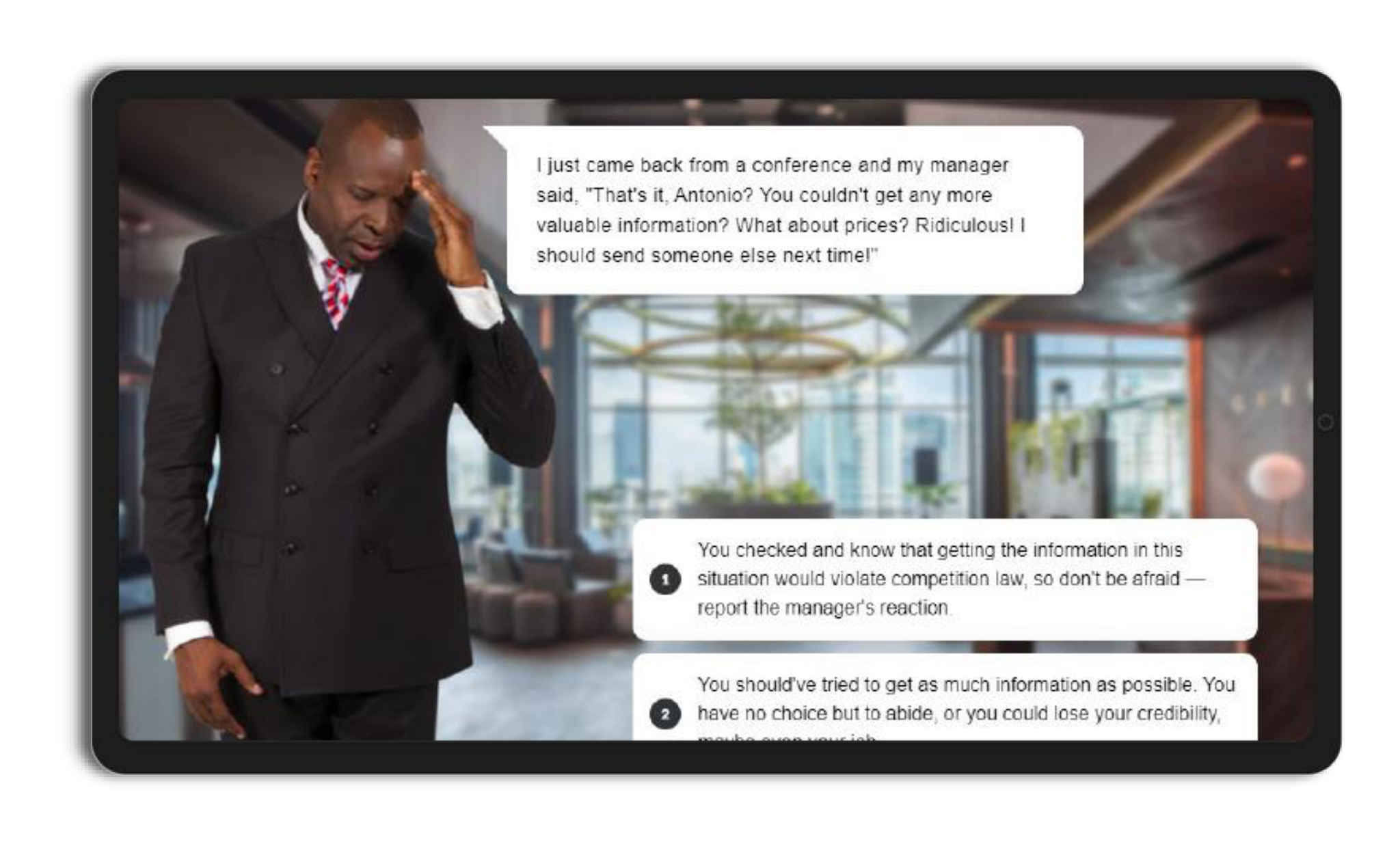
The crucial concepts are carried by scenarios and scenario-based questions. In one, an employee returns from a conference to a manager who is openly dismissive about the information he failed to bring back, including competitor pricing. The learner is asked what should happen next, choosing between reporting the reaction, knowing that obtaining that information would have violated competition law, or accepting the pressure on the grounds that refusing would cost credibility and possibly the job.
The second option is written as something a colleague might genuinely say, which is what makes the question worth asking. Pressure of this kind works precisely because complying feels like the sensible, self-protective choice at the time.
A story that unfolds across a sequence
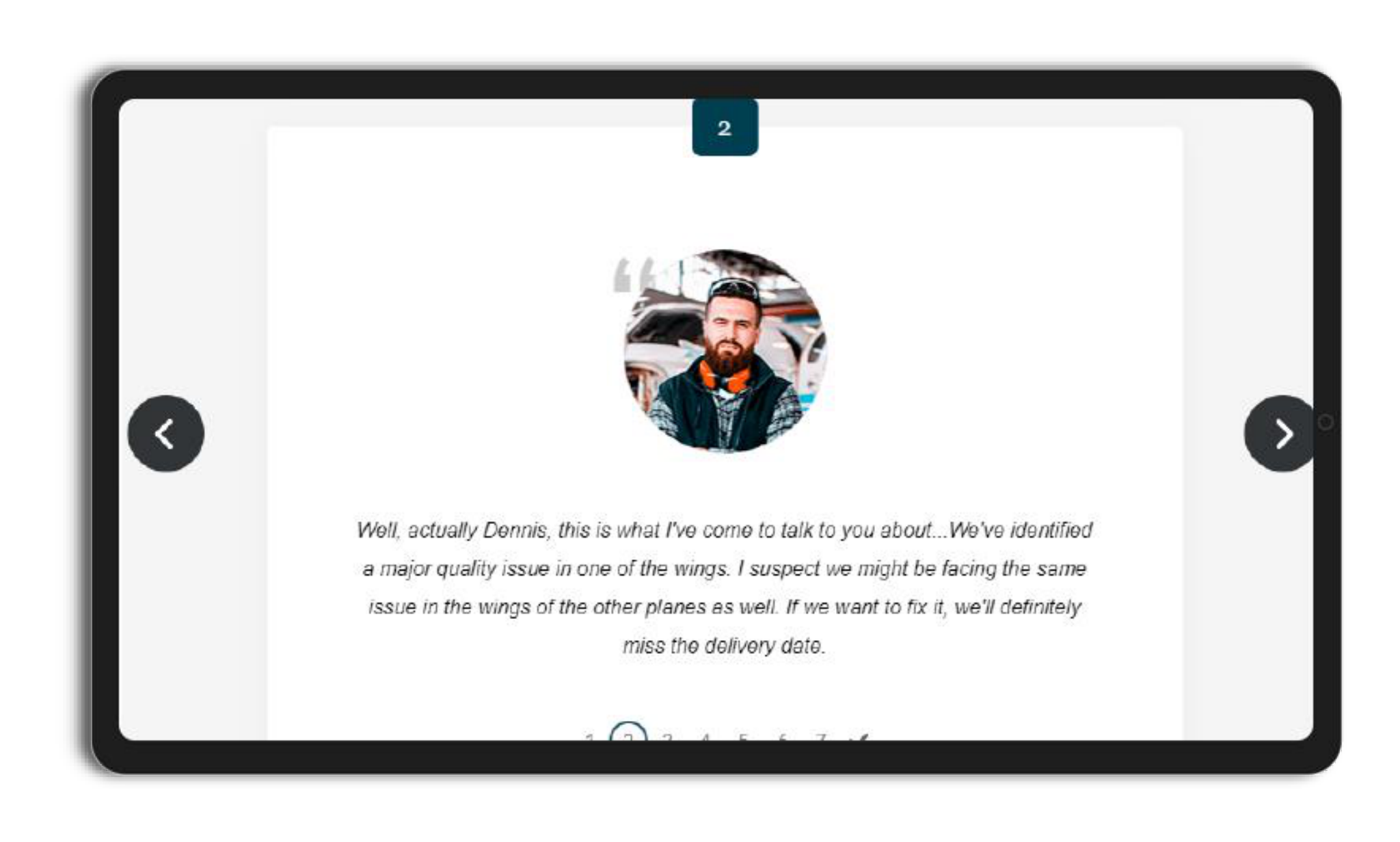
Longer situations play out as a sequence learners move through at their own pace. In one, an engineer raises a major quality issue found in an aircraft wing, suspects the same issue may affect other aircraft, and states plainly that fixing it will mean missing the delivery date.
Setting the conflict in aircraft manufacturing rather than in an abstract workplace is what earns the audience attention. The tension between a quality concern and a delivery commitment is one this workforce recognizes, and the stakes need no explanation.
Consequences laid out on flip cards
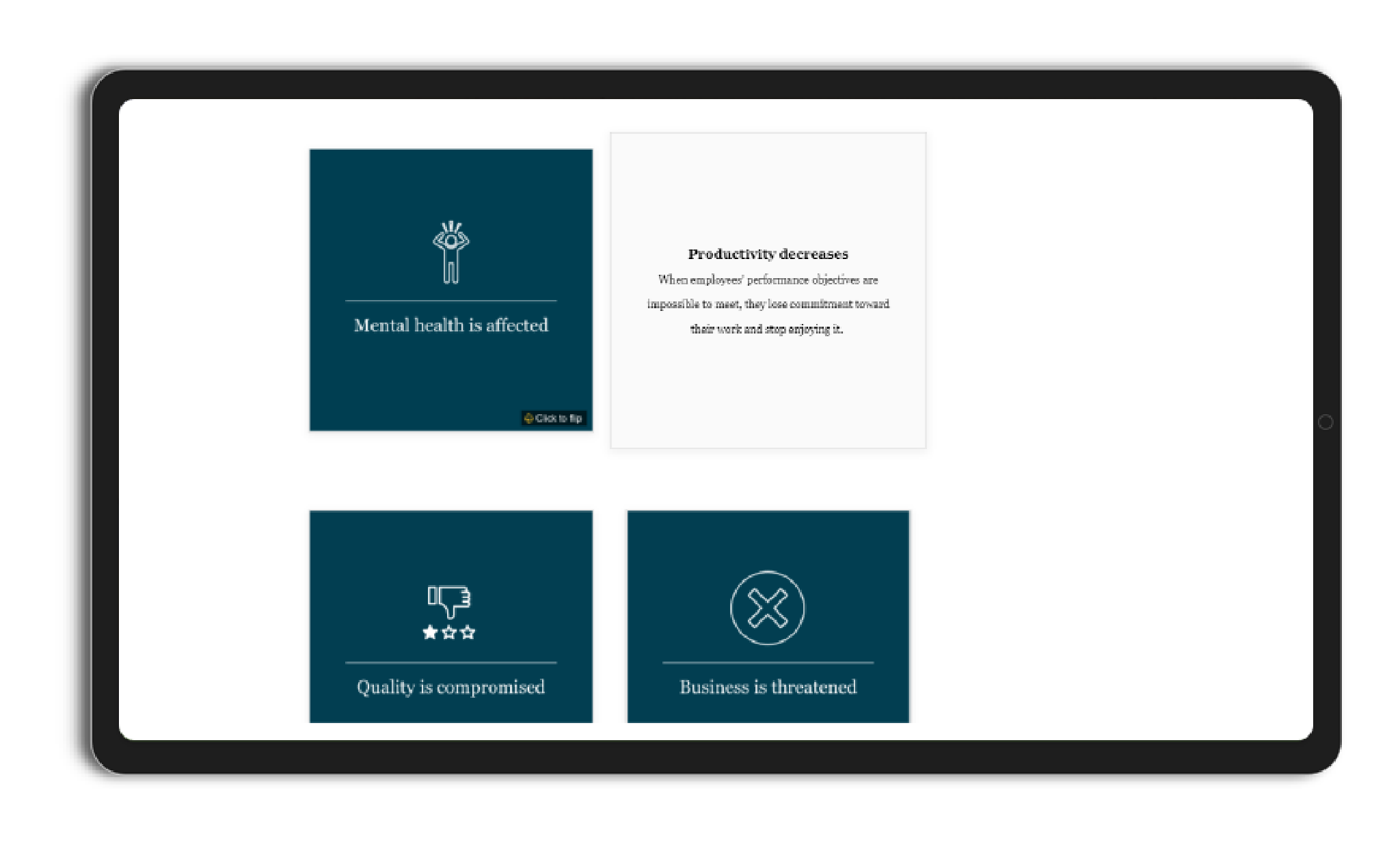
Infographics, flip cards, hotspots, and other interactions carry the supporting material. The consequences of sustained high pressure are presented as cards learners turn over, covering the effect on mental health, the fall in productivity when performance objectives become impossible to meet, the compromising of quality, and the threat to the business itself.
Grouping the personal and organizational consequences together is a considered choice. It frames undue pressure as a business problem as well as a human one, which is what gives an employee grounds to raise it.
Showing people where to take it
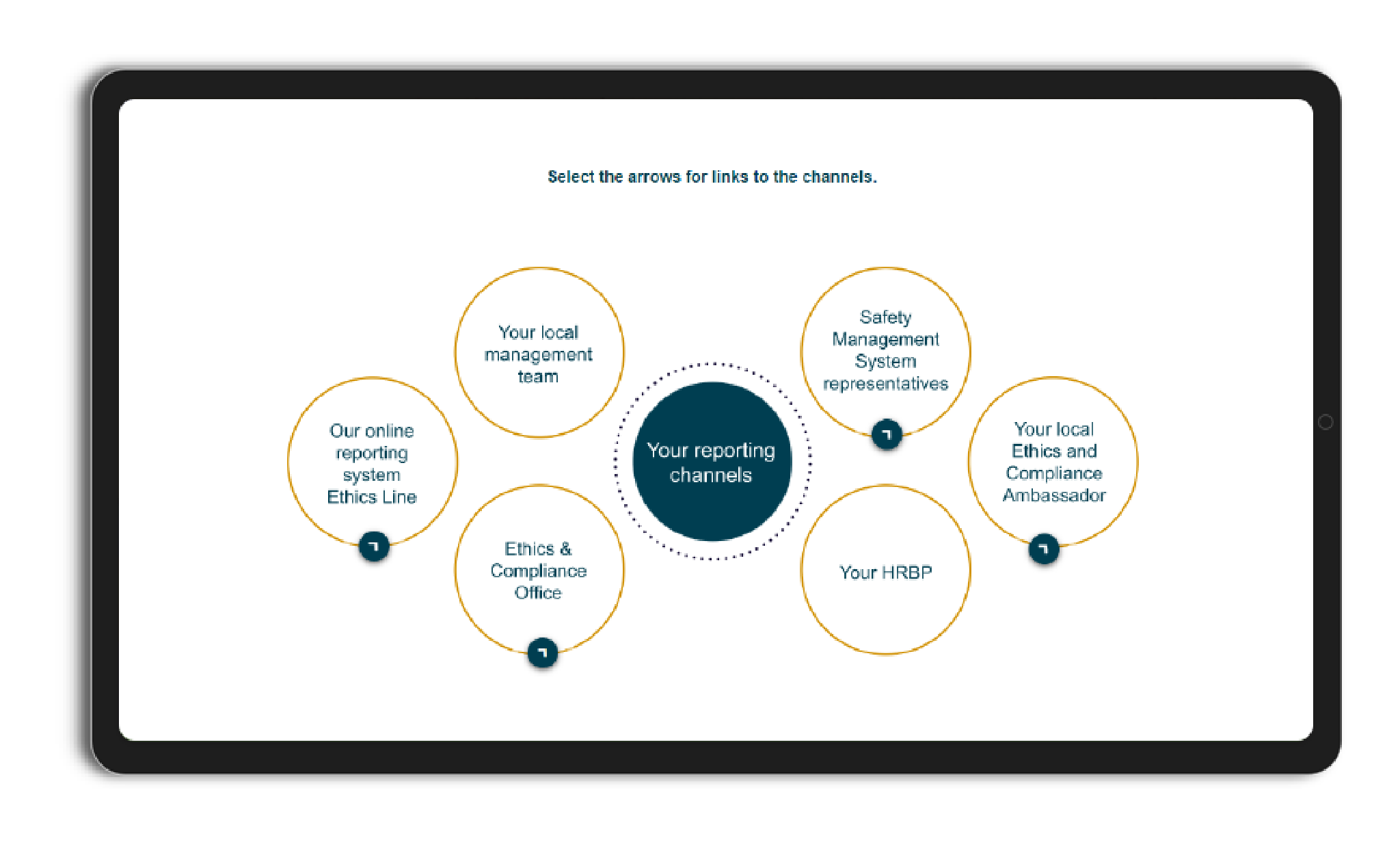
The program ends by making the routes out of the situation concrete, mapping the reporting channels available. Learners can reach their local management team, the ethics and compliance office, an online reporting system, safety management system representatives, their local ethics and compliance ambassador, or their HR business partner.
This screen is the one that converts awareness into action. Training that explains undue pressure and stops there leaves an employee more troubled and no better equipped. Naming six specific routes, more than one of which avoids the line manager entirely, is what makes speaking up a realistic option.
Built responsive throughout
A fully responsive design built in Articulate Rise delivered the learning experience the client needed across devices.
The Strategies Behind the Design
Three strategies power the solution.
- Story Based Learning
- Scenario Based Learning
- Custom Visual Design
Self-directed learning underpins the experience, and delivery combines mobile learning with personalized learning through the client LMS and LXP.
The Impact
Learners related to the content and compared their own situations with those of the characters in the training. On a subject people are reluctant to raise, recognizing your own circumstances in someone else is often the step that makes the topic discussable at all.
Employees became more sensitive to the subject and came away understanding that preventing high pressure matters and that several options exist at work for reporting it. That second half is the practical outcome, since knowing the channels is what turns recognition into something an employee can act on.
Following the response to this program, the organization has scheduled several further compliance courses of a similar nature.
Handle Difficult Subjects Without Losing the Room
Some training topics carry a cost if handled badly, and pressure at work is one of them. This program worked because the scenarios were specific enough to be recognized, the wrong answers were written as things people genuinely believe, and it finished by showing employees exactly where to go rather than leaving them with the problem. If you have a sensitive subject that needs training people will take seriously, Liberate can help you design it. Get in touch to talk it through.

subscribing!
Related Case Studies