



.avif)

Creating Impactful Induction Training Using Varied Learning Strategies –A Solution to Drive User’s Behavioral Change


Induction training carries a weight that is easy to underestimate. It is the first structured experience someone has of how an organization works, and whatever standard it sets tends to be the standard people assume applies everywhere else.
One of the leading financial service providers asked our team to build induction training for its customer care executives. The existing program ran in a classroom, and the ask was to convert that content into eLearning while making it engaging enough to secure real participation and understanding rather than attendance.
The Challenge
Induction training is a systematic form of employee training that prepares both new hires and existing employees to work in a new role or position. It is designed to integrate people into a new system and help them start on new processes without friction.
For customer care executives, that integration is behavioral as much as procedural. Handling a customer well is not a process anyone can be walked through in a slide, and the classroom version had the advantage of live discussion that a converted course would lose unless something was built to replace it.
How the Solution Was Built
The primary focus was to drive behavioral change among the customer care executives, with the mindset aspect kept firmly in view throughout. That distinction shaped the design. A course aimed at behavior has to give people something to judge and decide on, not simply something to read.
A macrolearning path built from microlearning formats
To meet the mandate we followed a macrolearning path made up of microlearning formats. The path gives the induction a shape a new joiner can see, while the individual units stay short enough to work through in the gaps of an early week that is already full of other demands.
A master narrative carrying the topics
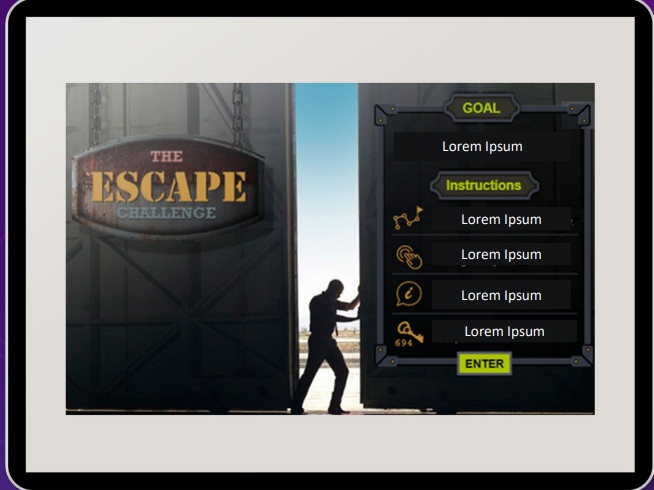
The primary strategy employs a master narrative, with topics delivered through a range of interactive formats rather than a single presentation style. We created an immersive situational environment designed to feel as close to real as possible, and built for sticky learning through high quality content, easy navigation, and compelling visual design. Videos run throughout to hold attention and to carry the messages that matter most.
Listening to real calls and rating what they hear
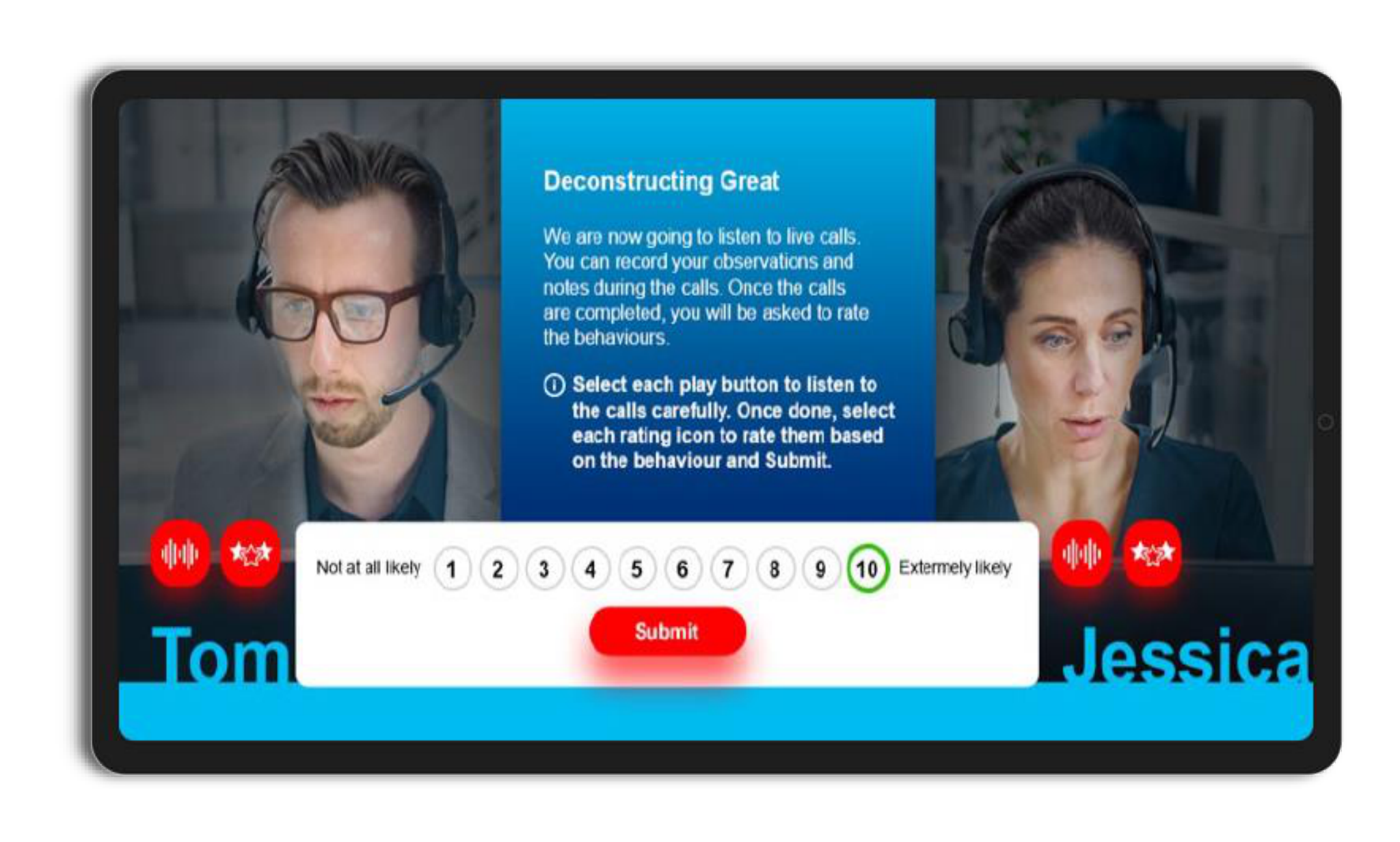
The most direct piece of behavioral work in the program asks learners to listen to live calls handled by two agents, record their observations as they go, and then rate the behaviors they observed on a scale.
This is the exercise that replaces what the classroom used to provide. Judging someone else handling a call requires a learner to form and defend a standard of their own, which is a far better preparation for taking calls than being told what good service sounds like.
Scenarios, tips, and job aids
To make the learning practical we included scenario and situational activities alongside tips, best practices, and downloadable job aids. The job aids matter most in the weeks after induction, when a new executive is on live calls and needs an answer in seconds rather than a module to work through.
A gamified assessment leading to certification
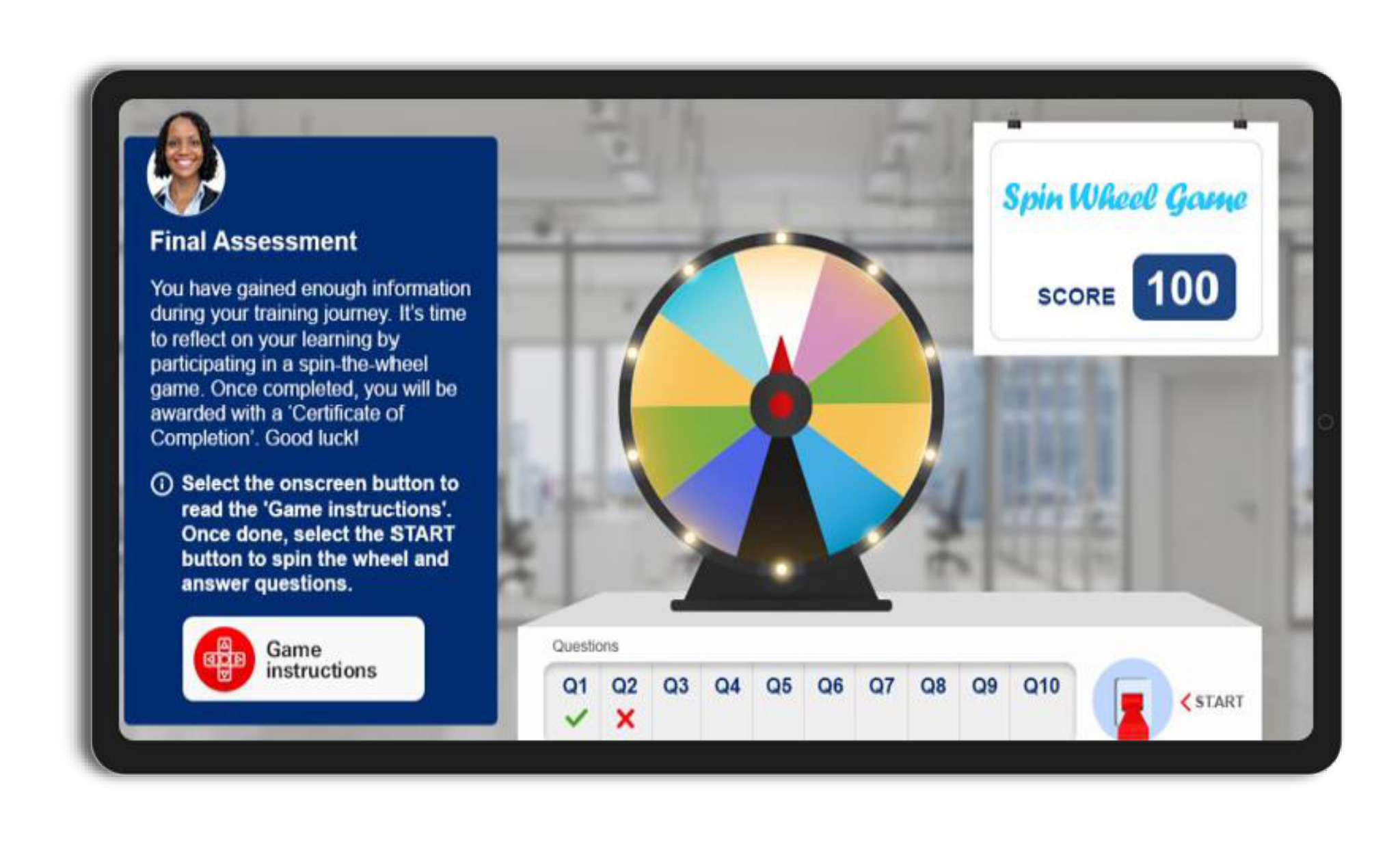
The program closes with a gamified assessment carrying a required passing score and a certificate of completion. Learners spin a wheel to reach each of ten questions, with progress and score visible as they work through them.
Framing the final assessment as a game is a deliberate choice for an induction audience. New joiners are already being measured on a great deal in their first weeks, and an assessment that feels like a test adds pressure at exactly the wrong moment.
The Strategies Behind the Design
Eight strategies power the solution.
- Interactive Video
- Learning Journey
- Mentor Based Learning
- Activity Based Learning
- Video Based Learning
- Scenario Based Learning
- Animations
- Gamified Assessment
The program was built as a responsive Storyline course with microlearning elements, delivered through the client LMS so that it sits alongside the rest of the onboarding a new executive works through.
Convert Induction Training Without Losing the Room
Classroom induction works because people discuss, observe, and form judgments together, and that is precisely what most conversions leave behind. This program kept it by having learners assess real calls, decide what good handling sounds like, and finish with an assessment that rewards them rather than screening them. If you are moving induction or onboarding online and want it to shape behavior from the first week, Liberate can help you design it. Get in touch to talk it through.

subscribing!
Related Case Studies