


.avif)

How a Large Entertainment and Theme Park Chain Improved Sales and Customer Service with Next Gen eLearning


Upselling has an image problem with the people asked to do it. Frontline staff hear a target and picture themselves pushing an extra item on a guest who has already said what they want. The good ones resist it, and they resist it for a reason that reflects well on them, which is that they do not want to be the reason a family leaves feeling worked over.
This case study covers how one of the world’s largest entertainment and theme park chains approached that problem, and why the training treated upselling as part of the guest experience rather than as a sales technique bolted onto it.
The background
The chain wanted to encourage upselling as part of its customer experience. The primary ask was sales training that was highly focused and aligned to forecasted business outcomes, rather than general selling skills adapted for a retail setting.
Two constraints came with it. The training was to be complemented by on-the-job practice so teams could build experience in a controlled environment, which meant the digital program had to prepare people for something real rather than stand alone. And as an entertainment company, the client wanted the larger-than-life quality of its parks to come through in the training its employees took.
The design problem
Selling in a theme park is not the same as selling in a store. The guest is mid-experience, often with children, often tired, and the transaction is a small part of a day they have paid a lot for. An associate who gets the timing or the tone wrong does not lose a sale. They damage the visit.
There is also nothing abstract about the skill. It shows in whether the till point is tidy, whether the price is visible, and which words come out of an associate’s mouth in the two seconds they have. Training that stays at the level of principles never touches any of that.
How our team approached the solution
Short experiential modules, built for mobile
Our team led with mobile learning, combined with gamification, simulations, and personalization, to fast-track the sales training. The content was built as short, focused, experiential modules so learners could take in an idea and practice it through an activity in the same sitting. For a frontline audience working shifts across a large site, short and mobile is not a preference. It is the only format that gets used.
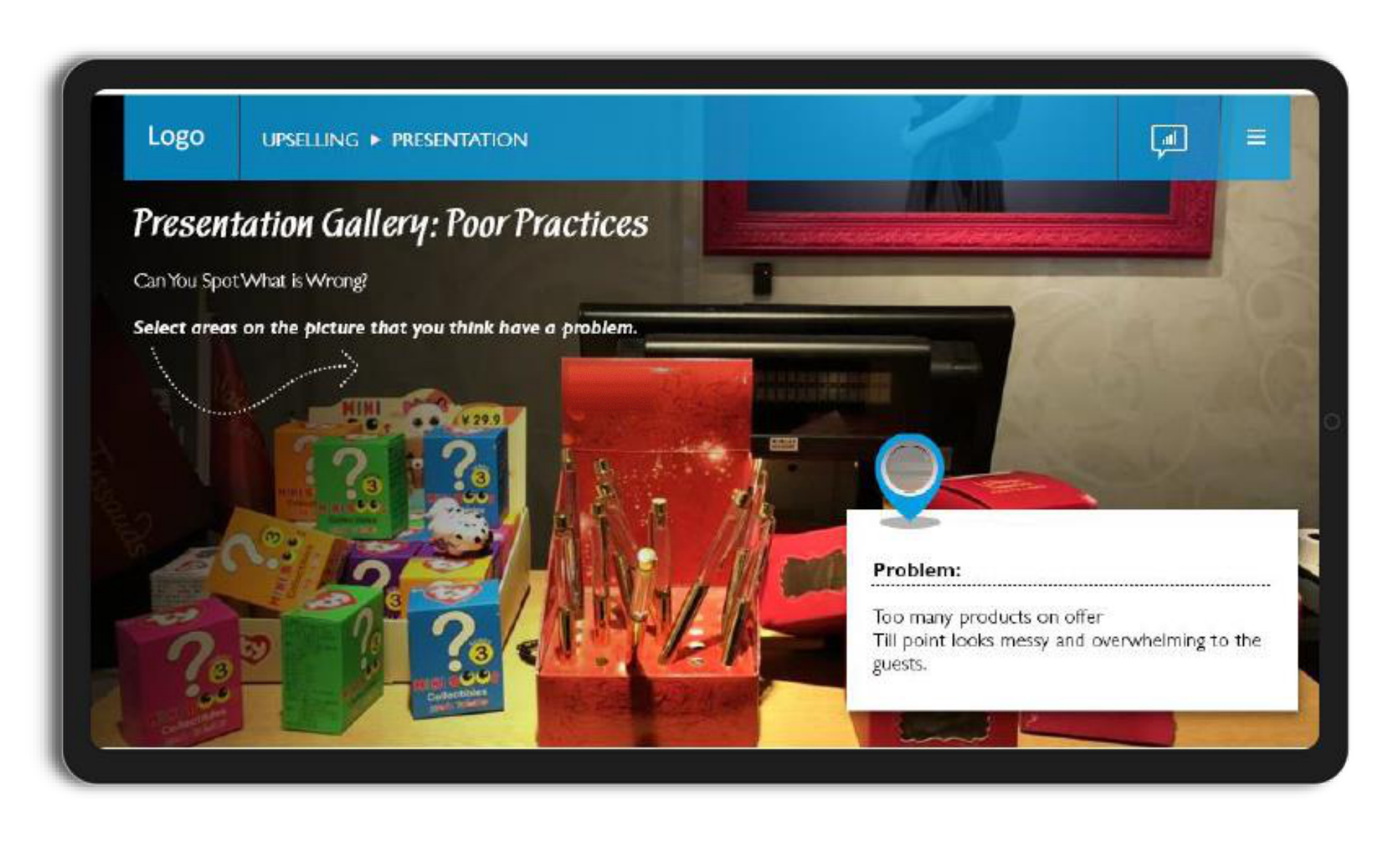
Spot the problem in a real retail scene
Rather than describing good presentation, the program showed a real till point and asked learners to identify what was wrong with it. Selecting an area on the photograph reveals the problem, in this case too many products on offer and a display that reads as messy and overwhelming to guests. It is a small interaction that does something a checklist cannot, which is train the eye. An associate who has practiced spotting a cluttered counter will notice their own.
Branching simulations for the conversation itself
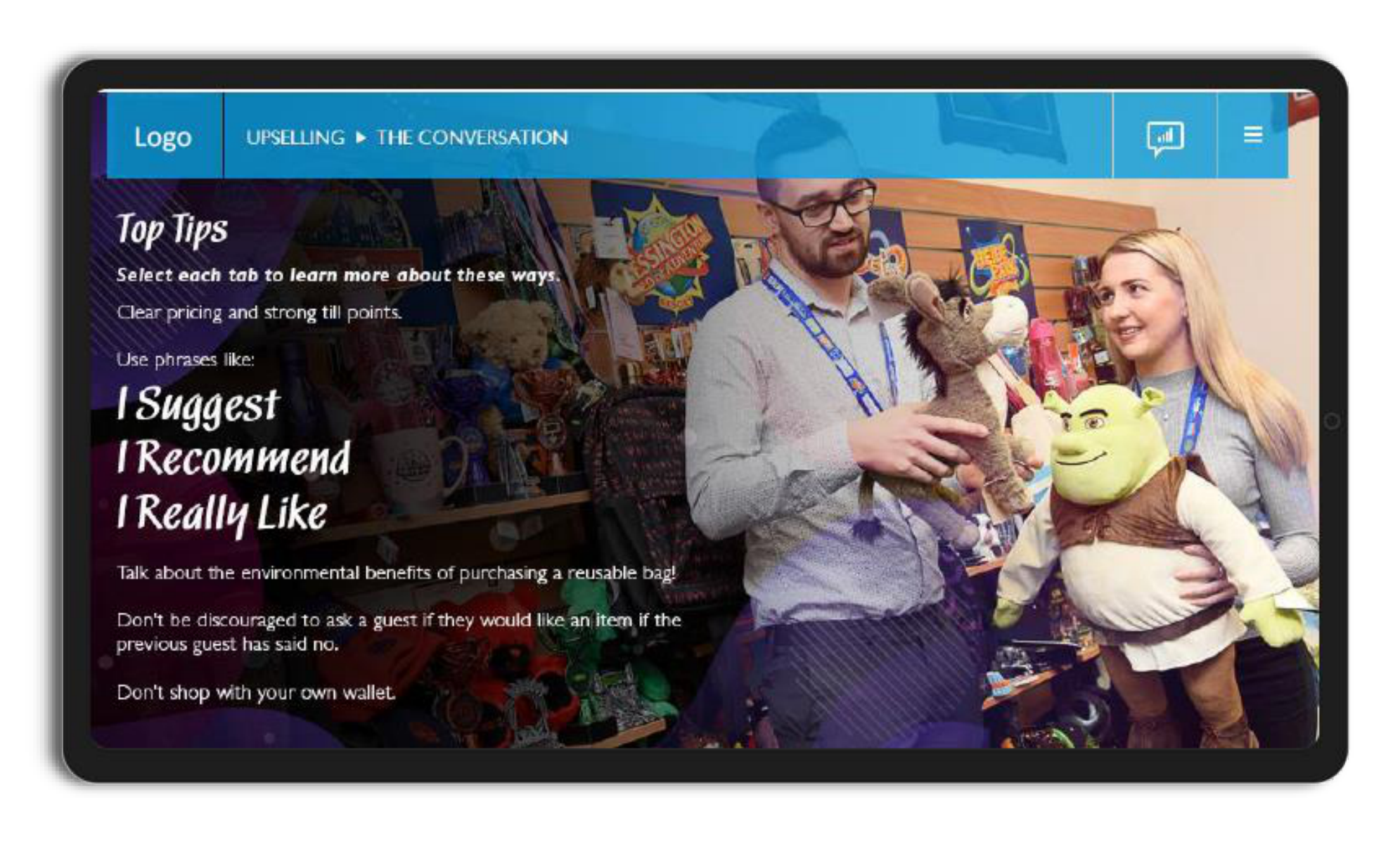
Branching, decision-making simulations carried the conversation skills. This is where the tone problem gets solved. A simulation lets an associate try the pushy version and see the guest’s reaction, which teaches restraint far more effectively than a guideline telling them to be tactful. It also gives them the specific phrasing that works, practiced rather than read.
Personalization and a gamified assessment
Personalization shaped what each learner saw, and a gamified assessment was added to support recall while keeping the experience enjoyable. Assessment framed as a game matters more than usual for a voluntary-feeling skill like upselling, where a formal test signals that this is a compliance exercise and the design was working hard to say the opposite.
Contextualized imagery throughout
Contextualized imagery ran through the whole program, using the client’s own environments rather than stock retail photography. That is what delivered the larger-than-life quality the brief asked for, and it is also what made the scenarios recognizable. An associate looking at their own shop floor takes the lesson more seriously than one looking at a generic counter.
The impact
- Associates felt equipped and confident about selling, which had been missing before the training.
- Sales tips and guidelines helped increase upselling numbers for the organization.
- The practical approach produced higher completion rates than comparable online programs the organization had run previously.
The first result is the one that explains the second. Confidence was the blocker, not technique. Associates who believe an upsell can improve a guest’s day will make the offer, and associates who do not will avoid it however well they have been told to phrase it.
What this case study shows
Sales training for frontline service roles fails when it is designed as sales training. What worked here was treating the offer as part of the guest experience, then teaching it the way you teach any craft skill: show a real situation, let people get it wrong safely, and give them the exact words.
The on-the-job component matters too. The digital program was never meant to finish the job. It was meant to get associates ready for supervised practice, which is a more honest ambition for any program aimed at a skill that ultimately happens in front of a customer.
If you are training frontline teams on selling or service, Liberate can help you build something they will use on shift rather than complete and forget.

subscribing!
Related Case Studies