






.avif)

Simulation-Based Learning in Action: 4 Examples of AI-Enhanced Role Plays That Deliver Results


Summary
Explores how AI transforms traditional role plays into dynamic, scalable coaching tools through lifelike avatars and real-time feedback. By merging emotional realism with 3D environments and adaptive branching scenarios, organizations can provide a safe space for employees to practice high-stakes decisions and build lasting behavioral capability.
Introduction
People learn best through experience. Research consistently shows that active practice, reflection, and feedback drive deeper understanding than passive instruction. Simulation-based learning is built on that principle, offering learners a space to experiment, take risks, and refine their approach through guided experience.
Artificial intelligence now amplifies this process. By analyzing learner input and adapting scenarios in real time, AI makes simulations more responsive and personal. The result is learning that behaves like a coach, observing, responding, and helping employees improve through meaningful practice.
Simulations at the Heart of Skill Development
Simulations recreate the complexity of workplace challenges, giving learners a chance to apply knowledge in context. They immerse learners in situations where decisions and behaviors drive outcomes, creating emotional engagement that strengthens retention and performance.
An effective simulation offers:
- Authentic context that mirrors workplace conditions
- Meaningful consequences that make every choice matter
- Safe experimentation where mistakes become learning opportunities
Organizations use simulations to build readiness across a range of applications such as leadership, customer service, safety, and compliance. The format helps learners bridge the gap between understanding and doing, leading to stronger behavioral outcomes and lasting capability.
What Happens When Role Play Meets Artificial Intelligence?
Role plays have long been used to develop interpersonal and decision-making skills. However, they often depend on human facilitators, can be difficult to scale, and vary in quality. Artificial intelligence changes this model completely.
AI-enhanced role plays simulate human conversation through intelligent avatars that respond to language, tone, and intent. Instead of fixed scripts, learners engage in fluid dialogues that evolve dynamically. They receive immediate feedback on what worked, what didn’t, and how to improve.
This creates a safe and repeatable practice environment that supports self-directed learning and measurable progress. It combines the realism of conversation with the efficiency and consistency of digital delivery.
What Makes AI-Enhanced Role Plays Effective
AI-based simulations work because they blend intelligent design with emotional realism. Their effectiveness lies in four key strengths:
- Relevance – Scenarios are grounded in the learner’s professional context.
- Adaptivity – The AI adjusts tone and responses to match learner behavior.
- Feedback – Learners receive targeted insights and coaching after each session.
- Scalability – Training can be rolled out globally without logistical limitations.
The result is experiential learning that feels personal, engaging, and directly applicable to daily work.
Bringing AI Role Plays to Life through 4 Examples of Practice and Application
The following examples demonstrate how AI-driven role plays move beyond theory to deliver hands-on capability building. From business communication to leadership decision-making, they showcase how practice, reflection, and feedback combine to create measurable impact.
1. Practicing Business Conversations with AI
Challenge Professionals often struggle with challenging conversations such as negotiations, client meetings, or feedback discussions. Classroom learning can teach communication principles but rarely offers a chance to rehearse them effectively.
Approach In this simulation, learners take on roles such as seller, buyer, or customer service representative. AI avatars interpret tone and intent, adjusting responses to simulate natural dialogue. The system provides real-time prompts and detailed feedback on clarity, listening, and persuasion.

Impact Learners gain confidence through repeated, self-paced practice. They refine their communication style, improve interpersonal awareness, and transfer these skills directly into workplace interactions.
2. Using Live Video Role Plays to Build Customer Empathy
Challenge Customer-facing employees must manage emotionally charged situations and maintain professionalism under pressure. Traditional training struggles to capture the immediacy of such interactions.
Approach The live video format uses AI-generated avatars created from recorded human footage. Learners speak or chat with these avatars, which display lifelike gestures and facial expressions. The AI analyzes tone and pacing, then provides personalized feedback on empathy, patience, and word choice.
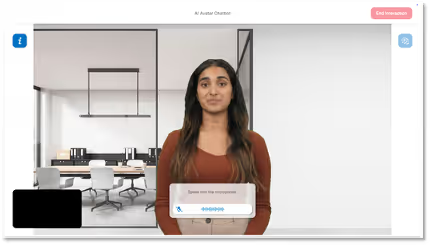
Impact This approach humanizes digital training while preserving scalability. Learners experience realistic interactions that strengthen emotional intelligence and self-regulation, leading to more consistent and empathetic customer communication.
3. Immersive 3D Role Plays for Workplace Scenarios
Challenge In technical or operational environments, employees must make fast decisions that balance safety, teamwork, and precision. Conducting such training on site can be costly or risky.
Approach Learners enter 3D virtual environments that replicate their workplace, from factory floors to office setups. Within these spaces, they interact with AI avatars that simulate colleagues, customers, or supervisors. The system tracks performance and decision outcomes, allowing for targeted coaching.

Impact Immersion helps learners visualize consequences and connect emotionally with the training. They strengthen both procedural knowledge and interpersonal coordination. The result is faster onboarding, better retention, and improved operational safety.
4. Building Leadership Judgment through Branching Scenarios
Challenge Leaders often face complex ethical and interpersonal dilemmas where every decision carries cultural and business implications. These scenarios are difficult to simulate effectively in traditional learning formats.
Approach Branching AI role plays guide learners through evolving situations where each decision influences the storyline. The AI evaluates not only choices but also tone, reasoning, and consistency. Learners receive detailed debriefs that highlight judgment patterns and potential blind spots.
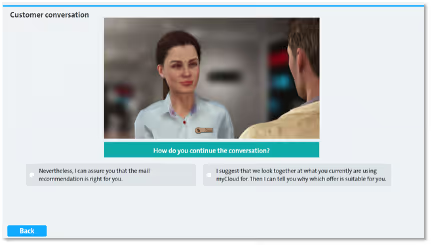
Impact This format promotes reflection and accountability. Leaders learn how communication style and empathy affect trust, morale, and outcomes. Over time, it helps cultivate sound decision-making and values-driven leadership.
How Simulations Strengthen Capability Across the Organization
Once used selectively, simulations are now a core element of enterprise learning strategies focused on measurable skill development. They combine engagement with measurable outcomes, making them ideal for developing both technical proficiency and soft skills.
By allowing employees to experiment and practice in a safe environment, simulations accelerate skill acquisition and reduce errors. They also give learning teams valuable behavioral data that can inform coaching, recruitment, and performance management.
When embedded into the broader learning ecosystem, simulations:
- Reinforce learning through practice and feedback
- Drive behavioral change more effectively than knowledge-based training
- Support adaptive learning paths tailored to individual needs
- Help organizations cultivate confidence and capability at every level
Parting Thoughts
AI-enhanced role plays represent the next stage of simulation-based learning. They help organizations translate learning investment into workplace performance. Instead of absorbing content, learners build capability through interactive experiences that promote reflection and application.
For organizations, this means learning that scales without losing authenticity. For learners, it means the opportunity to rehearse, improve, and succeed in an environment that supports growth. AI is opening new frontiers in learning design, enabling simulations that adapt to each learner and deliver experiences once thought impossible.

subscribing!
Related articles


.jpg)
.jpg)






.jpg)
