


.avif)

What Liberate’s Global BFSI CLO Panel Taught Me About the Next Phase of Learning

About the Author - Rod Beach
Rod Beach is the Founder of the Liberate Group of companies, Australia, and a respected thought leader in the learning and education technology sector with over 30 years of experience. His expertise spans corporate training, higher education, digital learning innovation, and organizational performance enhancement, serving some of the world's largest enterprises and educational institutions.
-------------------------------
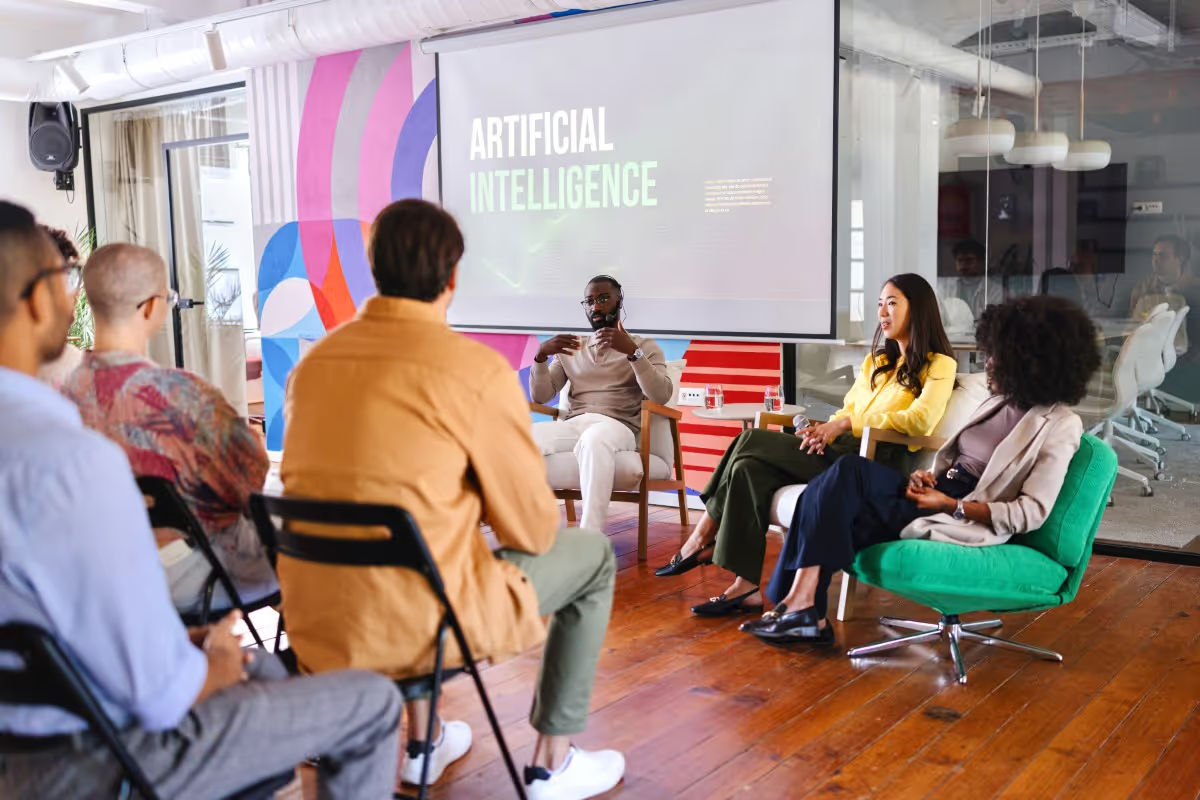
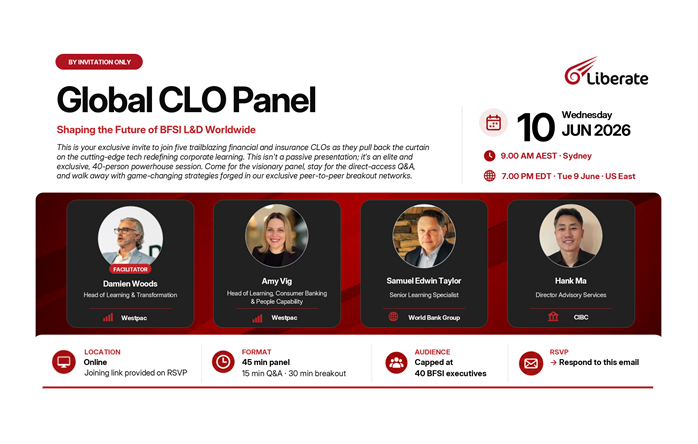
Last week, I had the privilege of hosting something I had been looking forward to for a couple of months. We brought together around forty senior Learning and Development leaders from banking and financial services, spanning Australia, the United States, Canada, and the Middle East, for a CLO Expert Panel under strict Chatham House rules. Damien Woods, Chief Learning Officer at Westpac, facilitated the panel itself, and we were joined by a genuinely formidable group: Hank Ma from CIBC in Toronto, Samuel Taylor from the World Bank Group in Washington, Amy Vig from Westpac’s customer-facing learning team and Caroline Pertha who works at Bendigo and Adelaide Bank.
I want to share some of what came out of that conversation, because it confirmed something I have been saying for a while now. The organisations pulling ahead are not the ones with the most impressive technology. They are the ones building the right ecosystems around their people.
The pressure is real, and it is about scale
When you put forty senior banking and financial services L&D leaders in a room, the first thing you notice is how consistent their pressures are. AI literacy and fluency came up as the top priority almost universally, and not because it is fashionable. These businesses want measurable productivity, sharper decision-making, and better customer outcomes. The hard part, as Hank from CIBC put it, is global scale. It is one thing to upskill a team. It is another thing entirely to roll capability out to forty thousand or a hundred and fifty thousand employees and have it actually land.
Damien shared a sharp example from his time at Woolworths, where a hundred and fifty thousand frontline staff work across eleven hundred stores. When a process changes, you need instant, consistent uptake at the point of need, which is why they have been investing so heavily in mobile-first, in-the-moment delivery. That is the learning-doing gap made very concrete, and it is the gap I have spent thirty years trying to close.
There is also a competitive dimension that is a reminder for us all. In banking (as for many industries), AI-enabled comparison tools are starting to threaten the relevance of the human advisor. The response from L&D is not to retreat. It is to elevate advisor capability so that clients keep choosing to come back to a person. I find that genuinely encouraging, because it puts learning right at the center of commercial strategy rather than off to one side.
Samuel brought a different angle from the World Bank, where staff increasingly need to work across five previously siloed entities. They used AI to analyse job postings and resumes and built a full skills ontology linked to learning content and career planning. That is the sort of forward-focused, strategic workforce planning I keep arguing should sit above L&D rather than buried inside it.
The role of the L&D professional is changing
For years I have been encouraging our profession to shift from being deliverers of training artefacts to being enablers of business outcomes. What struck me during the panel was how far the room had already moved in that direction.
The language has changed. People are now describing themselves as system architects and enablers rather than training developers. The attributes leaders said they look for in new hires were telling: stakeholder influence, an agile mindset, and a willingness to test something, watch it fail, and learn fast. Increasingly, L&D teams are enabling others across the business to build learning themselves, and concentrating their own effort on communities and knowledge-sharing networks rather than producing everything centrally.
Hank made a point that stayed with me. He observed that HR and L&D functions are often harder on themselves around failure than their business partners are. We champion psychological safety for everyone else, yet we do not always extend it to our own teams. If we are asking the business to experiment with us, we have to be willing to experiment ourselves, and to be honest when something does not work.
Samuel reframed the whole question of expertise in a way I thought was spot on. It is no longer about what you know. It is about how you access information and how well you discriminate between what is reliable and what is not. That has real implications for capability frameworks, which several people felt are now too slow to keep pace with the rate of change. The debate in the room was whether you maintain those frameworks at all, or pivot toward forward-focused skills targeting owned by strategic workforce planning. I do not think that question is fully resolved, and I suspect it will be one of the defining conversations of the coming few months.
Technology is finally embedding into the flow of work
This is the part of the discussion I personally find most exciting, because the technology is starting to do what we always hoped it would.
Samuel described an RFP underway to modernise the World Bank’s Open Learning Campus, built around three priorities: transparency of content, AI adoption in learning processes, and a genuinely better user experience. What I liked is that their tools are now embedding directly into Teams and Copilot, surfacing relevant content mid-workflow rather than asking people to leave what they are doing and go to a separate system. They are also moving from SCORM toward xAPI, which gives them far more granular, discoverable content.
Caroline shared how her smaller organisation built a Gemini Enterprise agent on top of their existing learning content. Rather than simply pointing people to modules, the agent personalises guidance through conversation. It has become the organisation's first enterprise-wide agent, and she was candid that getting there took extensive stakeholder and subject matter expert testing. Damien described Woolworths giving an early-adopter group of four hundred curious, tech-savvy people a six-month head start to build agents freely, with a dedicated channel where they shared daily and iterated rapidly. He called it mushrooming innovation, and I thought that was a lovely way to describe what happens when you trust capable people and get out of their way.
At Liberate, we track our revenue mix across content types precisely so we can see where the industry is heading. Right now that mix spans eLearning, blended, performance support, virtual and mixed reality, AI-generated content, and AI agents. One area I am watching closely is augmented reality and AI-enabled smart glasses. We are working with construction clients facing a real knowledge-transfer risk as their experienced veterans retire. Pre-release prototype smart glasses can surface contextual guidance, let a remote expert tap in, and measure everything along the way. Production versions are expected next year in a form closer to safety glasses, and I think they will matter enormously for industries where the knowledge lives in people’s hands rather than in documents.
Augmented intelligence, with a human in the loop
If you have heard me speak before, you will know I prefer to talk about augmented intelligence rather than artificial intelligence, because it keeps the human firmly in the loop. The panel reinforced exactly why that distinction matters.
The consensus was that AI coaching complements human coaching, it does not replace it. Amy described Westpac’s Ezra model, which pairs a human coach with an always-available AI coach, and the early feedback has been strong. Caroline made the point that the hardest design problem was teaching the agent when to redirect someone to a human being. That boundary-setting is the real craft.
Samuel offered the cautionary note of the day. The World Bank had an early iteration of an ethics chatbot that gave inaccurate advice and had to be pulled at the time. That is precisely why critical thinking and validation are now core workforce capabilities, not nice-to-haves. Hank put it well: AI can deliver just-in-time support, but leaders have to develop the judgment to challenge what the AI tells them.
Where to from here
I want to thank everyone who joined us, and Damien in particular for facilitating with such generosity. For those who want to continue the conversation, Ben extended an open invitation to the AITD national conference in Canberra in April 2027, and it is open to international attendees.
What I took away most strongly is this. The technology is no longer the constraint. The constraint, and the opportunity, is whether we have the courage to redesign the systems around our people, to embed rather than deploy, and to keep judgment, empathy, and integrity at the centre of everything we build. That is the work. It always has been.
If you would like to join our next global L&D sharing and networking event, please contact your Liberate point of contact.

subscribing!
Related articles





.jpg)