






.avif)

Gamification Trends in 2025 – Packed with Tips and Ideas You Can Use


Summary
This article explores how personalized learning empowers organizations to accelerate employee development through customized learning journeys. It highlights the role of AI, mobile learning, microlearning, and adaptive technologies in improving engagement, reskilling, retention, and long-term workforce growth.
Although Gamification for serious learning has been in use for nearly a decade, questions about its impact and ROI persist. In this article, I outline the value it offers and list 13 key Gamification trends, packed with tips and ideas you can use.
Gamification involves applying the principles and key elements of gaming to achieve specific learning objectives. The key elements of the Game mechanics that are a part of Gamification for learning include:
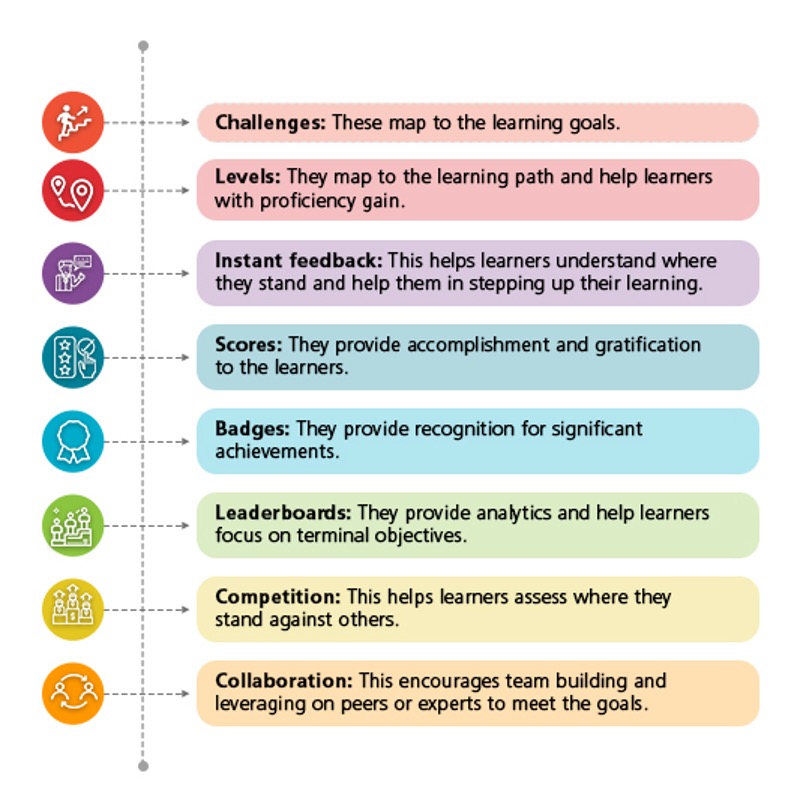
While “Have fun as you learn” resonates well with learners, these approaches are often looked at with skepticism by the corporates. Of the various myths associated with what Gamification can do/can’t do, I list the three I have encountered the most:
- A common myth is that Gamification in eLearning doesn’t effectively contribute to the learning process.
- Gamification adds fun to learning but does not drive learner performance.
- Gamification appeals only to millennials.
The fact is that well-designed Gamification based trainings provide help to both organizations and learners at many levels.
From the learner’s standpoint, the allure of Gamification in eLearning is multifaceted. It transforms the learning experience from a passive intake of information into an active journey of discovery and achievement. Here’s how learners benefit:
- Increased Engagement: Interactive gamified elements maintain learner involvement and motivate them to progress through their training.
- Immediate Gratification: Instant rewards and feedback in gamified learning stimulate dopamine release, reinforcing continued participation and effort.
- Autonomy and Competence: Gamified environments empower learners to make choices and exercise control over their learning paths, enhancing their sense of competence.
- Social Connection: Leaderboards and team challenges foster a sense of community and healthy competition, which can be particularly effective in remote learning settings.
- Personalized Learning: Adaptive Gamification can tailor challenges to individual skill levels, ensuring that all learners, regardless of their proficiency, find the content accessible and stimulating.
- Skill Mastery: By allowing learners to practice in a risk-free environment, Gamification encourages experimentation and deepens understanding, leading to mastery over time.
For businesses, integrating Gamification into eLearning strategies is an investment with measurable returns. Here’s the value proposition from a corporate lens:
- Enhanced Learning Outcomes: Gamified learning has been linked to improved retention rates, enabling employees to apply new skills more effectively in their roles.
- Higher Course Completion Rates: The engaging nature of gamified learning experiences reduces dropout rates and increases the number of employees who complete their training.
- Data-Driven Insights: The analytics provided by gamified systems offer insights into employee performance and engagement, aiding in the optimization of future training.
- Cultural Transformation: Gamification can be a catalyst for creating a learning culture within the organization, encouraging continuous professional development.
- Improved Performance: Employees who find learning enjoyable are likely to be more productive and innovative, driving business performance.
- Scalability and Flexibility: Gamified learning platforms can accommodate growing numbers of users and adapt to different learning needs, making them a scalable solution for businesses of all sizes.
Gamification bridges the gap between entertainment and education, enhancing the learning experience and aligning with strategic goals.
eLearning Gamification Trends
Now, let’s explore some Gamification Trends that deserve closer attention.
For each Gamification trend, I provide practical tips on why and how they can be used.
Gamification Trend #1: Immersive Learning Environments
In 2025, we’re witnessing a deeper immersion of gamified elements within learning environments. Virtual Reality (VR) and Augmented Reality (AR) are increasingly integrated into training modules, creating more realistic and engaging scenarios for learners.
Tips:
- Utilize VR to simulate complex tasks or environments for safe, hands-on practice.
- Implement AR for interactive job aids or to enhance real-world training with overlaid information.
- Design immersive storytelling experiences that draw learners into scenarios that mimic real-life challenges.
Gamification Trend #2: Adaptive Learning Pathways
Gamification is applied to adaptive learning technologies, creating custom pathways that adjust in real-time to a learner’s performance. This personalization ensures that each learner is constantly challenged at the right level and can progress at their own pace.
Tips:
- Integrate adaptive learning algorithms to tailor challenges and rewards to individual performance metrics.
- Use data analytics to understand learning patterns and refine the Gamification strategy accordingly.
- Ensure that Gamification design includes varying levels of difficulty to cater to a diverse learning audience.
Gamification Trend #3: Gamified Microlearning
Gamification is applied to microlearning modules, delivering content in small, bite-sized chunks to maximize engagement and retention in short learning sessions.
Tips:
- Break down complex subjects into micro-challenges that learners can quickly overcome.
- Offer instant feedback and rewards to keep motivation high in these short bursts of learning.
- Align microlearning objectives with broader Gamification goals for a cohesive learning experience.
Gamification Trend #4: Social Learning
Gamification is applied to social learning elements such as community challenges, collaborative quests, and peer reviews. This promotes a sense of community and leverages the motivational boost of social engagement.
Tips:
- Encourage collaboration with team-based challenges and leaderboards.
- Foster a learning community with shared goals and rewards.
- Implement social recognition features where peers can acknowledge each other’s achievements.
Gamification Trend #5: Focus on Soft Skills Development
Gamification is increasingly used to develop soft skills such as leadership, communication, and empathy. Scenario-based gaming allows learners to practice these skills in a controlled, risk-free environment.
Tips:
- Design role-play simulations where learners can practice negotiation, conflict resolution, and team leadership.
- Use branching scenarios to let learners explore different outcomes based on their choices.
- Provide reflective learning opportunities by incorporating feedback loops into the Gamification strategy.
Gamification Trend #6: AI-Driven Personalization
Artificial Intelligence (AI) is enhancing Gamification with personalized learning experiences. AI can analyze a learner’s interactions and performance, tailoring the gamified content to suit individual learning styles and preferences.
Tips:
- Use AI to offer dynamic content recommendations based on learner behavior.
- Implement AI coaches or chatbots that provide personalized tips and encouragement.
- Analyze data collected by AI to continually improve the relevance and impact of gamified learning activities.
Gamification Trend #7: Strategic Application of Gamification
Gamification has matured, moving beyond badges and leaderboards to include strategic applications in skill-building, practical learning application, and long-term behavioral change.
Today, it is much easier and quicker (and cheaper) to craft effective Gamification solutions on account of the maturing of authoring tools. There are several Use Cases that show what strategy works and what doesn’t. There is also a shift from Game based learning to using Gamification techniques at various levels.
Tips
Much in line with traditional eLearning, you can use elements of Gamification:
- For skill building and proficiency gain.
- To help application of learning on the job.
- To influence behavioral change (through a longer-term implementation).
Gamification Trend #8: Mobile and Microlearning Integration
Gamification is being adopted rapidly, particularly through mobile learning and microlearning formats, providing flexible, on-the-go training options that suit modern work environments.
Tips
You can opt for Gamification approaches that are bite-sized and optimized for smartphones. They provide learning on the go and can be designed to facilitate application on the job or help learners in proficiency gain.
Gamification Trend #9: Expanded Application Areas
Gamification is now applied broadly across various learning domains, from traditional eLearning enhancement to fully gamified approaches and support for instructor-led training (ILT) programs.
Tips
You can use Gamification (partial or full) as follows:
- To make traditional eLearning courses interesting by using partial Gamification techniques.
- Fully Gamified approaches to address varied training needs (includes formal, informal, collaborative, and performance support intervention).
- To support and pep up ILT programs through Gamified learning aids.
- Gamified portals.
- Game based learning.
NOTE: I see an acceleration in the adoption of Gamification, particularly in the first three formats rather than the Game based learning. The Gamified portals can be applied for certain niche applications. We have used them for Induction and Onboarding with success.
Gamification Trend #10: Corporate Training Diversification
Gamification strategies are successfully implemented across a spectrum of corporate training needs, including induction, sales, leadership, professional skills, application simulations, and compliance training.
Tips
There are several Use Cases that showcase the successful implementation of Gamification for learning across various corporate trainings. You can certainly evaluate using Gamification for:
- Induction and Onboarding.
- Sales training.
- Leadership training.
- Professional Skills training.
- Application Simulations training.
- Compliance training.
Gamification Trend #11: Next-Gen Gamification Techniques
Emerging techniques are employed for a more significant impact, including long-term Gamification for sustained behavioral change, integration of immersive technologies, microlearning-based challenges, personalized learning paths, social learning, and specialized Gamification portals.
Tips
The adoption of these techniques will help you improve the impact of your trainings manifold.
- Longer-term Gamification: Behavioral change requires the usage of Gamification over a long period of time. You can create a learning path that keeps the learner aligned to these goals over multiple weeks/months/quarters.
- Multiply the Impact: To make the learning journey more interesting, you can add immersive approaches like Virtual Reality or Wearable Tech into your fold.
- Leverage on Microlearning Based Gamification: Give the learners a “bite-sized” Gamification experience that can be consumed on the go. These could include a challenge (a set of Gamified questions) or a Micro-Game (mapping to a specific outcome).
- Personalized Gamification: Based on the current knowledge (validated through a Pre-Test), you can offer personalized learning and Gaming paths for learners.
- Social Learning Based Gamification: Let the learners collaborate with peers to meet a challenge. Or provide the support of experts to help them solve a problem.
- Invest in Niche Gamification Portals: These can be designed to offer customized learning paths and elements of Gamification, Microlearning, and Social Learning.
Gamification Trend #12: AI-Powered Gamification
AI-powered Gamification is revolutionizing learning with highly personalized experiences that respond to the unique needs of each learner. Through the analysis of performance and behavioral data with AI, gamified learning is dynamically optimized to keep learners engaged, motivated, and suitably challenged.
Tips:
- Dynamic Personalization: Use AI to adapt content and challenges to learner preferences and performance.
- Real-Time Adaptation: Create adaptive learning paths which adjust challenges and provide rewards as per the progress of learner.
- Immersive Simulations: Use AI with VR/AR to develop interactive and realistic simulations becoming a source of hands-on learning.
- Instant Feedback & Rewards: Apply immediate personalized feedback and rewards to boost motivation.
- Continuous Improvement: Utilize AI capabilities to monitor progress and adapt Gamification for continuous learner engagement.
Gamification Trend #13: Gamification for a Multigenerational Workforce
As today’s workforce is multi-generational, Gamification is evolving to engage employees across all age groups, from Baby Boomers through to Gen Z. Well-designed gamified learning experiences built with a range of learner profiles in mind will increase engagement and develop skills throughout the whole organization.
Tips:
- Personalized Experiences: Tailor challenges to different learning styles (e.g., points, narratives, microlearning).
- Multi-Platform Access: Ensure content is accessible on various devices to suit all tech comfort levels.
- Varying Challenge Levels: Design challenges with different complexity levels to engage all generations.
- Inclusive Rewards: Offer incentives that are valuable for both the younger and older generations (recognition, promotion).
- Collaborative Learning: Encourage team-based gamification to promote cross-generational knowledge sharing.
The skepticism once surrounding the effectiveness of Gamification has been dispelled as Gamification matures into a sophisticated, strategic tool in learning and development. It now offers immersive environments, adaptive learning pathways, and integrates seamlessly with mobile and microlearning. Organizations are witnessing its powerful impact on corporate training diversification and the development of soft skills, with AI-driven personalization leading the charge toward more tailored learning experiences. Looking ahead, these trends indicate that Gamification will continue to play a crucial role in engaging learners and enhancing performance, fostering a culture of continuous improvement and development within forward-thinking organizations.

subscribing!
Related articles


.jpg)
.jpg)






.jpg)
