






.avif)

Right Skilling: Aligning Learning Strategy to Drive Organizational Growth


Right skilling is a strategic process that enables organizations to address skill gaps and equip employees with the necessary competencies needed for their roles while aligning the learning strategy with organizational goals.
Understanding Different Skilling Strategies
Right Skilling
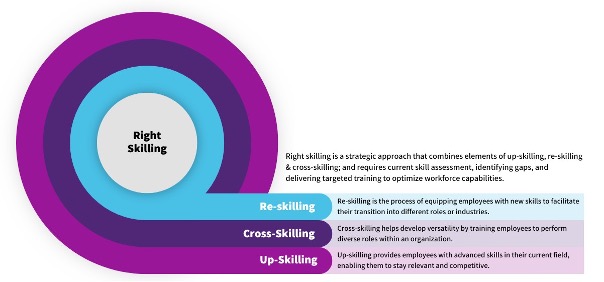
Right skilling encompasses both upskilling and reskilling, which allows organizations to match employees' skills with the requirements of their roles. Right skilling requires organizations to equip employees with the precise skills needed to excel in their professional roles by assessing current skills, identifying the gaps, and providing employees with targeted training.
Due to the dynamic nature of the marketplace, organizations must continuously adapt to evolving roles and technologies. Right skilling allows organizations to optimize workforce capabilities, maximize productivity and improve efficiency, thereby maintaining an agile workforce that can adapt to the emerging workplace challenges.
Cross Skilling
Training employees in several different professional roles to foster versatility and adaptability across various functions is called cross-skilling. It enables employees to seamlessly transition across roles as needed, thus promoting efficiency, resilience, and operational continuity within the organization. Cross skilling helps organizations cultivate a pool of employees with diverse skills, thereby reducing dependency on specific individuals and mitigating the risks associated with skill shortages or attrition.
Upskilling, Reskilling, Cross Skilling, and Right Skilling
Upskilling, reskilling, cross skilling, and right skilling are all strategies that allow organizations to enhance workforce capabilities and address evolving requirements of a dynamic job market. However, there are subtle differences between each of these approaches, as described below.
Upskilling provides employees with advanced skills in their current field, enabling them to stay relevant and competitive amidst the changing industry trends. For instance, upskilling a software developer might involve learning a new programming language or an emerging technology like artificial intelligence or blockchain.
Reskilling is the process of equipping employees with new skills to facilitate their transition into different roles or industries. Reskilling is especially important in scenarios where job roles may become redundant due to automation, outsourcing, or changes in consumer preferences. For instance, reskilling a manufacturing worker with data analysis skills can help meet the requirements arising out of automation of traditional assembly line tasks.
Cross skilling helps develop versatility by training employees to perform diverse roles within an organization. Cross skilling creates flexibility and adaptability, enabling organizations to adapt to sudden changes or transitions, while also optimizing workforce capabilities, maximizing productivity, and improving efficiency. For example, providing a customer service representative with training to handle both phone and email inquiries can improve customer satisfaction.
Right skilling is a strategic approach that helps organizations ensure that employees possess the relevant skills aligned with organizational objectives. As explained earlier, right skilling combines elements of upskilling and reskilling; and requires current skill assessment, identifying gaps, and delivering targeted training to optimize workforce capabilities. By helping organizations align skill sets with evolving job demands, right skilling improves agility, competitiveness, and sustainability, in alignment with specific organizational needs.
The Importance of Aligning Skilling Strategy to Business Objectives
Aligning skilling strategy to business objectives can help organizations improve overall success by addressing specific needs and priorities of workforce development.
Skilling strategies should be designed in such a manner that facilitates identifying the skills needed for organizational goals and providing targeted learning for employee development. When aligned with business priorities, skilling strategies can enable organizations to drive success and adapt to changing market requirements.
It is essential to mention that leadership can play a pivotal role in fostering a culture that embraces skilling initiatives aligned with business needs, driving organizational success in the long term. By setting clear expectations, allocating resources, and championing continuous learning initiatives, the leadership team can demonstrate a commitment to employee development, emphasize the importance of acquiring relevant skills, and inspire a culture of growth and adaptability.
Benefits of Adopting the Right Skilling Strategy
The right skilling strategy can help organizations increase employee productivity, organizational agility, and drive long-term sustainability. Some benefits of adopting the right skilling strategy include:
- Enhanced Productivity and Competitiveness: Right skilling is a corrective action that allows organizations to adjust training correctly with organizational goals. By equipping employees with the latest and most relevant skills, right skilling can help increase efficiency, streamline processes, enhance productivity, and gain a competitive edge in the industry.
- Skill Gaps Mitigation: By identifying areas of improvement and providing employees with targeted training or development opportunities, right skilling mitigates skill gaps and equips employees with the necessary skills to meet evolving job demands.
- Agility and Resilience: By providing employees with versatile skill sets, right skilling enables the workforce to readily pivot and acquire new competencies, enabling organizations to quickly adapt to the emerging challenges and respond effectively to technological advancements.
- Employee Engagement and Retention: By demonstrating commitment to employees’ professional growth and development, right skilling helps improve job satisfaction and loyalty. Right skilling also provides employees with opportunities for continuous learning and skill advancement, creating a positive work environment.
- Cross-Functional Collaboration: By equipping employees with diverse skills, right skilling fosters teamwork and cross-functional collaboration across different departments or teams, breaking down silos. Employees with a broader range of competencies are in a better position to contribute more meaningfully to interdisciplinary projects, share knowledge, and drive innovation.
Designing an Effective Skilling Strategy
Designing an effective skilling strategy enables proactive planning for future workforce needs and building agility in a dynamic business landscape. There are certain key parameters, as described below, that organizations must consider while designing an effective skilling strategy.
- Identifying Skills Needs and Gaps: A crucial factor in designing an effective skilling strategy, identifying skills needs and gaps enables organizations to align their training initiatives with areas that need improvement, thereby ensuring that the resources are invested judiciously. Using data analytics, organizations can drive data-driven identification of skills gaps and needs, identify trends and emerging skill requirements, and facilitate more effective workforce planning.
Another key ingredient in an effective skilling strategy is relationship building, as it improves the understanding of existing and required skills through internal relationships and fosters collaboration. Strong relationships enable organizations to gather valuable feedback, gain buy-in from stakeholders, and create a supportive environment for continuous learning and skill development.
Using personalized plans that are customized according to individual learning styles, preferences, and career aspirations, organizations can maximize learner engagement, improve motivation and retention, ultimately driving organizational success. - Incorporating Technology: Incorporating technology into designing effective skilling strategies helps deliver personalized and interactive training experiences. Digital tools such as adaptive learning platforms, AI, and AR/VR not only help adapt content delivery according to individual learner’s skill levels, but also provide real-time feedback and enhance knowledge retention through immersive learning experiences. Furthermore, technology makes learning resources accessible, offering greater flexibility and scalability in remote skilling initiatives.
- Communicating the Strategy: Communicating the skilling strategy within the organization is important for aligning stakeholders' expectations and fostering a culture of learning. It also helps outline the training schedule clearly, enabling employees to know about the upcoming learning opportunities and planning accordingly.Additionally, integrating feedback mechanisms into the strategy helps solicit input from participants, identify areas for improvement, and adapt the skilling initiatives for more meaningful learning outcomes.
- Delivering the Skilling Program: Delivering the skilling program effectively is vital in supporting varied career paths in an organization. Through continuous learning, mentorship, and coaching initiatives, effective skilling initiatives provide employees with opportunities for skill and professional development. Organizations must consider using performance monitoring and rewards systems that recognize and incentivize skill acquisition and application, to motivate employees to participate in skilling initiatives and contribute to organizational success.
- Measuring Success: Another important factor in building an effective skilling strategy is measuring success. By tracking the impact of training initiatives through performance indicators such as retention, productivity, job satisfaction, and overall business success, organizations can drive data-driven decision-making and accountability.Furthermore, by analyzing metrics and feedback, organizations can identify the opportunities to refine the skilling program. Using the results of right skilling initiatives to adjust the learning strategy can help organizations ensure that their training efforts are aligned with organizational goals and contribute to workforce development.
Conclusion
Right skilling is crucial in aligning workforce capabilities with organizational objectives. It is vital in ensuring that employees possess the right skills needed to drive business success.
By strategically matching skill sets to job roles, organizations can use right skilling to increase productivity, foster innovation, improve competitiveness, and fuel business growth. Right skilling also helps organizations improve employee satisfaction and career progression, as relevant skills empower employees to excel in their roles.
With a strategically designed right skilling strategy, organizations can achieve their strategic goals and cultivate a positive workplace culture with a motivated and fulfilled workforce.

subscribing!
Related articles


.jpg)
.jpg)






.jpg)
