






.avif)

How to Choose Training Companies: A Practical Guide


Summary
Learn how to choose the right training company with this practical guide covering top providers, key trends, and a simple framework to evaluate your best fit.
What do you do when your teams need to learn faster than ever, but your current training just isn't moving the needle? Maybe people complete the courses, but nothing changes on the job. Maybe your workforce is struggling to keep up with new tools, new expectations, and constant change. Or maybe you're being asked to prove the impact of your training programs, and the data isn't telling the story you need it to.
You're not imagining it. The speed of change is real. According to the World Economic Forum Future of Jobs Report 2025, on average 39% of today's skill sets are expected to be transformed or become outdated over the 2025-2030 period. And when learning can't keep pace, performance suffers.
That's why choosing the right training company matters so much. You need a partner who understands your world, your challenges, and your goals and can create training that people actually use, remember, and apply.
This guide will help you get there. You'll find a curated list of top training companies, key trends shaping modern corporate learning, and a clear framework to evaluate which partner is right for you.
Let's walk through it together.
TL;DR
- Training quality directly impacts how fast your workforce adapts, performs, and grows. Choosing the right partner is now a strategic business decision.
- Modern training companies combine strong instructional design, smart technology, and measurable outcomes to deliver learning that actually sticks.
- Trends like AI-driven personalization, microlearning, immersive learning, and cohort experiences are reshaping how organizations build capability.
- A solid evaluation process should look beyond content to performance impact, scalability, measurement, collaboration, and long-term support.
- A pilot-first approach is the safest way to validate whether a partner can deliver the behavior change and results your business needs.
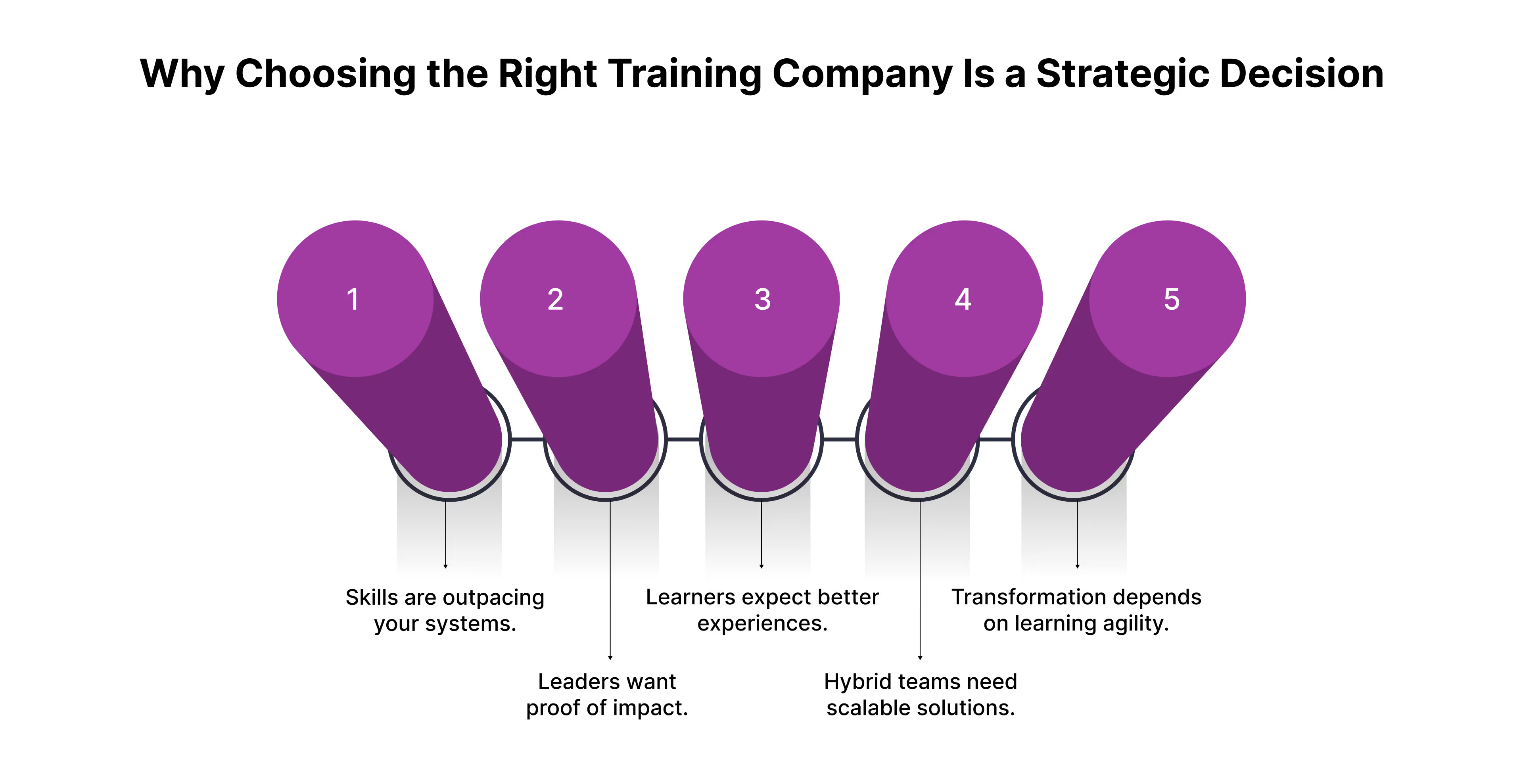
Why Choosing the Right Training Company Is a Strategic Decision
Training isn't just another item on the HR checklist anymore. It's directly tied to how fast your organization can adapt, innovate, and stay competitive. When the skills your teams need are changing at the same pace as your business priorities, the quality of your training partner becomes a make-or-break factor.
The wrong partner can leave you with low adoption, generic content, and programs that don't shift real behavior. The right one can help you build capabilities that power performance, strengthen culture, and support long-term growth.
Here's why the decision matters more than ever:
1. Skills are aging faster than your systems can keep up.
Teams are expected to learn new tools, new processes, and new ways of working, while still meeting daily demands. A strong training company helps employees close this gap quickly with learning that's relevant, engaging, and easy to apply on the job.
2. Leaders want proof of impact.
It's not enough to say a program went well. Business heads want data: How did it reduce errors? Improve productivity? Speed up time-to-competence? A capable partner helps you link training outcomes directly to business metrics.
3. Learners expect better experiences.
Today's workforce doesn't respond to outdated slideshows or long, one-size-fits-all courses. They want short, practical, story-driven, and tech-enabled learning that feels built for them, not at them.
4. Hybrid and distributed teams need scalable solutions.
Remote work, global teams, and constantly shifting roles mean training must scale, adapt, and remain accessible without losing quality. The right partner ensures consistency across locations, functions, and learner types.
5. Business transformation depends on learning agility.
Whether it's digital transformation, process redesign, or a culture reset—training is the engine that moves people forward. And that requires a partner who understands both learning and change.
Choosing a training company isn't just a procurement step. It's a strategic decision that shapes how capable, confident, and future-ready your workforce becomes.
How to Choose the Right eLearning Company to Maximize Training ROI
Selecting an eLearning partner isn't about comparing feature lists or picking the flashiest portfolio. It's about choosing a team that understands your learners, your business realities, and the performance gaps you're trying to close.
Here's what truly matters when making that decision.
Look for a Partner Who Starts With the Problem, Not the Content
The best eLearning companies don't begin with storyboards or timelines; they begin with questions. What behavior needs to change? What frustrates learners today? Where does performance break down? This early discovery work is where genuine value is created, because it ensures every learning experience is built around real-world challenges rather than generic subject matter. When a vendor jumps straight into production, you know they're solving for output, not impact.
Prioritize Learning Design That Feels Human, Not Just Functional
Tools, platforms, and media formats all matter, but the heart of any effective program is its learning design. That includes the storytelling techniques used to pull learners in, the way scenarios mirror real situations, and the emotional and cognitive cues that help people apply what they've learned at work.
Choose Innovation That Supports Learning Instead of Overshadowing It
The industry is full of buzzwords but technology only amplifies learning when it's used with intention. A meaningful partner will help you integrate digital elements that genuinely enhance the experience: a simulation to practice decision-making, a microlearning series to reinforce key concepts, or personalized learning that adapts to each learner. Innovation should reduce friction, not add complexity. If a provider pushes tech without context, that's a red flag.
Make Sure They Can Connect Learning to Business Outcomes
Training that can't be measured usually can't be improved. Look for a partner who understands how to tie learning to performance, not just through dashboards and completion rates, but through meaningful indicators like faster proficiency during onboarding, fewer errors in the field, stronger customer interactions, or more confident leadership behaviors. When a partner speaks the language of KPIs instead of "courses completed," you know they're focused on ROI, not deliverables.
Look Beyond Customization to True Alignment With Your Brand
Many providers claim they "customize" content, but real customization goes deeper than colors and fonts. It reflects your organization's voice, values, systems, workflows, and personality. When learners recognize their world inside the course, adoption goes up, and so does performance.
Be Aware of Signals That Suggest a Poor Fit
Sometimes the warning signs appear early: off-the-shelf templates passed off as custom work, visuals that feel dated, vague answers about analytics, or a tendency to overpromise and under-explain. If the early conversations feel rushed or shallow, the final product likely will too.
If you are having trouble finding a perfect fit, here are some top providers to consider.
Match Your Problem to the Right Solution, Quick Use-Case Map

Different business challenges require different training approaches. Instead of picking a partner based on features alone, match your problem to the solution that will create the strongest impact. Use this map to guide your thinking.
1. When Compliance Errors Are Rising
What you need: Short, scenario-driven training that's easy to apply on the job.
Best solutions:
- Microlearning
- Guided practice scenarios
- Knowledge checks and spaced reinforcement
- Mobile-ready content for quick access
This approach reduces mistakes and improves awareness without overwhelming your teams.
2. When Sales Teams Need Better Conversations, Not More Content
What you need: Realistic practice and coaching—not long modules.
Best solutions:
- Conversation simulations
- Role-play (AI-supported or instructor-led)
- Continuous reinforcement nudges
- Coaching toolkits for managers
This helps teams retain new messaging, build confidence, and close more deals.
3. When Technical Skills Need a Rapid Upgrade
What you need: Hands-on practice and structured learning paths.
Best solutions:
- Blended bootcamps
- Labs and sandboxes
- Benchmarked skill pathways
- Certification preparation
- Bite-sized learning for reinforcement
Ideal for digital transformation, cloud migration, cybersecurity, and data literacy initiatives.
4. When Leadership Capabilities Need a Reset
What you need: Human-centered, reflective, and practice-heavy programs.
Best solutions:
- Cohort-based learning
- Live workshops and coaching
- Peer discussions and action learning
- Multi-week journeys with real-world assignments
Leaders develop the soft skills and mindsets needed for hybrid teams and high-change environments.
5. When Onboarding Takes Too Long
What you need: A frictionless experience that gets new hires productive faster.
Best solutions:
- Step-by-step microlearning
- Interactive walkthroughs of tools and systems
- Performance support (job-aids, quick guides)
- Manager enablement resources
Shortens time-to-competence and improves early engagement.
6. When Customer-Facing Teams Need Consistency
What you need: Training that aligns messaging and customer experience across locations.
Best solutions:
- Role-based learning journeys
- Video scenarios and practice simulations
- LMS/LXP pathways for tracking
- Reinforcement and certification layers
Useful for retail, service, hospitality, and distributed support teams.
7. When You Need to Train Extended Teams (Partners, Vendors, Franchisees)
What you need: Scalable learning that works beyond your internal workforce.
Best solutions:
- Multi-tenant LMS/LXP setups
- Lightweight microlearning
- Self-paced training with assessments
- Region-wise localization
Helps maintain quality and consistency across all touchpoints.
8. When You Need Learning to Stick Long-Term
What you need: Reinforcement built into the design, not added later.
Best solutions:
- Spaced repetition
- Scenario refreshers
- Monthly challenges or micro-tasks
- Manager check-ins and coaching prompts
This closes the "knowing–doing" gap and turns training into habits.
Major Trends Shaping Training Companies in 2026

The way organizations train their people has changed more in the last four years than in the previous decade. Training companies are reshaping their solutions to meet new expectations, new technologies, and new business realities. Understanding these trends helps you choose a partner that's ready for what your teams need today — and what they'll need next.
1. Lifelong Learning Is Becoming a Business Imperative
Jobs are evolving faster than job descriptions. Employees no longer "learn once and perform forever." Organizations now need continuous learning cycles that build capability over time, not once-a-year training events.
Training companies increasingly offer learning journeys, coaching, spaced reinforcement, and repeated practice to support long-term development.
2. AI-Powered Personalisation Is the New Baseline
AI is now embedded in everything from content recommendations to adaptive assessments, but the focus has shifted from novelty to purpose.
Modern training partners use AI to identify skill gaps, personalize learning paths, adjust difficulty levels, and automate learning workflows.
The goal is to make learning timely, relevant, and efficient, without adding more work for learners or L&D teams.
3. Microlearning and Performance Support Are Driving Real Behavior Change
Organizations want training that fits into work, not around it. Bite-sized modules, how-to demos, guided practice, and job aids are now core for building confidence and reducing errors on the job.
Training companies that blend microlearning with scenario-based practice deliver stronger application and retention.
4. Cohort-Based and Social Learning Are Growing, Especially for Leadership
High-impact skills like communication, problem-solving, and leading change can't be mastered through content alone.
Cohort learning, with peer discussions, reflection, coaching, and real-world projects, is now a key ingredient in leadership and culture-building programs. Training providers are leaning heavily into human connection as a learning accelerator.
5. Immersive Technologies Are Moving Into the Mainstream
AR and VR have matured from "nice to have" to effective practice environments for high-stakes or complex skills.
Simulations help learners experience difficult conversations, safety-critical tasks, customer scenarios, and decision-making challenges.
Companies are choosing training partners who balance immersive technology with sound instructional design, not just flashy experiences.
6. Human Skills Are Taking Center Stage in an AI-Driven Workplace
As AI automates tasks, the skills that make people valuable, empathy, leadership, teamwork, and adaptability, are becoming top priorities.
Training companies are expanding offerings in emotional intelligence, people management, coaching skills, creative problem-solving, and collaboration.
These programs are becoming essential for organizations preparing their workforce for an AI-augmented future.
7. Data-Driven Learning Decisions Are Replacing Guesswork
Learning data is becoming more accessible, more granular, and more actionable. Modern providers support organizations with dashboards tied to performance metrics, behavior analytics, skill benchmarking, and measurement frameworks that show what changed, not just what was completed.
This shift toward evidence-based L&D is helping leaders prove ROI and secure future budgets.
How EI Helps You Streamline Training for Employees
Most organizations struggle with training that gets completed but doesn't translate into real performance. Learners feel disconnected from generic content, managers don't see behavior change, and L&D teams can't link training to business results. With skills evolving rapidly and workflows becoming more complex, outdated training approaches simply can't keep up.
EI solves these challenges with learning solutions built around human behavior, business outcomes, and modern learning science. Instead of pushing content, EI designs emotionally intelligent, experiential, and data-driven training that fits how people actually work and learn.
Key Features
- AI-powered adaptive learning paths that personalize content and accelerate skill development
- Custom eLearning built for role relevance using scenarios, storytelling, and real-world context
- Short-form microlearning that reinforces knowledge and supports performance on the job
- Immersive learning (AR/VR & simulations) for safe, hands-on practice of critical skills
- End-to-end learning strategy & consulting to modernize ecosystems and align training with business goals
- Measurement frameworks that track behavior change and connect learning to performance metrics
With EI, organizations gain a partner that builds training people remember, use, and apply, driving measurable impact where it matters most.
Conclusion
Choosing the right training company isn't just a procurement decision; it's a strategic investment in your people, your culture, and your long-term performance. The right partner will help you close skill gaps faster, strengthen leadership capabilities, support business transformation, and build a workforce that can adapt with confidence.
The companies in this list each bring something valuable to the table. But the real difference lies in finding a partner who understands your challenges, your learners, and the outcomes you're trying to drive, and who can translate that into meaningful, human-centered learning experiences.
If your goal is to build training that people actually remember, use, and apply on the job, then the next step is simple: partner with experts who can help you get there.
Ready to build learning experiences that drive real behavior change and measurable performance? Book a call with EI's learning experts.
Frequently Asked Questions
1. How do I know which training company is right for my organization?
Look for alignment with your business goals, not just your training topics. The right partner will ask about performance metrics, behaviors, and real-world challenges, and design learning solutions that address those directly.
2. What's the ideal size for a pilot group?
Most organizations see the best insights with 25–100 learners. It's large enough to identify patterns and small enough to manage feedback, coaching, and iteration effectively.
3. How long should a training pilot run before rollout?
A good pilot typically spans 60–90 days. This allows time to launch content, gather usage and sentiment data, observe early behavioral changes, and refine before scaling.
4. Are advanced technologies like AR/VR or AI necessary to get results?
Not always. Technology helps, but impact depends more on instructional design, practice opportunities, and relevance to real work. Choose tools that support your goals, not ones that simply look impressive.
5. What's the biggest red flag when evaluating a training company?
Any provider that jumps straight into talking about content or platforms, without asking about your business problem, is a risk. Effective partners start with goals, behaviors, and outcomes, not modules.

subscribing!
Related articles


.jpg)
.jpg)






.jpg)
