


.avif)

Learning Is the Work: What CLOs Are Really Saying in 2026


Summary
The CLO Priorities 2026 discussion highlighted a clear shift in learning leadership—from tracking activity to proving business impact. The strongest insight was that learning creates value when it is embedded in strategic priorities, linked to measurable outcomes, and treated as a critical driver of workforce transformation rather than a standalone function.
There is a question that has been shadowing L&D leadership for years: are we genuinely driving business performance, or are we building programs that sit adjacent to it?
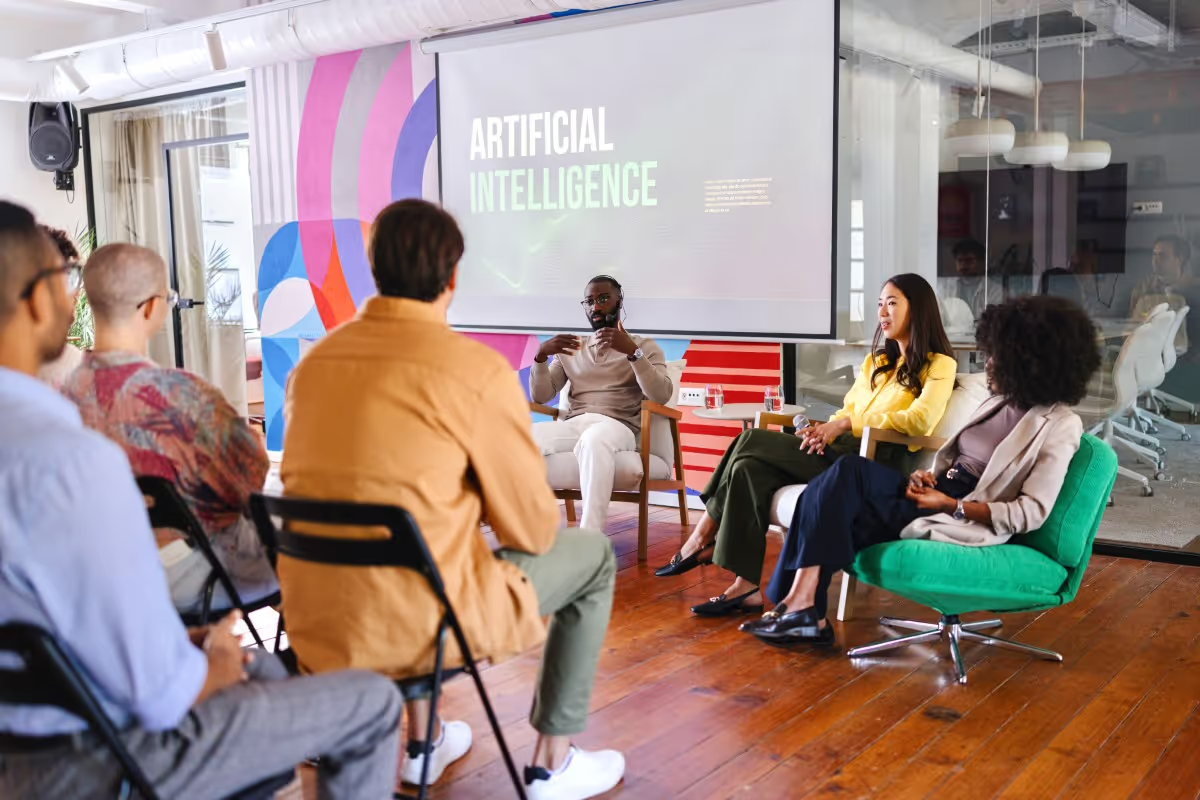
On April 14, six senior learning and talent leaders convened for the CLO Priorities 2026 webinar, hosted by Liberate Global in partnership with Brandon Hall Group. What followed was not a polished keynote. It was the kind of candid, cross-industry exchange that does not make it into conference presentations.
Here are the ideas that should travel beyond that room.
The 42% Problem Is a Positioning Problem
Brandon Hall Group research showed that only 42% of organizations report strong alignment between their learning initiatives and business goals. Michael Rochelle, who presented the data, was clear about what that number reflects: learning functions that are not embedded in strategic planning cannot align to it.
The fix, the panel agreed, is not better content. It is a different conversation with leadership. Alexandra Hyland of Kraft Heinz put it directly: move out of L&D language and into the language that matters to the business leader. Speak to their must-wins. Reference their KPIs. Make the connection between capability development and the outcomes they are accountable for.
When we move from talking about completion numbers to time to impact or risk reduction or measurable performance, that is truly where we start to move into a partnership model. - Alexandra Hyland, Kraft Heinz
Learning Is the Work
One of the sharpest moments of the session came during a rapid-fire debate: is learning in the flow of work the future, or a myth? Alexandra Hyland challenged the premise of the question entirely.
Learning is the work. I think that is one of the biggest things we have to combat, this idea that learning is seen as some separate activity that needs to be scheduled and takes us away from what we need to do. - Alexandra Hyland, Kraft Heinz
Adonica Black of Aptiv built on this, questioning the value of measuring learning hours at all. The insight is not whether someone completed a course. It is whether they commanded the skill and whether that helped them do something better. Until the profession shifts from tracking activity to tracking impact, the credibility gap with business leadership will persist.
Technology Succeeds When It Is Treated as a People Project
Julia Suk, SVP of Enterprise Sales at Liberate Global, drew on a formative experience from a major banking institution to make a point that resonated across the panel. Every technology transformation that fails, fails for the same reason: it is treated as a software implementation rather than a people implementation.
Without people understanding what is in it for them and why we are adopting a new technology, chances are it is a hard road. Organizations that succeed are the ones with a leader who deeply agrees that it is a people implementation more than a technology implementation. - Julia Suk, Liberate Global
Poushali Chatterjee of TCS offered a concrete counterpoint from an organization operating at scale: 600,000 people across 58 countries. Her team's success with AI and digital upskilling came not from technology alone but from the combination of platform, gamification, mentoring frameworks, and leadership role modeling. When employees see their most senior leaders taking the same training, the culture of learning becomes credible.
Purpose Is Not Optional
Adonica Black shared that Aptiv had just completed a significant corporate spin-off, and with it, a full reset of mission, values, and behaviors. The learning function was central to that work: using micro-lessons led by the CEO and board to bring the entire global organization into alignment with the new strategy.
Purpose-driven learning cannot be more important. Learning in lockstep with the business's objectives is the true insight that enables learning leaders to get access to all of the other leaders in the business, because they see the connectivity between learning and accomplishing their goals. - Adonica Black, Aptiv
The AI Question Is More Nuanced Than the Hype Suggests
When asked about their biggest development initiatives, the AI conversation finally surfaced explicitly. Alexandra Hyland described being internally courageous about pushing back on proposals to train people on tools they do not yet have access to. The principle: do not teach for the sake of teaching. Deliver value to people as they learn to use AI to do their work better.
Kelly Stuart-Johnson of VML brought the sharpest contrarian view. In a creative business, AI has been an existential question. Her team's current focus is not AI adoption but the human skills that AI cannot replicate: how to listen, how to connect, how to exercise empathy and judgment. As she put it: be human first.
Poushali Chatterjee added the dimension that is not discussed enough: the risk that AI erodes thinking. When people stop learning because they expect AI to do it for them, the organization loses something that no platform can restore.
The One Word
Michael Rochelle closed by asking each panelist for the single word they would give every L&D leader to carry into the rest of 2026. The answers:
• Julia Suk: Confluence
• Poushali Chatterjee: Balance
• Alexandra Hyland: Rebel
• Adonica Black: Courage
• Kelly Stuart-Johnson: Intentional
Taken together, those five words form something close to a mandate. The learning leaders who will create the most impact in 2026 are the ones willing to challenge the status quo, hold a principled position, bring disparate priorities into confluence, and act with intention rather than habit.
Watch the full recording at YouTube

subscribing!
Related articles
.jpg)