




.avif)

Creating Leadership Training with a Different Flavor – A Solution to Improve Leaders’ Reaction to Change


Most leadership training built around change management teaches leaders how to move other people through a transition. It covers communication planning, resistance curves, and the right language to use when a restructure is announced. What it rarely does is ask the leader to look inward first and work out how they personally respond when the ground shifts underneath them.
A market frontrunner in the tobacco sector came to us with exactly that gap in mind. Their industry was evolving quickly and the organization wanted to understand how its leaders actually reacted when they were the ones being asked to change. Instead of another course on change leadership theory, they wanted something diagnostic. The program had to require leaders to examine their own aptitude for change and their own resilience before asking them to guide anyone else through it.
The Challenge
The brief had two parts that pulled against each other. The first was to capture and categorize how leaders responded to a set of carefully constructed prompts about change. The second was to turn those responses into a comprehensive report that carried genuine diagnostic value and arrived with learning elements attached to each result.
The second part was where the difficulty sat. The organization was large, covering multiple regions and business units, and the range of possible response patterns was correspondingly wide. Designing a dense matrix of results that stayed readable was the critical challenge here. A diagnostic that produces an accurate but impenetrable output is arguably worse than no diagnostic at all, because the leader closes the report and nothing in their behavior changes. The design had to carry analytical depth without asking leaders to interpret analytics.
How the Solution Was Built
A diagnostic tool that hides its own complexity
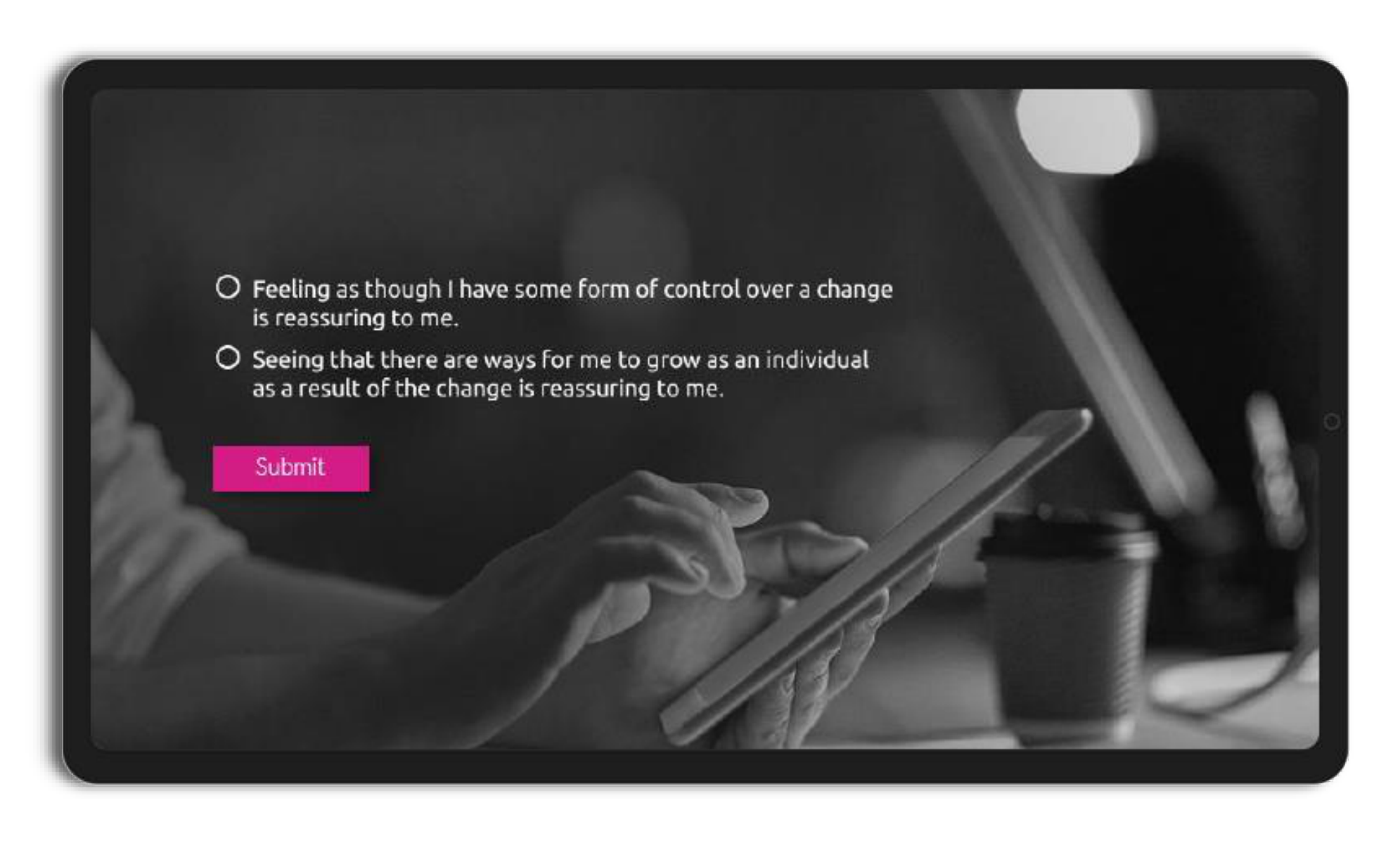
Our primary approach was to design a diagnostic tool that simplified the user experience of what could otherwise become complex analytics. Leaders worked through a series of statements about control, growth, and reassurance during periods of change, selecting the responses that reflected how they genuinely felt rather than how a leader is supposed to feel. The interface was deliberately quiet. One question on screen at a time, no progress anxiety, and no visible scoring while the leader was still answering.
Translating the analysis into a visual spectrum
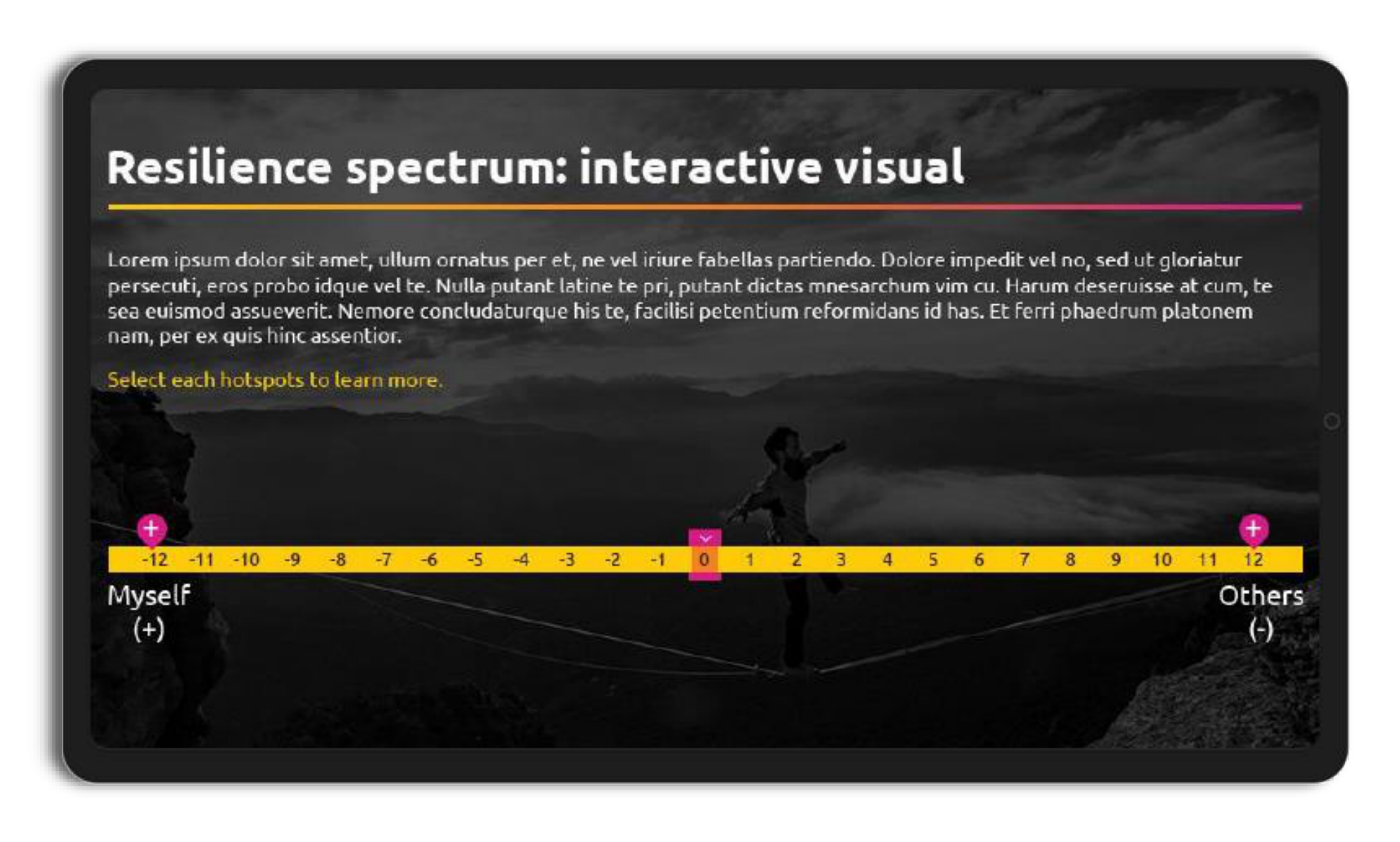
We partnered closely with the L&D teams to create an algorithm that conveyed the change response analysis back to leaders through a visual spectrum. This was the design decision that made the dense results matrix workable. Rather than returning a label or a numeric score that leaders would either dismiss or over-read, the spectrum plotted their position along a continuous scale with clearly marked poles at either end. Interactive hotspots along the scale opened short explanations of what each region meant in practice, so the leader could see not only where they sat but what sat on either side of them.
Learning that arrives with the diagnosis
A diagnosis on its own only tells a leader something about themselves. To help leaders take tangible action from what the tool surfaced, learning was offered through crisp, concise concepts tied directly to the results. Each outcome came with associated learning elements rather than a generic reading list, which kept the connection between the finding and the response immediate. The full report could be printed or downloaded as required, giving leaders something to return to weeks later when a real change situation arrived and the training had faded.
Built for the phone first
The exclusively designed diagnostic tool was made available in a fully responsive format on mobile phones, and delivered through the organization’s existing LMS and LXP. Senior leaders in an operationally intensive business are rarely sitting at a desk with a spare hour. Making the diagnostic something they could complete between meetings, on a phone, removed the most common reason this kind of reflective program goes uncompleted.
The Strategies Behind the Design
- A diagnostic tool as the core of the experience rather than a bolt-on assessment
- A custom algorithm mapping responses to a readable results matrix
- Custom visual design and thematic visuals carrying the analysis
- Crisp, concise content attached to each diagnostic outcome
- A comprehensive report with download and print features
- Mobile learning built on fully responsive design
- Delivery through the organization’s existing LMS and LXP
The Impact
Leaders found the comprehensive diagnostic report genuinely useful as a reference point, both during the program and afterward. That matters more than it might sound, because the usual fate of an assessment output is a single glance and a closed tab.
Leaders also reported increased awareness of their own aptitude toward change, which was the central objective the organization set out with. The organization went on to observe leaders demonstrating more consciousness when dealing with their teams in change situations, suggesting the self-knowledge was carrying into everyday management rather than staying inside the training. On the strength of the pilot in one region, replication across other global business units was planned.
Start Leadership Training with the Leader, Not the Theory
Change leadership programs often fail quietly because they treat the leader as a neutral conduit for a message. This program worked by starting somewhere less comfortable, asking leaders to examine their own reaction first, then handing them a clear and readable picture of what that reaction looks like alongside the learning to do something about it. If you want leadership training that begins with genuine self-awareness and holds up when a real change situation arrives, Liberate can help you design it. Get in touch to talk it through.

subscribing!
Related Case Studies