



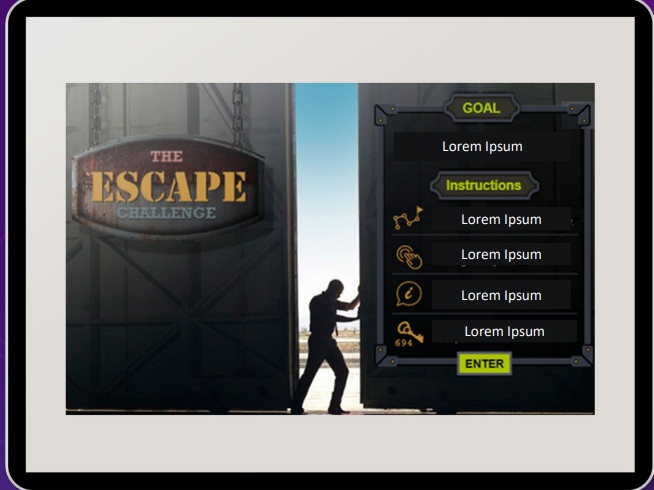

.avif)

How A Premier Sports Car Club Uplifted Their Leadership Training Through Personalized Microlearning


Member organizations have a leadership problem that most companies do not. People step into positions of responsibility because they volunteered, because they have been around a long time, or because nobody else put their hand up. Very few of them arrive with any training for the role, and the organization has limited leverage to insist on it.
A premier sports car club came to our team with exactly this situation. Members holding leader and official roles without the necessary qualifications were dealing with the consequences of not being fully equipped to handle those responsibilities.
The Challenge
The club wanted a course that would instill a sense of accomplishment and pride in its leaders while teaching them the finer nuances of the role, with the aim of improving teamwork and communication across its regions and at its events.
The pride element is the part worth pausing on. In a volunteer leadership context, training that reads as a correction will not be completed, let alone acted on. The program had to raise the standard while making the people taking it feel more capable rather than found wanting.
How the Solution Was Built
We understood that behavioral change was the route to improved performance and to fewer member conduct complaints, so the learning was designed around meaningful engagements and performance support tools rather than around content coverage.
Designing for an established organization
Looking at the history of the club, we recognized that it leaned heavily toward its long-standing membership. That shaped the tone of the program. The learning was crafted to highlight the advantages of change rather than to assert the need for it, and to carry the empathy that an audience with deep attachment to how things have always been done will reasonably expect.
A roadmap learners work through at their own pace
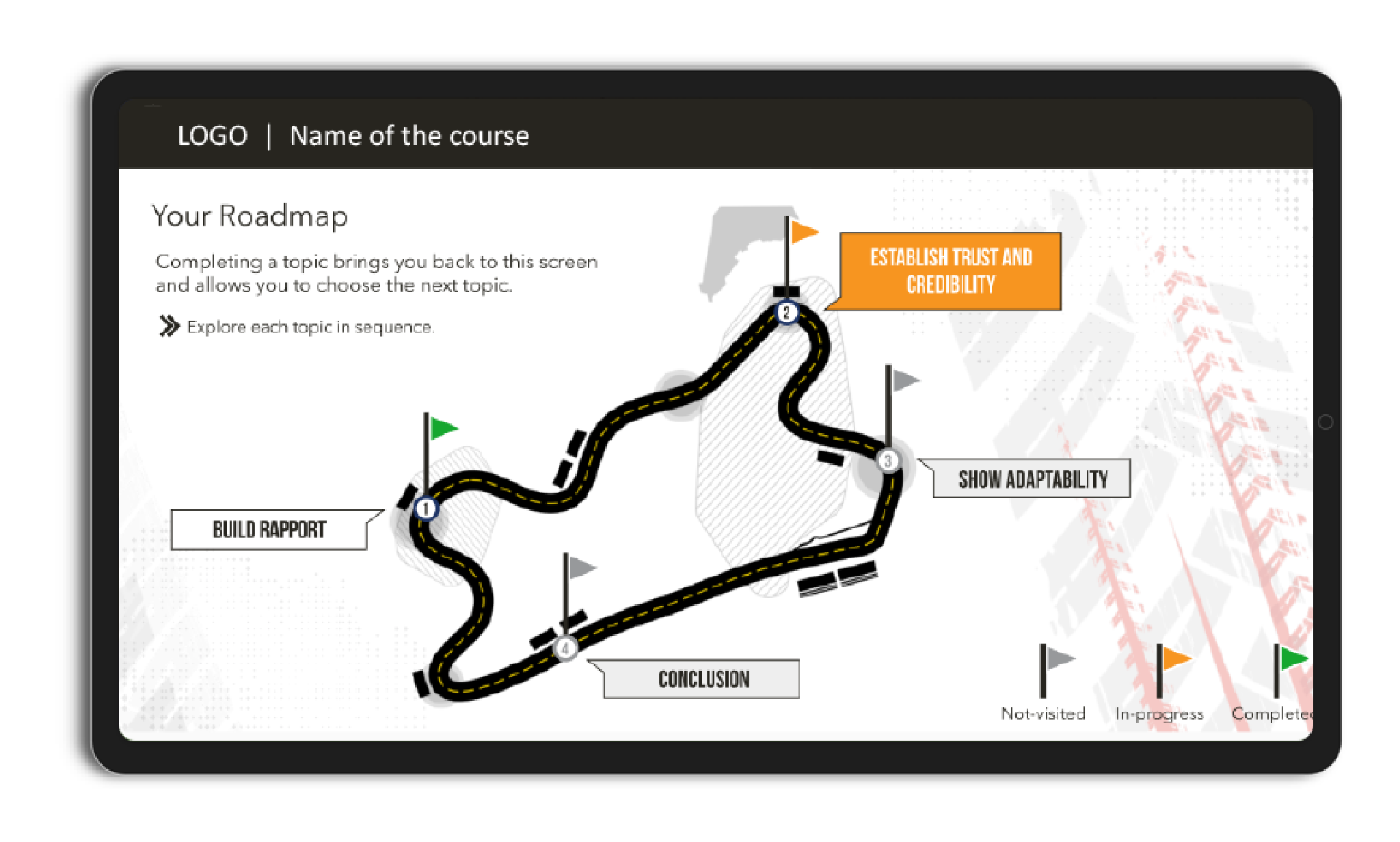
The program is structured as a learning journey presented on a circuit map, with each topic marked as a point on the track. Learners work through build rapport, establish trust and credibility, and show adaptability in sequence, returning to the map after each one to choose the next. Progress is visible at a glance through the flag markers.
Using a racing circuit as the navigation device is more than decoration for this audience. It signals that the program was built for this club rather than adapted from a generic leadership library, which matters to members who would notice the difference immediately.
A mentor-based approach built on real conversations
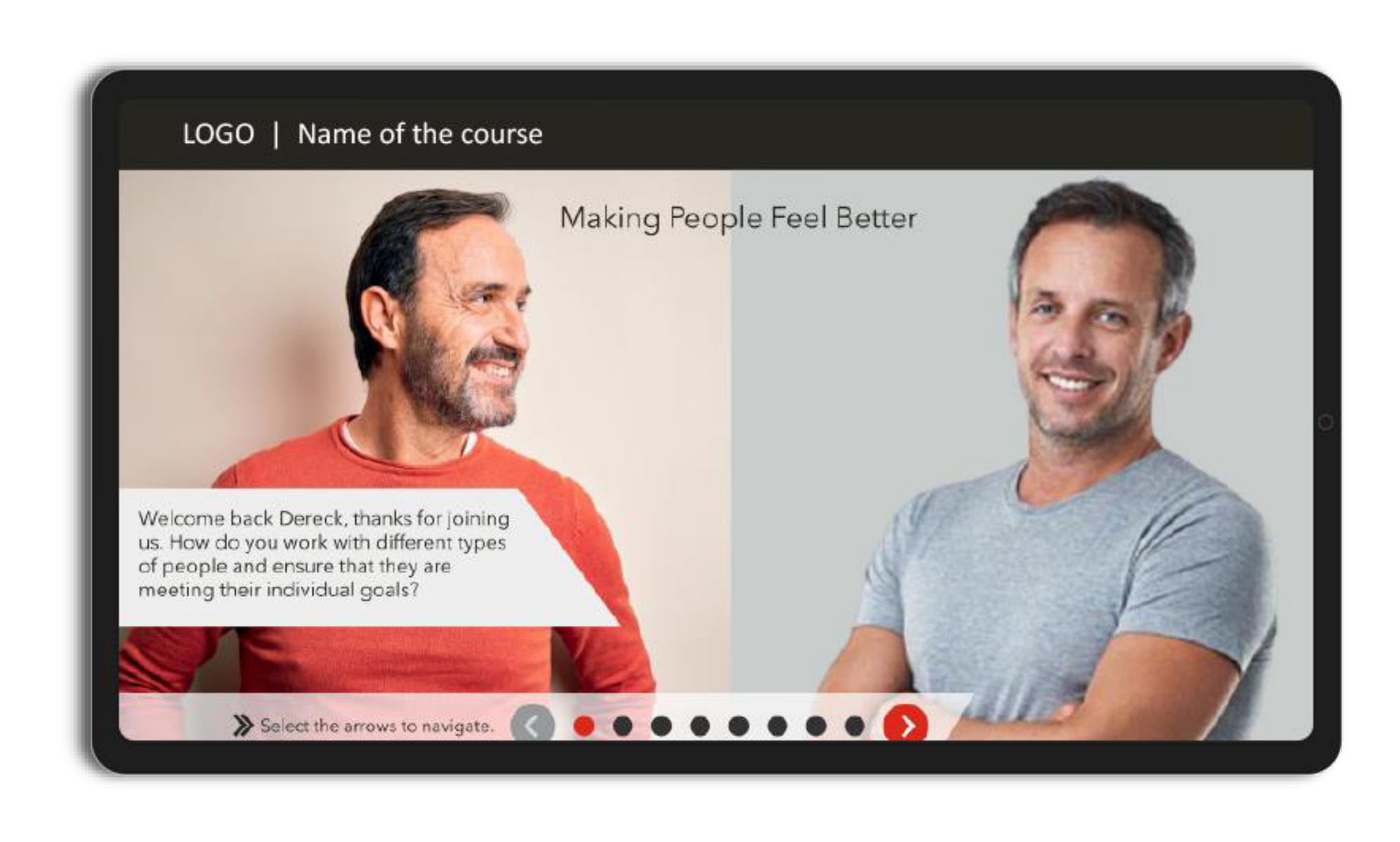
A mentor-based approach paired with real-life scenarios became the primary strategy for driving behavioral change. Learners sit in on conversations with experienced figures who are asked the questions the learner would want answered, such as how to work with different types of people while making sure each of them is meeting their individual goals.
Scenarios that begin with self-observation
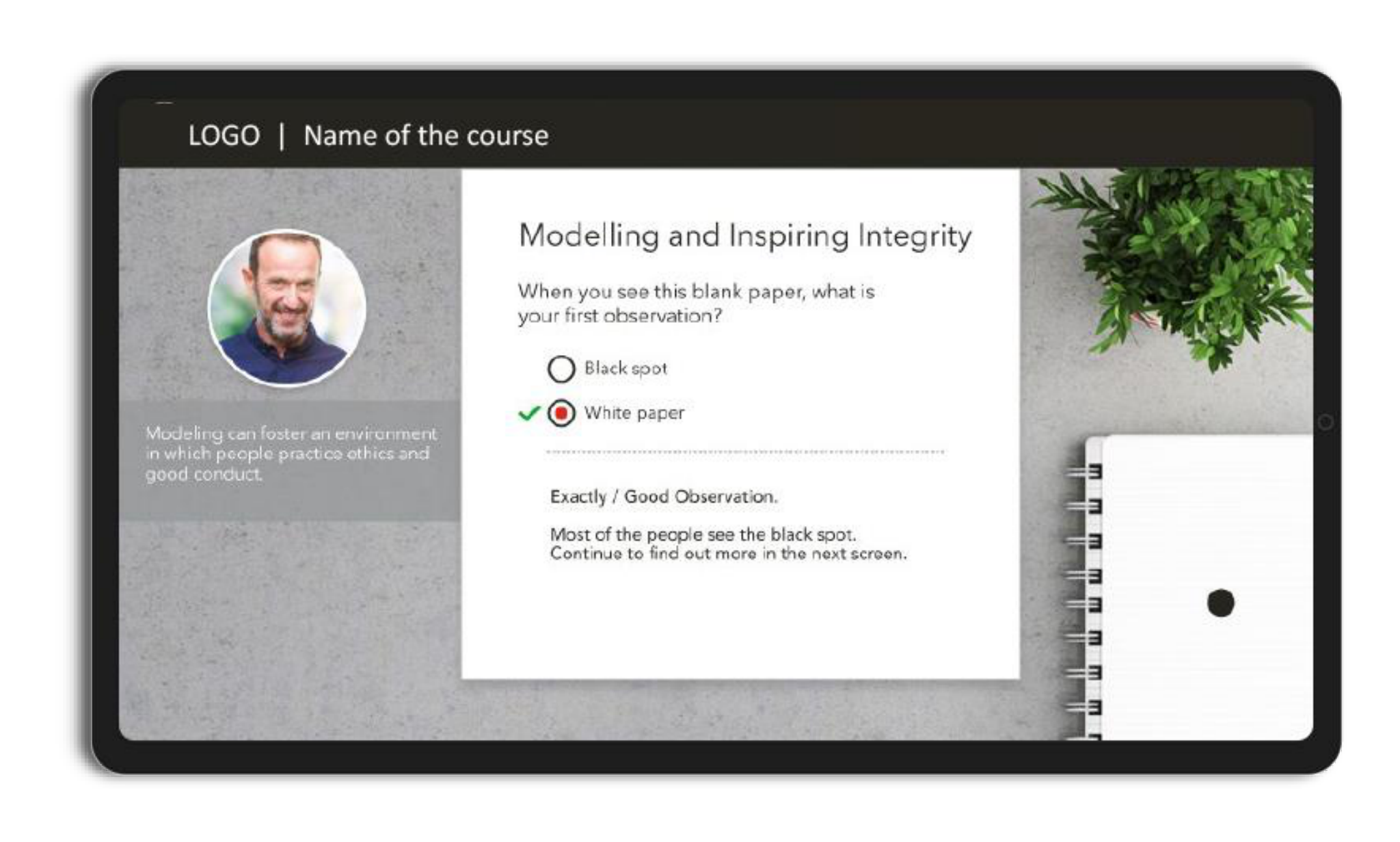
The program repeatedly asks learners to notice something about themselves before it teaches them anything. One exercise on modeling integrity shows a sheet of paper with a single black spot and asks what the learner sees first. Most people report the spot rather than the page, which opens the discussion about how leaders shape the environment around them by what they choose to focus on.
Performance support and social learning
Performance support tools were built in so that the material remains available when a leader is actually running an event or handling a situation in their region. Social learning runs alongside, which suits an organization whose leaders are already part of a community and are used to learning from one another.
The Strategies Behind the Design
Six strategies power the solution.
- Scenario Based Learning
- Learning Journey
- Performance Support Tools
- Mentor Driven Learning
- Experiential Learning
- Immersive Learning
Delivery combines mobile learning, microlearning, and personalized learning through the club LMS and LXP, so that volunteer leaders can work through the material in short passes around their existing commitments.
The Impact
Leaders acknowledged an increased awareness of what effective leadership qualities look like and of the need to build them. For an audience that had stepped into these roles without formal preparation, recognizing the gap is the necessary first move.
In follow-up feedback, stakeholders confirmed that they were able to meet the club mission, vision, and values effectively.
Club reports also indicated increased membership alongside improvements in satisfaction and in likelihood to recommend the club to others. This is the outcome that carries the most weight, because membership and recommendation are the measures a club is ultimately run on, and they sit several steps downstream from a leadership course.
Build Leadership Training People Want to Complete
Leadership training for volunteer and member-led organizations has to work without the leverage that employment provides, which makes tone as important as content. This program succeeded by treating its leaders as capable people worth investing in, structuring the journey around something they recognized, and giving them tools they could use at the next event rather than notes they would file away. If you are building leadership training for an audience that cannot simply be told to take it, Liberate can help. Get in touch to talk it through.

subscribing!
Related Case Studies