



.avif)

How a Disaster Management Services Provider Digitized Their Process Training Program into an Interactive eLearning Course


Crisis management training carries an unusual burden. The material has to be absorbed calmly, in advance, by people who will need it during the worst hours of their working lives. It also has to be taught without dramatizing the subject, because the audience includes people who have already lived through incidents of the kind being described.
A global disaster response services provider working in aviation asked our team to move its classroom program online. The organization wanted a seamless learning program that would help both its own employees and its clients plan, train, exercise, and, where necessary, respond to an incident.
The Challenge
The aim was to digitize the classroom training into an engaging learning experience, and the difficulty sat in the nature of the content itself. The material was dry in places and sensitive in others, which are two problems that pull against each other. Dry content invites lighter treatment to hold attention, while sensitive content demands restraint.
The program also had to reach international clients, which meant the digitized version had to work for audiences the original classroom sessions had never been designed to serve.
How the Solution Was Built
Our primary goal was to design a seamless digitized program that would generate an instant connection with learners. The approach had to do two things at once. It had to help learners understand a sensitive subject, and it had to help them remember the principles of aviation crisis management well enough to act on them later.
Principles broken into learning nuggets
We worked alongside the client subject matter experts to shape the relevant principles into small learning nuggets, which is what made effective microlearning possible rather than simply shorter modules. On crisis content, the size of each unit matters for a specific reason. A learner who needs to revisit one principle should not have to work through an entire session to reach it.
A structured learning journey
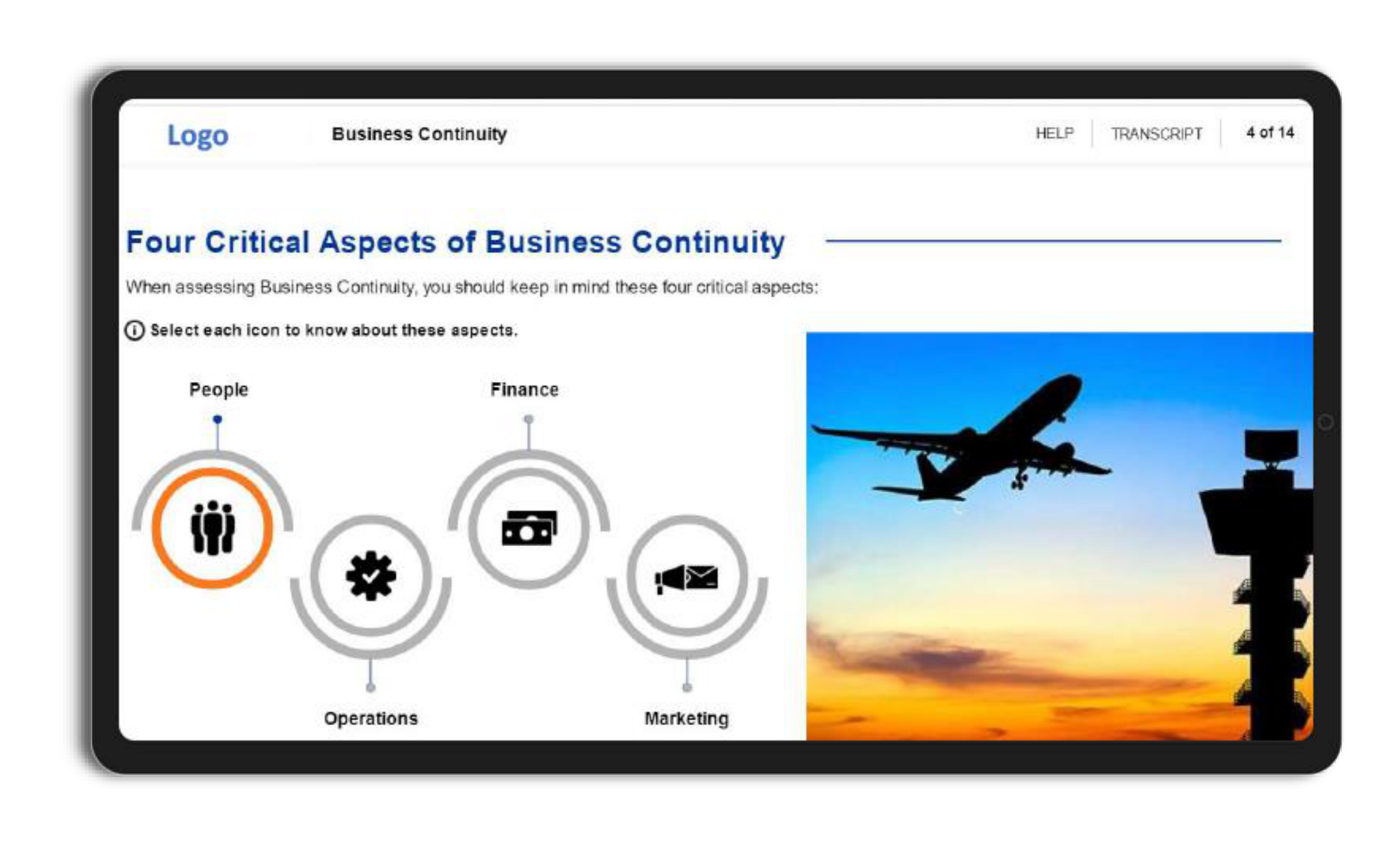
The content is organized as a learning journey that moves through the assessment framework in sequence. Learners meet the four critical aspects of business continuity as a single interactive overview and select each one to work through it in turn, which gives them the full shape of the framework before any individual part of it.
Illustrations that carry sensitive material
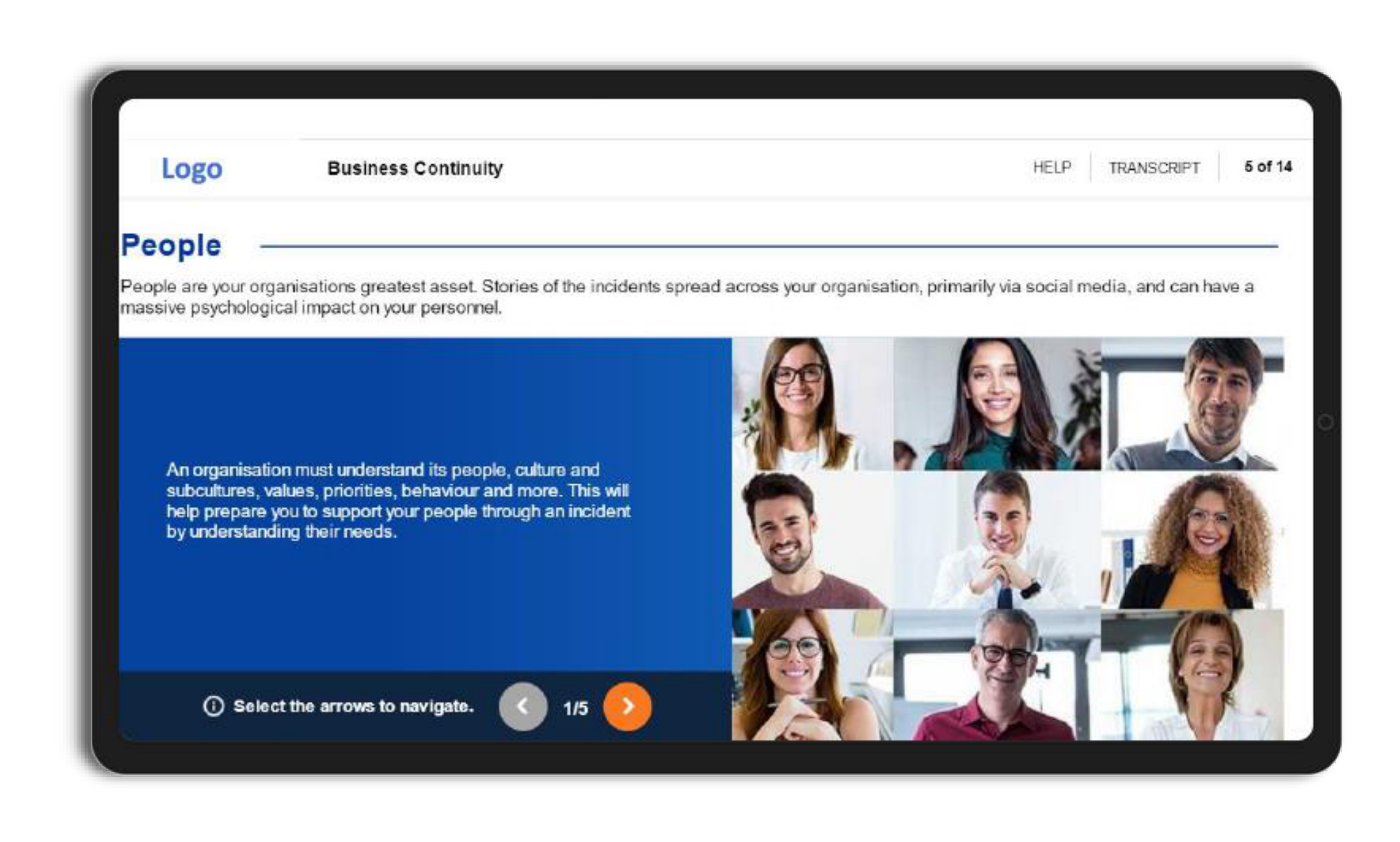
Illustrations and interactive elements are used throughout to present material that would otherwise sit as dense text on screen. The section on people opens by acknowledging the psychological impact an incident has on personnel and how quickly accounts of it spread through an organization, and the design treats that seriously rather than decorating it.
Performance support for the moment it is needed
Performance support tools were built into the program so that the principles remain reachable after the training is complete. In crisis management this is not a supplementary feature. The gap between learning the material and needing it can run to years, and a tool someone can consult under pressure is worth more than anything they half remember from a module.
The Strategies Behind the Design
Four strategies power the solution.
- Microlearning
- Learning Journey
- Performance Support Tools
- Illustrations
Alongside these, the program uses interactive learning and video-based learning, delivered as microlearning through the client LMS so that employees and client teams reach the same program from one place.
The Impact
Learners responded positively to what was, for many of them, a first experience of digital learning. That matters more than it sounds for an audience meeting the format for the first time, since a poor first encounter tends to color everything that follows it.
Learners also demonstrated the values and behaviors covered in the program noticeably better than they had under the previous face-to-face training, which the client attributed to the digitized version being more relatable. Improving on classroom delivery rather than merely matching it is the harder outcome to achieve, and it is the one this project reached.
Learners came away with a better understanding of the processes and of how to implement them in real situations, and the goal of establishing the importance of compliance with the process was achieved.
Move Sensitive Training Online Without Losing Its Weight
Digitizing classroom training gets harder as the subject gets more serious, because the techniques that keep people engaged can easily undercut material that needs to be treated carefully. This program worked by breaking the principles into pieces learners could return to, giving them a clear route through the framework, and leaving them with support tools for the moment the training is actually needed. If you have sensitive or high-stakes content to move online, Liberate can help you design it. Get in touch to talk it through.

subscribing!
Related Case Studies