



.avif)

Improving the Customer Service and Service Quality of a Large Cinema House with Microlearning


Frontline service work is made up of small procedures that have to be performed correctly every time, in front of a customer, usually at speed. Counting back change, handling a complaint, explaining a concession offer. Nobody remembers a transaction that goes smoothly, and everybody remembers one that does not, which is why consistency matters more in this kind of role than depth of knowledge does.
A large cinema house asked our team to train all of its frontline customer service associates on the various aspects of the services the company offered. The aim was accurate knowledge and awareness across the whole population so that customer service was consistent and high quality, which the business treated as a key mandate rather than a training initiative.
The Challenge
The scale of the curriculum was the first difficulty. More than 22 learning modules were needed to cover the services in question, which is a large body of content for an audience that works shifts and cannot be taken off the floor for long.
The audience was the second. Associates sat at different levels of the organization and came with varied backgrounds and cognition levels, so a single treatment of the material would have been too basic for some and too demanding for others. Building 22 modules that worked for all of them at once was the tall part of the ask.
How the Solution Was Built
Our primary design focused on two aspects, the curriculum and the audience, and the solution followed from treating them as one problem rather than two. We crafted a microlearning path with just-in-time assets for the different audience categories, and adjusted the complexity levels according to the roles people held.
One path, calibrated by role
Breaking a large curriculum into microlearning pieces makes it schedulable, which is the practical requirement for shift-based staff. Calibrating the complexity by role is what makes the same path usable across an audience that varies as widely as this one did. An associate who has been on the floor for years and a new starter can work through the same topic without either of them being handed content pitched at the other.
Activities that ask for the actual task
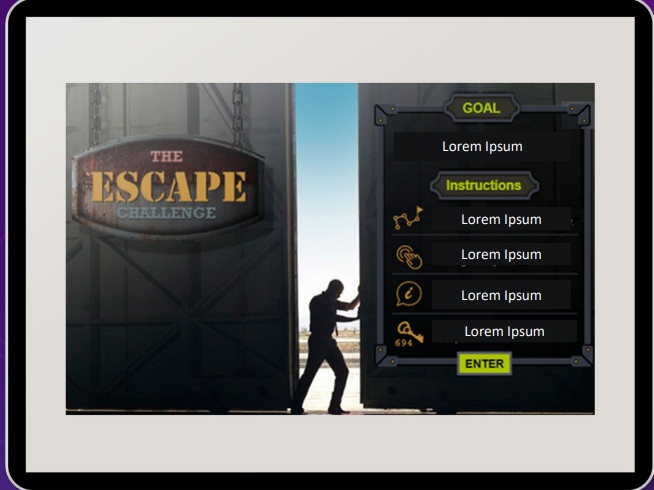
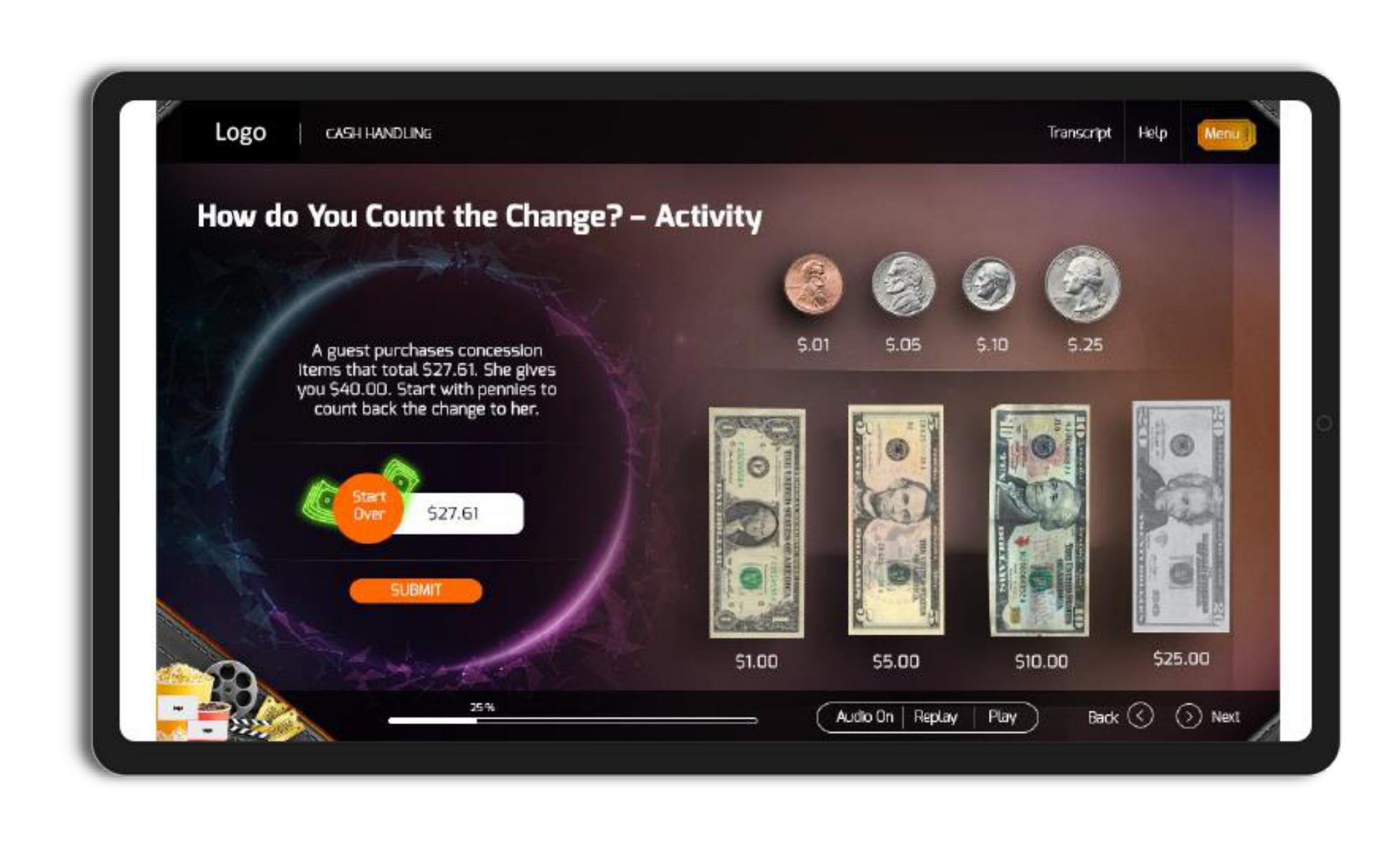
Unique simulated activities were built to map real-life solutions rather than to test recall. In the cash handling module, the learner is given a scenario where a guest pays forty dollars for concession items totaling twenty seven dollars and sixty one cents, and is asked to count the change back starting with pennies. The denominations sit on screen and the learner assembles the amount, with a running total and the option to start over.
Asking the learner to perform the task rather than choose the right answer from a list is what makes an activity like this worth building. Counting change back correctly is a physical sequence, and practicing the sequence is closer to the job than knowing the total would be.
Summaries that walk back through the decision
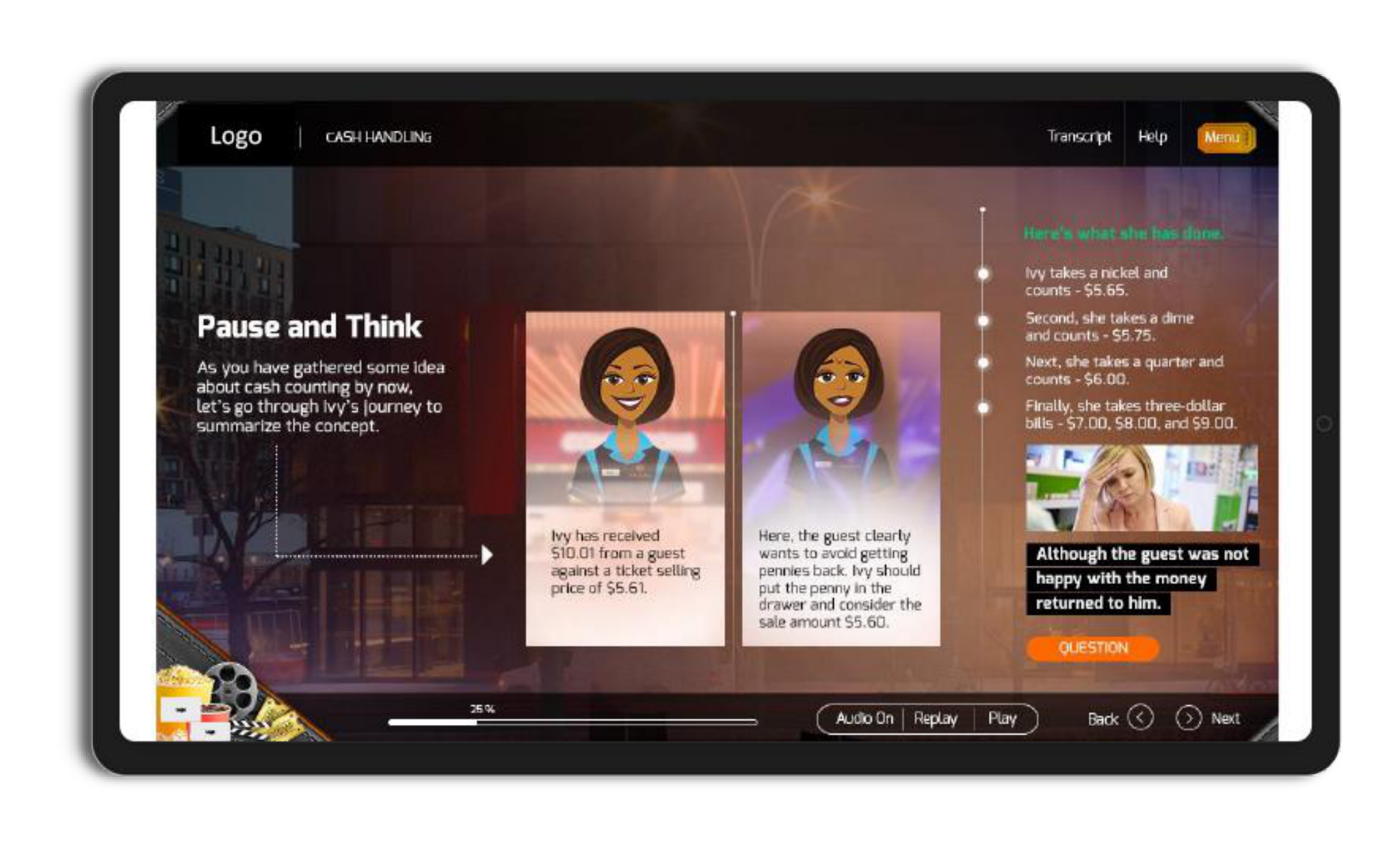
The modules pause at intervals to consolidate what has been covered. In one of these, the learner follows an associate named Ivy through a transaction step by step, seeing what she received, the judgment she made about a stray penny, and the order in which she counted the change back. A note alongside acknowledges that the guest was not entirely happy with how the money was returned, which is a more useful thing to show than a clean outcome would be.
Story based learning carries these sections, so the summary arrives as a colleague explaining what she did rather than as a list of points to review.
Personalization, theme, and material to keep
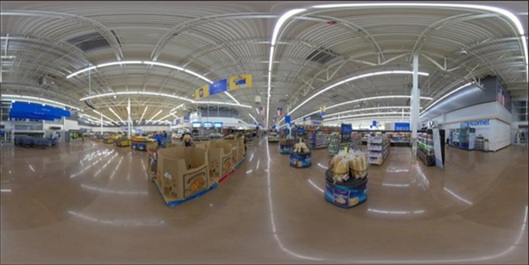
A relatable set of avatars provided the personalization, and a thematic visual design carried the cinema setting through the interface, with popcorn, film reels, and marquee lighting placed so that the training looked like the workplace it was written for. Downloadable cheat sheets and checklists gave associates something to keep after the module ended, which is what performance support means for a role where the task happens at a counter rather than at a desk.
The Strategies Behind the Design
Six strategies power the solution.
- Microlearning
- Simulated Activities
- Interactive Learning
- Personalized Learning
- Just-in-time Learning
- Immersive Learning
Scenario based learning, story based learning, and performance support tools sit behind these, and delivery combined microlearning, personalized learning, and mobile learning served through the client LMS and LXP.
The Impact
The post-training survey indicated seamless learning and implementation across the various associate hierarchies, which speaks directly to the calibration decision. The concern with a role-adjusted path is that it works well for one group and poorly for another, and the feedback suggests it held across levels.
Customer satisfaction scores increased following training completion as a result of the improved services. That is the outcome the business asked for at the outset, and it is the one that matters most here, since customer satisfaction in a cinema is measured on the same counters where the training is applied.
Higher and better completion rates were also recorded, which for a curriculum of more than 22 modules delivered to shift workers is a meaningful result on its own.
Train Frontline Teams Without Taking Them Off the Floor
Large service curricula fail on delivery more often than on content. This one worked because the material was broken into pieces that fit around a shift, calibrated so that associates at every level got something pitched for them, and built around activities that asked people to do the task rather than describe it. If you need to train a frontline team at scale without pulling them away from customers, Liberate can help you design it. Get in touch to talk it through.

subscribing!
Related Case Studies