




.avif)

Solving the Learner Engagement Challenge in Compliance Training with Personalization and Scenario Based Learning


Compliance training content is often dry and prescriptive, which is exactly why it tends to be boring. The material is written to be precise rather than readable, and a course that follows it closely inherits both qualities. Learners get through it, and very little of it stays with them.
A market frontrunner in the tobacco sector came to our team with that problem in a more pointed form than usual. Employees needed to comply with the legal and documentation aspects of the business, and previous training on the subject had failed to deliver the results the company wanted. They were anxious to make it happen this time, which set a clear bar for the redesign.
The Challenge
A program that has already failed once is harder to fix than a program that has never been attempted. The audience arrives with an expectation formed by the earlier version, so the new course has to earn attention that the subject would otherwise be given automatically.
The content itself also resists simplification. Legal and documentation obligations are precise by nature, and anything that softens them to make them easier to read risks changing what employees are actually being told to do. The engagement problem had to be solved without loosening the accuracy of the material.
How the Solution Was Built
To involve learners from the very outset and make the training relevant, our team used derivative scenario based learning. The learner is drawn into a situation replicating a real-life scenario first, and then learns the concepts from inside that situation rather than being given the concepts and asked to apply them afterward.
The situation comes before the rule
That ordering is the whole design. When a rule is presented first, the learner has nowhere to put it and reads it as an instruction to remember. When the situation comes first, the learner has already formed a view about what should happen, and the rule arrives as an answer to a question they are holding rather than as a statement to file away.
The course opens on the topic in the workplace and tells learners it will be explored through real-life examples, with the two characters who carry the scenarios already on screen. Setting that expectation on the first screen matters for an audience who have been through a version of this before.

Characters the learner gets to know first
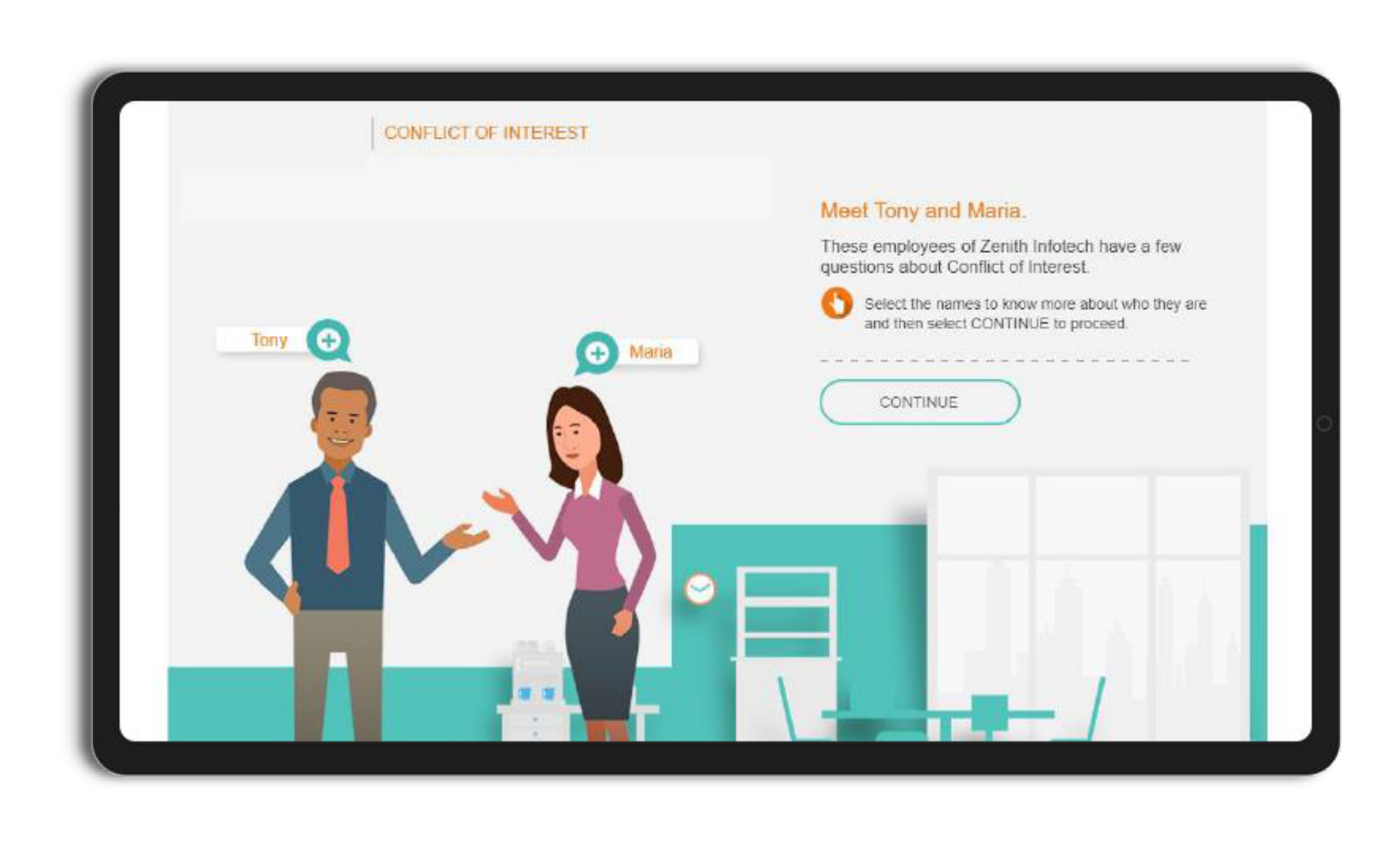
The learner meets two employees of the fictional organization used throughout the program and is invited to select their names to find out who they are before continuing. Spending a screen on who these people are, rather than moving straight to the first decision, is what allows the later situations to read as something happening to someone the learner recognizes.
The character interactions were woven carefully around the specific compliance aspects the training covers, so the conversations carry the content rather than decorating it. Information highlights sit alongside them for the points that need to be stated precisely.
Personalization and an active role in the decisions
Learners select an avatar and then play an active role in decision making related to legal hold notices, which is where the compliance obligation becomes a choice with consequences rather than a procedure to acknowledge. Giving the learner the decision is the mechanism that turns a documentation requirement into something they have practiced.
Design that carries a serious subject
The illustration and minimalist design approach provided the visual appeal the material needed, even though the underlying concept is a serious one. Restraint is the right instinct here, since a heavily decorated treatment of a legal obligation undercuts the seriousness of what is being taught, while a plain one loses the audience before the first scenario.
A post-training survey was embedded directly in the course to capture immediate learner feedback. Collecting reactions at the moment of completion rather than through a separate follow-up is what produced the response data this program was ultimately judged on.
The Strategies Behind the Design
Five strategies power the solution.
- Scenario Based Learning
- Personalized Learning
- Action-Oriented Learning
- Interactive Decision-Making
- mLearning
Story based learning and performance support tools sit alongside these, and delivery combined personalized learning and mobile learning served through the client LMS and LXP.
The Impact
Learner feedback captured at the end of the training indicated extreme engagement, and the scenario based approach was credited directly for it. Because the survey ran inside the course, that response came from people who had just finished rather than from a sample who chose to reply later.
The use of innovative formats and active participation allowed learners to achieve the learning objectives the training set out to meet, which is the point that separates an engaging course from an effective one.
The organization also saw higher participation and completion rates compared with the previous trainings on the same subject. That comparison is the most useful result in the case study, since it measures the redesign against the earlier version rather than against a general benchmark, and participation was the specific thing the company had failed to secure the first time.
Fix Compliance Training That Has Already Failed Once
A compliance program that did not work the first time needs a different design rather than a refresh of the same one. This one succeeded by putting learners inside the situation before explaining the rule, giving them characters to follow and decisions to make, and keeping the visual treatment restrained enough to respect the subject. If you have a compliance course that people complete without absorbing, Liberate can help you rebuild it. Get in touch to talk it through.

subscribing!
Related Case Studies