



.avif)

12 Cutting-Edge Approaches to Learning Evaluation Methods


Summary
Moving beyond "smile sheets" and completion rates, modern learning evaluation uses frameworks like Kirkpatrick’s 4 Levels and AI-driven analytics to link training directly to business KPIs.
Many corporate L&D leaders struggle to move beyond basic metrics like course completion rates or satisfaction scores. It’s crucial that learning programs genuinely enhance employee productivity, drive business performance, and contribute to the organization’s bottom line.
By understanding the modern, data-driven approaches, organizations can unfold actionable insights and ensure their L&D initiatives are fully aligned with business goals.
In this blog, you’ll explore twelve cutting-edge approaches to learning evaluation that help you make informed decisions, optimize learning strategies, and show the true ROI of L&D programs.
Key Takeaways:
- Frameworks like Kirkpatrick’s 4 Levels, Phillips' ROI Methodology, and the CIRO Model help assess training effectiveness and link learning outcomes to business goals.
- AI-driven platforms, gamification, and real-world simulations provide real-time insights and actionable data for continuous improvement.
- Connecting L&D programs to organizational KPIs such as productivity, retention, and customer satisfaction ensures measurable business impact and justifies ROI.
- Employee surveys and 360-degree assessments refine programs to keep them relevant, engaging, and aligned with evolving business needs.
- AI-powered personalization tailors training to individual employee needs, improving engagement and skill development outcomes.
A Quick Overview of Learning Evaluation & Why It Matters
Learning evaluation helps organizations measure how effectively training programs achieve their goals. It examines whether employees gain new knowledge, apply it on the job, and contribute to tangible business results.
For L&D teams and HR leaders, it goes beyond simply tracking course completion or satisfaction scores. The focus is on understanding how learning improves performance, productivity, quality, and talent growth.
Here are the key reasons why learning evaluation is crucial for bringing real organizational impact.
1. Identifies Skill and Performance Gaps
Standard training programs can overlook the skills employees actually need, limiting role-based improvements and wasting resources. Structured evaluation highlights which skills are improving and which are underdeveloped. It helps guide targeted interventions and ensures future programs address real business needs.
2. Improves Learner Engagement and Retention
Employees disengage when training feels generic or irrelevant. Evaluation tracks engagement levels, content effectiveness, and learning preferences, giving L&D teams the insights to refine course design. It enhances delivery and motivates employees to apply their learning on the job.
EI enhances learning effectiveness through a unique measurement framework that scientifically evaluates courses and learner performance. This framework predicts learning outcomes, identifies factors affecting learnability, and provides actionable insights to improve course design, retention, and learner engagement.
3. Allows Continuous Program Improvement
Many training programs remain unchanged even when they no longer meet business goals. Regular evaluation acts as a feedback loop, identifying what works and what needs updating. This ensures learning content and delivery evolve continuously, keeping programs relevant, effective, and aligned with organizational priorities.
Recognizing why learning evaluation matters helps us see how modern approaches can make it more impactful.
Top Cutting-Edge Approaches to Learning Evaluation
Learning evaluation has moved beyond simply tracking participation. For corporate L&D leaders, the focus isn’t just on who completed a course, but on how learning improves productivity, retention, and overall business results.
Below are 12 cutting-edge approaches to learning evaluation, helping organizations make informed decisions, improve programs, and show measurable ROI.

1. Kirkpatrick’s Four Levels of Evaluation
This model is still the cornerstone of modern learning evaluation. It examines programs across four stages: Reaction, Learning, Behavior, and Results. This provides L&D teams with a full picture of how employees respond to training, what they learn, and how they apply it on the job to deliver real business impact.
Key features include:
- Flexible approach for leadership, compliance, and skills training.
- Clear link between learning activities and workplace performance improvements.
- Helps identify which stages deliver ROI and where training can be improved.
2. Phillips ROI Methodology
Building on Kirkpatrick’s model, the Phillips Method adds a fifth stage, Return on Investment, showing the financial impact of learning initiatives. It helps executives and HR leaders justify training budgets with clear evidence of productivity and profitability gains. This turns L&D into a measurable business contributor rather than just a cost.
Key features include:
- Supports decision-making with evidence-based budget planning.
- Captures both tangible (sales, efficiency) and intangible (morale, retention) benefits.
- Shows how learning investments tie directly to long-term business performance.
3. CIRO Model (Context, Input, Reaction, Outcome)
The CIRO model evaluates training before, during, and after it happens, ensuring programs meet real business needs. It looks at organizational context, resources used, learner reactions, and final outcomes, creating a continuous evaluation process rather than a one-off check.
Key features include:
- Measures training design quality, engagement, and performance after learning.
- Encourages proactive planning instead of reactive assessment.
- Aligns learning interventions with long-term strategic objectives.
4. CIPP Model (Context, Input, Process, Product)
The CIPP model examines every stage of a training program, from planning to outcomes, ensuring that learning design aligns with business needs. It helps L&D leaders check if resources, delivery, and results meet expectations. Focused on continuous improvement, this approach is beneficial for effective, enterprise-wide learning programs.
Key features include:
- Four-phase evaluation covering program needs, resources, delivery quality, and outcomes.
- Encourages ongoing assessment throughout the learning lifecycle.
- Suitable for large-scale, multi-phase training rollouts.
5. Kaufman’s Five Levels of Evaluation
Kaufman’s framework builds on Kirkpatrick by distinguishing between individual, organizational, and societal impacts. It measures how learning benefits both employees and the broader business ecosystem, helping managers link skill development to wider organizational and social results.
Key features include:
- Five levels: input, process, micro results (individual), macro results (organizational), and societal impact.
- Balances internal skill growth with external stakeholder value.
- Supports sustainability-focused or community-oriented organizations.
6. Brinkerhoff’s Success Case Method
This method studies the most and least successful training cases to identify what brings strong results. By combining quantitative and qualitative analysis, L&D teams can focus on evidence-based improvements rather than relying on assumptions.
Key features include:
- Highlights factors behind high-impact training results.
- Identifies obstacles that prevent knowledge application.
- Supports focused optimization of program design and delivery.
7. Pre- and Post-Training Assessments
Comparing learner performance before and after training provides clear evidence of skill improvement. It sets a baseline and validates whether learning delivers the intended results, giving measurable insight into knowledge retention and application.
Key features include:
- Establishes data-driven benchmarks for training effectiveness.
- Tracks progress across teams or departments.
- Simplifies reporting for compliance and leadership reviews.
8. Observation-Based Evaluation
Observation evaluates employees in real work settings to see how well they apply training on the job. It provides qualitative insights that surveys may miss and helps leaders identify areas for ongoing coaching.
Key features include:
- Direct, behavior-based performance evaluation.
- Ideal for customer-facing, practical, or safety-critical roles.
- Involves managers or trainers as observers for objective assessment.
9. Surveys and Feedback Forms
Surveys capture learner reactions, satisfaction, and perceived usefulness immediately after training. When designed well, they provide actionable insights into engagement and content relevance.
Key features include:
- Collects qualitative and quantitative learner feedback.
- Identifies gaps in content clarity, pacing, or delivery.
- Supports continuous improvement through recurring evaluation cycles.
10. Case Studies and Simulations
Case studies and simulations test how learners handle real-world challenges in controlled environments. They evaluate decision-making, problem-solving, and skill application under realistic conditions, making them ideal for leadership, sales, or compliance training.
Key features include:
- Measures readiness to apply knowledge under pressure.
- Offers immediate, actionable feedback.
- Builds confidence through experiential learning.
11. 360-Degree Feedback
This method gathers input from peers, supervisors, and direct reports to assess post-training performance and behavior change. It gives a well-rounded view of how learning affects workplace relationships and outcomes.
Key features include:
- Evaluates both interpersonal and role-specific skills.
- Tracks progress over time for leadership programs.
- Supports data-driven succession and promotion decisions.
12. Comparative Analysis
Comparing trained and untrained groups helps isolate the true impact of learning programs. It shows performance differences that result directly from training, helping leaders make informed decisions about resource allocation and scaling programs.
Key features include:
- Uses control and test groups for accurate impact measurement.
- Ideal for high-investment or pilot programs.
- Informs strategic decisions on scaling or refining initiatives.
These cutting-edge approaches set the foundation for exploring how gamification and simulation can make learning evaluation more engaging and effective.
Suggested Read: How to Design Strategic Learning Initiatives That Deliver Results
Using Gamification and Simulation in Learning Evaluation
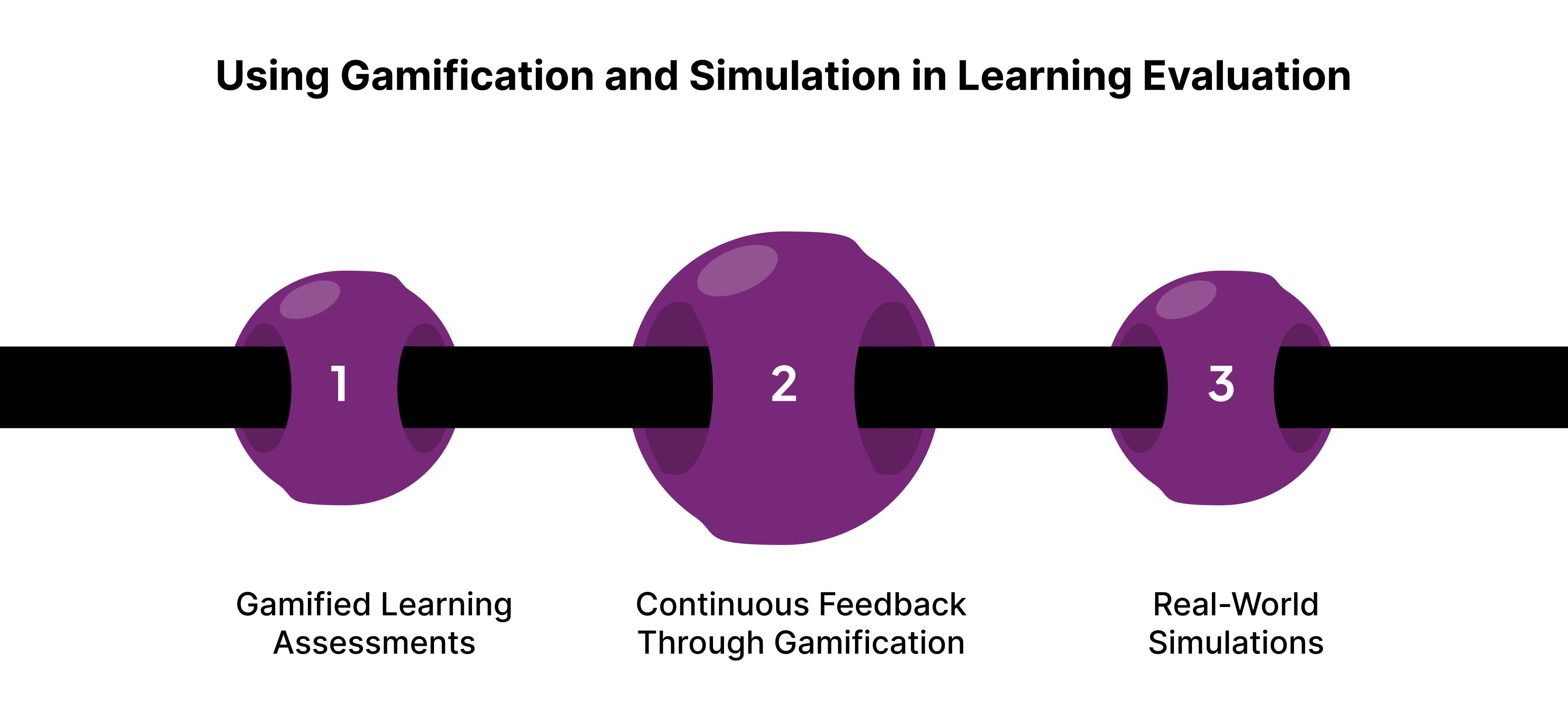
Gamification and simulation are powerful tools that make learning more engaging, providing L&D teams with clear insights into how employees apply their skills. They increase motivation and provide real-time data on knowledge retention and practical application. Here’s how they’re used in learning evaluation:
1. Gamified Learning Assessments
Gamified assessments utilize game elements, such as points, badges, and leaderboards, to make learning more engaging and enjoyable. This approach motivates learners to participate actively while allowing L&D teams to track progress in real-time. Gamification increases engagement while ensuring that learning objectives are met effectively.
EI enhances eLearning engagement through gamification by utilizing game principles such as points, badges, leaderboards, and challenges. These elements make learning interactive, motivate employees to complete courses, and help reinforce key concepts in a fun, memorable way.
Check Demo: Examples of Gamification in eLearning
2. Continuous Feedback Through Gamification
Gamification also allows for continuous feedback by tracking points, levels, and achievements. L&D teams can use this data to monitor engagement and effectiveness throughout the training process, adjusting content and addressing challenges as needed. Real-time feedback ensures learning stays aligned with performance goals.
3. Practical Simulations
Simulations place learners in realistic, job-related scenarios where they must apply their skills to solve problems or make decisions. This hands-on approach enables L&D teams to assess how effectively employees apply training in real-world work situations.
Simulations provide a clear picture of how employees will perform on the job and highlight areas for improvement.
After seeing how gamification and simulation enhance learning, it’s equally important to understand how evaluation ties directly to business goals and KPIs.
Also Read: Impact of Gamification in Corporate Learning and Development
Connecting Learning Evaluation to Business Goals and KPIs
Aligning learning evaluation with business goals and key performance indicators (KPIs) is essential to show the real value of training programs. By measuring how learning outcomes tie to business results, L&D teams can prove that training is a driver of performance and growth. Here’s how to link learning evaluation to business goals:
1. Align Training with Business Objectives
The first step is to make sure training programs directly address the organization’s strategic needs. They should have clear outcomes that reflect business priorities. Evaluation metrics should track how well training supports these goals, ensuring learning efforts stay aligned with company objectives.
2. Identify Relevant KPIs for Learning Programs
L&D teams need KPIs that show both individual and organizational impact. Examples include employee productivity, time-to-competency, retention, and customer satisfaction. By tying these KPIs to learning outcomes, teams can see how training contributes to the broader business strategy and identify areas that need improvement.
3. Track Progress and Measure Impact
Once KPIs are set, progress needs to be tracked consistently. By using Learning Management Systems (LMS) tools, analytics dashboards, and feedback surveys, L&D teams gather data on learner performance.
This data helps determine whether the skills gained through training are translating into measurable results, such as improved efficiency, better customer interactions, or increased revenue. Linking these results to KPIs makes it easier to show the ROI of training programs.
Seeing how learning evaluation connects to business goals makes it easier to implement these methods effectively.
Simple Tips to Apply Cutting-Edge Learning Evaluation Methods
Applying cutting-edge learning evaluation methods doesn’t have to be complicated. By focusing on simple, practical approaches, L&D teams can measure training impact more accurately, identify skill gaps, and continuously improve programs.

1. Create Personalized Learning Paths
Utilize AI-powered platforms to create personalized learning paths tailored to each employee’s skills and job requirements. Personalization keeps training relevant, enhances engagement, and accelerates skill development.
2. Make the Most of Data and Feedback to Improve Learning
Combine analytics with learner feedback to spot patterns and refine programs. Adjust content, pacing, and delivery for better engagement and results. Act on feedback regularly and track key metrics to ensure training continues to improve and aligns with evolving business goals.
3. Use Peer Assessments and Collaborative Learning
Encourage peer assessments to see how employees apply skills in team settings. Collect feedback on collaboration and problem-solving. This builds a social learning culture and strengthens development. Utilize peer feedback trends to identify leadership potential and areas that require additional support.
4. Use Mobile Learning to Track Continuous Development
Enable mobile learning so employees can access training at any time and from anywhere. Track engagement and performance to support ongoing development. Mobile learning adds flexibility while helping L&D teams monitor consistent progress. Use mobile analytics to spot behavior trends and adjust content for maximum engagement.
Must Read: Building Successful Corporate Learning Strategies: Essential Components and Examples
EI Making Learning Evaluation Smarter
Many organizations struggle to develop L&D programs that deliver measurable outcomes and align with strategic goals. Without a strong learning evaluation system, it’s challenging to determine whether training is truly improving performance or creating tangible business impact.
At EI, we specialize in advanced learning evaluation methods that provide actionable insights beyond traditional metrics. Our data-driven approach enables organizations to measure the effectiveness of learning initiatives, ensuring they contribute directly to employee development and organizational success.
Key features of EI’s learning evaluation solutions include:
- Custom Evaluation Metrics that align learning outcomes with business objectives, allowing you to measure the direct impact of training on performance and productivity.
- Continuous Feedback Integration that monitors learner progress in real time and creates ongoing opportunities for program improvement.
- Performance Support Tools that help employees apply new skills in real time, supporting continuous learning.
- Gamification with points, badges, and challenges that keep learners engaged and motivated, making training more interactive and enjoyable.
- Scenario-Based Learning places employees in real-world situations, helping them make better, more informed decisions under pressure.
- Advanced Analytics that track learning outcomes, measure ROI, and refine L&D strategies using data-driven insights.
- Mobile-First Design that allows smooth access anytime, anywhere, even offline, making it ideal for hybrid and frontline teams.
With a focus on continuous improvement and data-backed insights, EI helps organizations enhance their L&D programs, show the ROI of training, and ensure every learning initiative delivers measurable business value.
Final Thoughts
Effective cutting-edge approaches to learning evaluation are essential to ensure that L&D programs drive measurable business results. By using advanced evaluation techniques, L&D leaders gain clear insights into how learning affects employee performance, productivity, and overall organizational outcomes.
These insights optimize training effectiveness and highlight the real value of L&D investments to stakeholders. At EI, we specialize in modern learning evaluation approaches that go beyond traditional metrics, ensuring your training programs deliver measurable impact.
With a focus on continuous improvement, we help organizations assess the true effectiveness of their learning initiatives. Ready to transform your L&D strategy into a data-driven, performance-enhancing engine and unfold the full potential of your L&D initiatives?
FAQs
Q1. How can L&D teams use learning analytics to improve training programs?
A1. Learning analytics helps L&D teams track employee progress, spot skill gaps, and see how training impacts performance. By analyzing data like completion rates, engagement levels, and quiz scores, L&D leaders can fine-tune content and delivery methods.
Q2. What role does employee feedback play in refining L&D programs?
A2. Employee feedback provides crucial insights into the learning experience. It shows what content is engaging, what might be confusing, and which areas need improvement. Regular surveys and feedback forms enable L&D teams to refine training programs, ensuring they remain relevant, effective, and engaging.
Q3. Can learning evaluation methods be applied to soft skills training?
A3. Yes, learning evaluation methods can be applied to soft skills like communication, leadership, and emotional intelligence. Tools like feedback surveys, 360-degree assessments, and observational evaluations help L&D teams track behavioral changes.
Q4. How do pre- and post-training assessments measure learning effectiveness?
A4. Pre- and post-training assessments give a clear picture of knowledge and skill growth. By comparing results from before and after training, L&D teams can determine whether learning objectives were met. They identify areas that require further focus and gather concrete data on skill retention and application in the workplace.
Q5. How can peer assessments support learning evaluation?
A5. Peer assessments let employees give feedback on each other’s performance, encouraging collaboration and continuous improvement. Incorporating peer evaluations helps L&D teams see how well skills are applied in team settings, providing deeper insights and a more complete view of learning outcomes.

subscribing!
Related articles


.jpg)
.jpg)




.jpg)