



.avif)

How to Build a Learning and Performance Ecosystem


Organizational growth is optimized when employees learn and grow, driving creativity and innovation. Vital to continuous development is a healthy learning ecosystem. This article outlines key issues to consider while fostering a learning ecosystem.
What Is a Learning Ecosystem?
A learning ecosystem is an environment in which all of the elements work together as a complete network to encourage and support individual development within an organization. More than just another training, it combines technology with people and processes to build a learning ecosystem. It is a non-traditional LMS platform that fosters a decentralized, peer-led way of learning where the focus is on employees as they work and are bolstered through collaboration with their peers. The concept is to help learners in acquiring the necessary skills to be able to drive (self-directed learning) their own career development. So, how they can and should be in control of their personal growth as well as leveraging networks for support.
What Are the Key Components of a Learning Ecosystem?
A learning ecosystem is essentially defined by interdependent organizational modes such as those represented within formal training programs, informal learning possibilities to build upon learning for employees, mentoring initiatives, and performance support systems. Together they form a harmonious amalgam that supports continuous learning for individual growth and performance improvement.
As well-organized pathways for personal growth, learning journeys are indispensable components of the larger organizational learning ecosystem. By integrating learning journeys, organizations may provide a culture of continuous improvement, personalize learning experiences, and link training programs with strategic objectives.
Why Should You Invest in a Learning Ecosystem?
People truly learn when they’re ready to accept new information. Training should solve immediate problems for employees when they’re most receptive.
A highly functional learning ecosystem provides the support employees need, when they need it.
L&D leaders have the unique opportunity to drive organizational learning in a way that supports employee efforts, feeds into enterprise goals and initiatives, and drives organizational growth.
Organizations with a healthy Learning and Performance Ecosystem are:
- More creative and innovative. Employees are better able to think outside their day-to-day norms, identifying creative solutions to old and new problems alike. High-potential employees who love to learn are an organization’s most valuable asset. In the 21st century, the most important attribute in an employee is their desire and ability to learn. The speed of change in business is not slowing down. In fact, it is only going to accelerate. Those employees and organizations who learn will adapt and thrive and those who don’t, will quickly fall behind.
- More collaborative. As employees participate in learning opportunities, either formal or informal, they understand more about how their role intersects, overlaps, and depends on others in the organization. They’re more likely to reach out and collaborate with those in other departments, breaking down silo walls.
- Better at effective iteration. A strong learning ecosystem instills the power of yet, versus the tyranny of now (as described by Carol Dweck in her book “Mindset”). In a learning ecosystem, there are triggers and wireframes that help employees gain the confidence that while they may not have all the solutions to their problems right now, they will – in the near future. They understand that quick iterations in a healthy feedback loop will create solutions that will drive organizational growth.
EI’s Learning and Performance Ecosystem
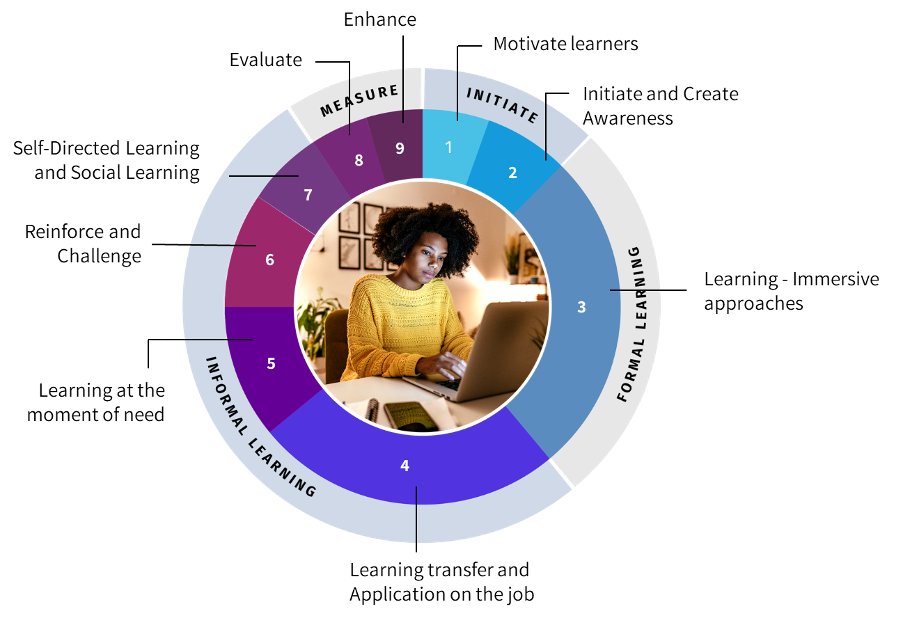
The EI Learning and Performance Ecosystem is an all-inclusive framework for driving continuous learning and development in organizations. It recognizes that continuous learning contributes to creativity and innovation, which should feed organizational growth; it acts as a guide, then, for L&D teams to operate in concert with business needs and goals.
A Learning and Performance Ecosystem combines formal training and informal learning opportunities, mentoring, and performance support systems to bring together an overall cohesive environment in the development of skills. It provides structured pathways toward personal growth that help align learning to organizational objectives and include learning as part of the all-encompassing ecosystem. The overall culture is toward continuous improvement, learning is made highly personal, and there is a direct impetus toward strategic alignment. This is where EI’s approach will include needs analysis, goal setting, continuous assessment, and feedback mechanisms - all of which provide solutions that can be customized to specific organizational needs.
Benefits of Adopting a Learning and Performance Ecosystem Based Approach
There are several other significant gains for organizations as they leverage the Learning and Performance Ecosystem based approach.
Organizational change is driven by formal and informal training, as well as a shift to a continuous learning culture. You can leverage the Learning and Performance Ecosystem to offer training and more significantly, to create a culture of continuous learning.
- A Learning and Performance Support Ecosystem, can be used for formal training as shown here.
- Upskilling and reskilling. Given the changing dynamics, there is a need to continuously upgrade employee knowledge and skills.
- Cross-functional skills For instance, a team may have strong programming skills but lacks effective product design or project management. A learning ecosystem can support those teams as they development members into scrum masters, for example.
- Fixing performance gaps. A learning ecosystem also helps identify important performance gaps by aligning training tactics to enterprise goals and drive organizational growth. Those intersections identify weaknesses as well as resources that may buttress or resolve those weaknesses.
- A learning ecosystem also address the ongoing need for effective compliance and onboarding
- In addition, a learning ecosystem drives organizational growth through informal learning.
- Providing just-in-time learning solutions, including job aids and performance support systems.
- Pushing nudges to employees whose performance may have dropped off.
- Fostering coaching and mentoring relationships – In a learning ecosystem, it’s vital that managers frequently evaluate employee performance, coaching when needed.
- A learning ecosystem changes an organization’s learning culture. It leverages social and collaborative learning platforms, helping employees collaborate more effectively while learning from each other.
- Driving organizational growth means that a learning ecosystem provides timely nudges to employees for self-directed learning. Perhaps when they may have some downtime, they listen to training. For instance, an organization in the United States provides personal security feeds audio-training to its employees’ earpieces between assignments (such as when they transition from one post to another).
- A learning ecosystem leverages social learning platforms so that employees can curate their own content and share it with others. Subject matter experts (SMEs) can also generate content and share it on the platform. The training department can use that content as source material in their training development efforts.
How Does a Learning and Performance Ecosystem Fuel Continuous Learning and Drive Organizational Growth?
A learning ecosystem fuels continuous learning and drives organizational growth in the following ways:
- It fosters an environment where learning is stickier and with this, the on-the-job application of learning increases.
- There is an emphasis on continuous skill building and reinforcement for existing employees.
- A learning ecosystem reduces the time to proficiency many organizations struggle with.
- Changing the way employees view learning in a healthy way is another result of a learning ecosystem. Perception is reality. Therefore, the more positive the perception employees have of training, the more likely they are to remember what they learn and apply it to their job.
- Finally, a learning ecosystem can trigger positive behavioral change in employees.
What Should Be the Key Considerations for Building Your Own Learning Ecosystem?
To build a strong learning environment, train but do more. The Learning and Performance Ecosystem model provides a comprehensive framework to establish an ecosystem for continuous learning and performance enhancement. Here’s a step-by-step guide to help employees learn and help an organization become effective.
- Create Awareness and Motivation
Start by creating awareness of the ecosystem’s structure and resources, ensuring employees understand how it aligns with their professional growth. Motivated learners are more likely to engage with the ecosystem and apply new knowledge.
- Engage and Enable Learning
Offer immersive learning experiences, such as scenario-based or problem-solving tasks, which allow employees to acquire knowledge in a meaningful way. Integrate job aids to help employees apply this knowledge on the job in real-time.
- Maintain Ongoing Engagement
Provide continuous learning pathways that reinforce acquired skills, offer practice opportunities, and challenge employees to deepen their expertise. Curated content helps keep learners engaged and motivated to return for further development.
- Integrate Mentoring and Feedback
Beyond traditional training, incorporate mentoring, coaching, and rewards to support ongoing development. Platforms for continuous feedback encourage employees to improve their skills and track progress over time.
- Evaluate and Adjust the Ecosystem
Regularly assess the impact of learning by tracking its application to employee performance and behavioral changes. Use this feedback to identify areas for improvement and make necessary adjustments to the ecosystem.
- Allow Time for Self-Directed Learning
Provide self-paced, on-demand resources where the employee can take ownership of their learning journey. Leverage self-directed learning opportunities with collaboration and peer learning.
- Foster a Virtuous Cycle of Learning
Reinforce learning with periodic challenges that push employees to apply their knowledge in new contexts. This ongoing cycle of learning, practice, and reflection drives continuous improvement.
- Continuously Iterate and Improve
Utilize the findings from the evaluations and feedback to incrementally shape or enhance the learning environment. See to it that the environment allows for adaptation when business needs change so that the ecosystem evolves over time while maintaining relevance and impact.
In conclusion, a strong Learning and Performance Ecosystem drives organizational growth by fostering continuous learning, collaboration, and innovation. It empowers employees to adapt and excel, aligning learning with business goals for sustained success.

subscribing!
Related articles


.jpg)
.jpg)





.jpg)