





.avif)

How to Build Better Learning Experiences with Personalized Learning – Featuring 3 Examples


High-performing and younger generational employees expect more from corporate L&D teams. Personalized Learning is a powerful way to serve that request. In this article, I outline how Personalized Learning strategies build better learning experiences.
What Is Personalized Learning?
Personalized learning customizes training to meet specific individual needs, making it feel unique to the learner. This strategy is helpful in an environment with abundant information, inadequate time, and high work expectations. It assists L&D teams to align training with business goals, enhancing upskilling, reskilling, and talent retention.
Personalized learning is increasingly being adopted by organizations to create pathways based on employee locations, roles, objectives, and performance. This is further optimized by AI and data analytics, which track progress, identify skill gaps, and customize content.
How Can Personalized Experiences Make Learning More Effective?
By adjusting instruction to each learner’s unique requirements, interests, and goals, personalized learning experiences increase the efficacy of learning. Rapid technology breakthroughs and changing workforce demographics are driving the demand for greater L&D in today’s fast-paced and competitive global economy. Employees may upskill or reskill more quickly with personalized learning than with generic training approaches, owing to L&D teams’ ability to match training with business goals.
By empowering employees to take charge of their own learning, this strategy promotes a culture of continuous learning that improves knowledge retention and engagement. Personalized learning ensures that training is timely, relevant, and effective by catering to the unique needs of each learner. This, in turn, leads to improved performance and long-term talent retention.
How Does Personalized Learning Work?
Personalized learning involves a series of processes and approaches that are personalized to the needs of each individual learner:
- Assess learner profiles to identify strengths, weaknesses, interests, and preferred learning styles.
- Creating personalized learning paths depending on the learner’s profile.
- Integrating technology to provide tailored material and measure progress.
- Regular assessments and feedback allow for adapting the learning path as needed.
- The learner-centric approach prioritizes the learner’s goals and preferences while designing and executing the learning process.
What Are the Different Levels of Personalization You Can Adopt?
1. Basic Level of Personalized eLearning
The fundamental techniques include:
- Flexibility to choose a font, theme, or background for the eLearning course.
- Create a profile and select an avatar (or upload the learner’s image).
2. Intermediate Level of Personalized eLearning
The challenge of being able to address divergent needs on account of different learning styles is a tough one to crack. However, the following techniques will help in minimizing this challenge:
- Selection of audio
At the start of the course, you may give learners the option of using audio or otherwise. (To allow this flexibility, make sure that the audio approach does not limit the amount of text on screen. This can be accomplished by using minimal audio to thread all of the frames, but the onscreen text covers the voice-over. Alternatively, if you have an excessive amount of audio, the non-auditory learner should have access to a transcript, which can still keep them interested). - Selection of different formats (in case of bandwidth challenges)
In certain geographies, the learners may need the flexibility to achieve the same learning outcome but without the approaches that hog bandwidth. (To manage this, you can replace videos with slideshows.) - Selection of videos vs interactive learning
Many learners want the option of watching an engaging non-interactive video to comprehend a subject before moving on to interactive tasks to practice. You may provide this flexibility to learners.
3. Advanced Level of Personalized eLearning
This level offers a customized learning path that can be selected based on:
- The learner’s role
- The learner’s region
This can also have the option for versions that are available in the local language. - The learner’s proficiency
A personalized learning path can be offered based on the learner's competency as measured by a test (pre-assessment). The test must be created with enough detail that you may lead learners to the sections they ought to pursue or skip. - The learner’s interest
Instead of the prescriptive approach of the pre-assessment, learners may take charge and construct a personalized learning path based on their areas of interest. Alternatively, individuals can be requested to fill out a survey form, and the system will offer recommendations depending on the categories they chose. - Personalized feedback to enhance the learning experience
Why Are Personalized Learning Strategies Essential to Support Changing Employee Demographics?
Employee demographics continue to evolve. The workplace itself, once viewed as a static environment, has undergone a revolution over the last two years. Learning and Development (L&D) teams need to evolve their strategies to match those changes.
Employees have found more effective ways to learn so their expectations have shifted. As the last of the Boomer generation retires, younger generations are taking their place, each with its own set of expectations, needs, and preferred learning options. To help employees thrive in this dynamic and diverse environment, L&D teams need to employ Personalized Learning strategies. Personalized Learning offers employees the learning content they want and need when and how they need it.
Hybrid teams present a new challenge. Gone are the days when teams could easily gather in a nearby conference room for live training. Many employees on the same team operate in different time zones and even countries and continents. Team skills development is challenged by team member space and time differences.
Learners have come to expect information just a few clicks away. Most jobs are complex enough that it’s no longer feasible to expect employees to remember how to do everything. They’re often faced with complex tasks they’re doing for the first time. They’re used to using search engines to quickly find the information they need, hoping it’s accurate. Most content is abbreviated as much as possible, offering individual concepts, principles, and procedures that are immediately applicable. Additionally, they expect smart recommendations based on what they’ve previously viewed or may need on the job.
Gen X learners still prefer more traditional learning modalities while Gen Y (Millennials) and Gen Z are digital natives accustomed to technology in the learning environment, aiding and guiding them in their efforts to find important information. While not a rule, it’s clear that the younger generations expect information to be three or fewer clicks (or taps) away.
How Does Personalized Learning Improve Learning Experiences and Maximize Employee Development?
Personalized Learning strategies improve content delivery and learning modalities, and general learning environments. Effective Personalized Learning strategies:
- Recognize that the most important resource of any organization is its people. Businesses are only as efficient and effective as their employees. Creating Personalized Learning experiences helps employees stay at the forefront of their specialty and move to new areas of operational knowledge as needed. They can take advantage of technology that leverages data to present personalized content.
- Build on previous knowledge learners bring to the situation. For example, small children learn the form of house cats and quickly translate that knowledge to understand that lions, tigers, and cougars are also cats. Similarly, employees have a set knowledge from which to start, and Personalized Learning capitalizes on that knowledge.
- Cater learning modalities to the learning, the situation, and the content. Some learners may prefer understanding all the underlying concepts and principles of a process while others just want simple facts and procedures from which to act, requiring different learning modalities. The location of learners also dictates the most effective learning modality. A geographically dispersed audience may benefit from Virtual Instructor-Led Training, but not if they’re also spread across continents. In that case, an asynchronous delivery modality is more appropriate. Finally, and most importantly, the content itself should drive Personalized Learning experiences. Leadership training that requires high levels of practice and feedback should most often be done live in small groups or even one-on-one with mentors and coaches. But foundational knowledge can be delivered in quick microlearning bursts.
- Iterate based on feedback. Quick iteration and evolution cycles based on user and subject matter expert feedback are important in Personalized Learning experiences. Learner needs, required skills, and work situations continue to evolve quickly, so the learning needs to iterate just as quickly, staying within the environment’s evolution loop.
Personalized Learning Experience Defined
Personalized learning is the process of developing training that is tailored to the specific requirements, readiness, and future goals of each learner. This approach empowers employees to take control of their learning journey, enhancing their interest and engagement. Personalized learning includes just-in-time aids to develop new skills that are aligned with business goals. It also employs advanced personalization techniques such as pre-tests, surveys, and artificial intelligence to customize the learning experience. This ensures that L&D teams deliver relevant, engaging, and effective training, allowing employees to thrive and prepare for future growth.
What Are the Different Ways to Create Personalized Learning Experiences?
Personalized Learning isn’t simple – it takes a concerted effort by L&D teams. The following are ways to create Personalized Learning experiences for employees:
- Create learner personasto guide Personalized Learning experience development. A learner persona identifies the knowledge, skills, background, and preferred learning modalities of each learner type in your audience ecosystem. Learner personas can even contain information such as what those types of employees face not just on the job, but before and after, what their long-term goals are, previous learning experiences, and learning expectations.
- Once learner personas are developed, Personalized Learning paths can follow. Those learning paths can look like learning journeys, identifying milestones and stops along the way to performance goals.
- Personalized Learning experiences should be mapped to the seniority level of learners. Depending on where learners are in an organization, whether small team supervisors or whole division executives, they require Personalized Learning strategies. Leaders of small teams may need to develop one-on-one coaching and mentoring skills while executive-level leaders may instead need to learn how to create enterprise-level strategies and motivational tactics to implement those strategies.
- Avatar-based learning can further enhance Personalized Learning experiences. Those avatars can act as the medium of guided exploration and learning, identifying things learners already understand so they can skip to more complex topics and information. They also act as guideposts and become familiar foundations on which to build new knowledge.
What Are Some of the Personalized Learning Tips and Best Practices to Improve Learning Experiences?
These Personalized Learning tips and best practices improve the learning experience:
- Understand the learners. It’s impossible to create Personalized Learning experiences without truly understanding what the learners need, what they face, how they go about their day-to-day jobs, and what future skills and knowledge they need to remain competitive.
- Do solid learner needs analysis. This is foundational to any Personalized Learning experience and is directly related to creating learner personas. This also identifies the learning that employees desire – not just what is essentially required (and certainly doesn’t include compliance training).
- Identify the required levels of personalization. Not all training needs to be highly personalized. Some trainings, like compliance training, are the same from one employee to the next. But training that includes many soft skills may require varying levels of hands-on practice and coaching with customized entry-level instruction.
What Are Some Examples that Support Personalized Learning Experiences?
It’s difficult to provide Personalized Learning experiences through basic page-turner eLearning. However, there are more effective Personalized Learning examples to be found in eLearning. Here are a few from our repository:
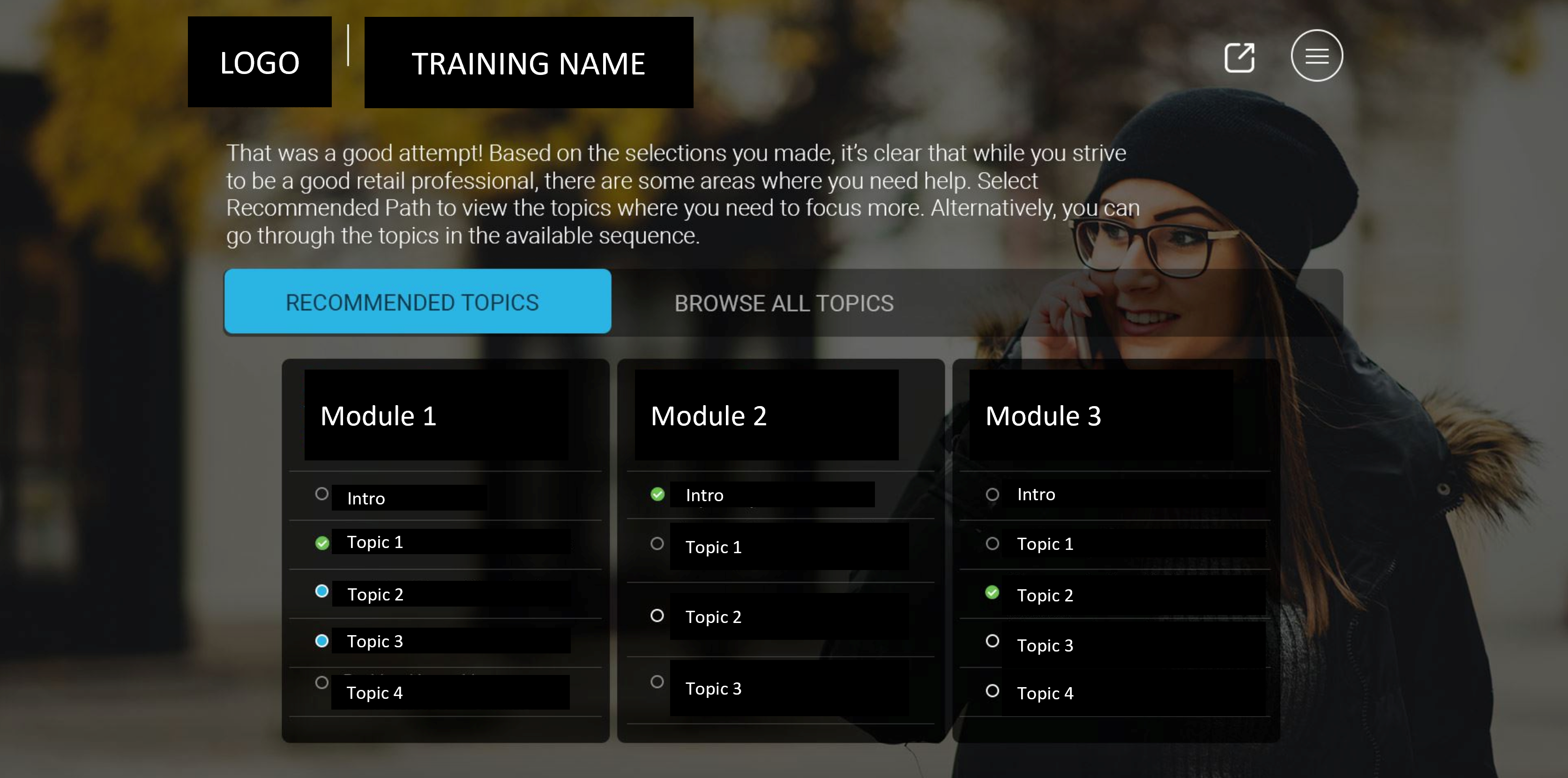
Example 1: Product Training for Sales Agents with a Pre-Assessment
A leading runner in the tobacco industry recognized that its sales agents required thorough product knowledge to increase their lead generation. To address varying levels of experience among the agents, we implemented a pre-assessment at the start of each module. This assessment gauges their current proficiency levels and learning preferences. Based on their scores and preferences, we tailored topic recommendations to personalize their learning journey. This approach enables learners to efficiently access pertinent information while also offering opportunities to explore additional topics of interest.
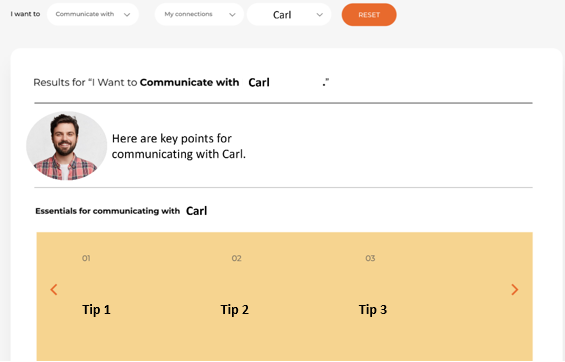
Example 2: An Adaptive Skill Development Platform
A DEI consulting company needed an innovative solution to equip its employees with cultural intelligence skills and country intelligence skills. As part of our solution, we created adaptive learning pathways and recommendations based on learner preferences as a quick way to access important learning content, that was deployed through a portal.
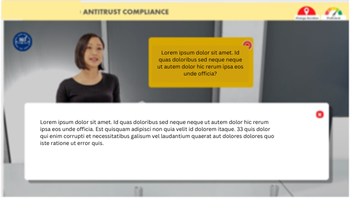
Example 3: A Hyper-Personalized Compliance Simulation for Legal Team Members
A multinational oil and gas company sought to transform its dense legal documents into an engaging learning experience that would capture and maintain learners' interest. Our solution involved interactive scenarios tailored to the learners' roles and profiles, allowing them to effectively apply the document contents. Additionally, the learners' performance in these activities were continuously tracked to offer relevant content assets based on their progress to enhance their understanding and improve performance in subsequent activities.
Leveraging AI to Create Personalized Learning Experiences
AI has transformed the L&D industry by enabling more personalized, inclusive, and effective training programs. Personalized learning, powered by AI, customizes training experiences to each learner’s specific requirements, interests, and goals. AI uses data analytics to monitor employee development, identify skill gaps, and tailor material to improve learning outcomes. This method is expected to boost the global personalized learning market above $2 billion by 2024, demonstrating its growing importance.
AI-powered personalized learning uses adaptive platforms, content production, and personalized recommendations to offer a customized learning experience. Instant feedback, natural language processing (NLP), and improved accessibility enable a thorough and inclusive learning experience. By integrating training with business goals and cultivating a culture of continuous learning, AI assists organizations in improving employee performance, retaining talent, and remaining competitive in a rapidly changing job market.
Parting Thoughts
The diversity of learners’ backgrounds, work situations, and locations all require as many Personalized Learning experiences as possible. Personalized Learning strategies allow L&D teams to maximize the effectiveness of their learning programs.
I hope the Personalized Learning examples mentioned in the article helps provide insights on how to build better learning experiences for high-performing and younger generational employees.
Meanwhile, if you have any specific queries, do contact me or leave a comment below.

subscribing!
Related articles


.jpg)
.jpg)


.jpg)
