






.avif)

How to Set a Foundation That Supports Employee Learning and Performance Improvement


Summary
This article explains how organizations can create a strong learning foundation that supports employee development, performance improvement, and retention. It highlights the importance of learning ecosystems, personalized learning, microlearning, gamification, coaching, and immersive learning strategies to foster continuous growth and business alignment.
One measure that helps organizations retain talent is the investment in employees’ professional development. In this article, I share my insights on how you can set a foundation that will support employee learning and performance improvement.
Employee retention is a key element in ensuring the success of an organization. Having a workforce that is engaged, committed, and aligned to organizational goals is vital in helping organizations achieve their business goals.
The investment on employees’ professional development (learning and performance improvement) helps organizations retain talent and get more committed employees.
- In fact, more than 40% of employees maintain that they are likely to stay longer with an organization if they see a steady investment on learning that leads to performance improvement.
- Similarly, 78% of employees said they would remain longer with their employer if they saw a career path within the current organization (Source: Mercer).
To achieve this mandate, L&D teams and business units must adopt a proactive approach for professional development of employees (learning and performance improvement) and aligning it to clear growth plans. With this in place, they can achieve reduced employee turnover, higher productivity, and a more engaged workforce.
I consult organizations across the world in their endeavor of “learning transformation” as they re-evaluate strategies that can aid them in improving their mandate of employee development. I have shortlisted the cues from these sessions and here are my recommendations that are easy to use and will help you set or strengthen a foundation that will support employee learning and performance improvement.
Work with a Bigger Picture – Use the Learning and Performance Ecosystem Based Approach
My first recommendation as you look at strengthening the foundation to support employee learning and performance improvement is to take a step back. Re-align your overall learning strategy and training delivery through a Learning and Performance Ecosystem based approach.
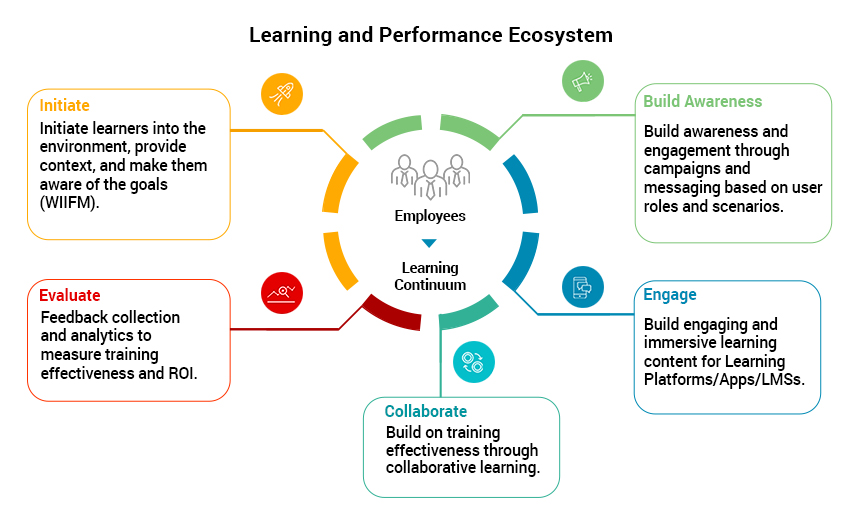
As you would notice, the employee is in the center of the Learning and Performance Ecosystem. This is the model we use at EI Design and will certainly help you foster a culture of continuous learning in your organization.
Here is my step-by-step guide on how exactly you can use this model for employee learning and performance improvement.
Step 1: To create a professional development model that will create the right impact, you need to incorporate several measures (not limited to training alone) that:
- Create awareness.
- Motivate learners.
- Engage and learn (acquire knowledge).
- Apply the acquired knowledge on the job.
- Job aids that help learners at the moment of their need.
Step 2: To retain the connect and keep the learning active throughout the year to help employees, provide learning pathways that offer learning aids. These could be used to help employees:
- Reinforce the acquired learning.
- Practice and hone their skills.
- Challenge and push them to the next level of learning, practice, or application.
- Offer relevant curated information to ensure they come back for more and the virtue cycle continues.
Step 3: Integrate additional measures (beyond online training or self-directed learning) including:
- Mentoring.
- Coaching.
- Rewards and Recognition.
- Investing on platforms that provide ongoing feedback (rather than being limited to annual or bi-annual feedback).
Step 4: This is the most crucial step to assess the impact of what you have done so far. Have scheduled connects to assess the progress and impact of the training.
This should focus on the impact of the training on employee performance improvement or behavioral change. Based on this analysis, you can identify remediation or focus on further growth areas. This should give you the requisite insights on improving what you had established during Steps 1, 2, and 3.
Recommended Online Training Formats and Strategies
You need to select formats and strategies that are aligned to what the learners want and what L&D teams want to see as the desired impact. Let’s look at both sides of the picture before I share my recommendations.
What Do Learners Want?
They want learning experiences that are:
- Accessible.
- Available on demand.
- Available within their workflow.
- Motivating
- Engaging and immersive.
- Relevant, relatable, and personalized.
- Challenging.
- Rewarding.
What Do L&D Teams Want?
The learning strategies should:
- Create sticky learning.
- Facilitate the application of learning.
- Provide room for practice and proficiency gain.
- Provide reinforcement to ensure the Forgetting Curve does not step in.
- Influence or trigger behavioral change.
You can adopt my 10 recommendations listed here and achieve a positive impact on your employee learning and performance improvement mandate:
- Use of Mobile Learning with a significant part of the training in a Microlearning.
- Use of techniques like Gamification, Apps for Learning, VR/AR sparingly but create high impact.
- Use the granularity of Microlearning nuggets to craft a personalized and more relevant learning path.
- Use Video Based Learning that provides high impact and better recall and retention.
- Use Interactive Video Based Learning to push the envelope from lower levels of cognition (Remember and Understand) to higher levels of cognition (Apply and Analyze).
- Use interesting Story Based Learning or Scenario Based Learning techniques to facilitate:
- Application of learning.
- Push critical thinking capabilities.
- Hone decision making skills.
- Use Gamification elements even in traditional eLearning to provide “fun as you learn.”
- Blend measures of spaced repetition (through learning pathways or Mobile Apps for learning) to trigger behavioral change.
- Leverage on Next Gen immersive approaches like VR and AR (as Microlearning nuggets) for specific components of the overall learning journey.
- Offer curated learning nuggets to ensure that learners keep coming back for more.
I hope this article provides the cues you can practically use to set or strengthen the foundation that supports your employee learning and performance improvement mandate.
If you have any specific queries, do contact me or leave a comment below.
Read More
- 10 eLearning strategies to create employee development training
- Updated eLearning Trends in 2019 to Help You Enhance Your Learning Strategy and Maximize Returns
- How to Enhance the Impact of Your Mobile Learning Strategy in 2019
- Microlearning Trends to Adopt in 2019
- Gamification Trends in 2019 - Packed with Tips and Ideas You Can Use

subscribing!
Related articles


.jpg)
.jpg)






.jpg)
