






.avif)

How to Create Learner Personas Using Audience Analysis


Summary
This article explains how personalized learning helps organizations improve employee development, accelerate reskilling, and build a culture of continuous learning. It highlights the benefits of customized learning paths, AI-powered learning experiences, microlearning, mobile learning, and adaptive technologies that support workforce growth and business goals.
Audience analysis is crucial in identifying the right learning strategy. In this article, I outline the significance of audience analysis and show you how you can use learner personas to create high-impact learning experiences.
Audience Analysis in L&D
Most of us (whether from the Instructional Design or L&D team) are aware of the significance of audience analysis. We know that only when this analysis is correctly applied to identify a learning strategy is when we would see the required gains in enhanced skill, thinking, or behavioral change in the learners.
Yet, quite often, this aspect is driven by assumptions and a limited analysis of what would truly resonate with the learners. Why does this happen?
Here is my take on this gap on audience analysis and how it impacts the eventual gain the learners seek. As Instructional Designers, we want to create courses with a “wow” factor, and this often leads us to opt for learning strategies that excite us, but they do not resonate well with the learners.
While it is important to create learning designs that excite learners, the learning journey must enable them to meet their specific mandate. Only then will they walk away with a sense of fulfilment and accomplishment.
Significance of Audience Analysis
To understand the learners (as in, by being in their shoes), we need to do an extensive audience analysis. To achieve the learner mandate, we need to understand the learners, think like them, and ascertain what would excite them and, more significantly, what would not.
Specifically, while conducting audience analysis, we need to identify what would help create a sticky learning experience, help them improve their performance, or solve a problem.
Additionally, we need to extend the audience analysis to include what learning strategies would help influence learners’ thinking process and, eventually, behavior.
In this article, I begin with the significance of audience analysis. Then, I take you through the technique of learner personas that can be used (in contrast to limited, real user sampling) to help you choose the right learning strategies and design formats that would create high-impact learning experiences.
Why Is Audience Analysis Necessary and How Does It Impact the Learning Design?
Today, Instructional Designers are spoilt for choice with the range of learning strategies and multiple design formats that can be used to craft a learning design. However, this does make the selection process a bit more difficult. How do you select the right option, when more than one approach or a combination thereof can work?
This is exactly where audience analysis helps. It helps us understand:
- Who are the target learners.
- What are their preferences (how they want to learn, when and where would they want to learn, what degree of control they require on how they want to consume learning, and so on).
- What is their current knowledge or proficiency level.
- What is driving or motivating them.
- What exactly do they want to accomplish (through training or performance support).
Sounds simple, is there a catch?
Online training typically addresses a wide and heterogeneous set of learners (coming from multicultural backgrounds, different geographies, different age groups, different proficiency levels, and certainly different motivation levels, and so on).
It is practically impossible to interact with each learner to understand what would resonate best with each of them.
This is where the technique of using learner personas comes in.
- By using the technique of learner personas, you can identify and select the learning design that will deliver the desired impact.
- It also helps you eliminate certain options (that may work with certain learner personas but not with others).
What Are Learner Personas?
Learner personas are fictional profiles based on real user data that help instructional designers understand their target audience's needs, preferences, and motivations. They enable the selection of effective learning strategies and designs tailored to meet learners' goals, enhancing engagement and impact.
It goes without saying that using cues from real or actual users will lead to a more definitive audience analysis. However, it is very challenging to pool in this data from all users. Hence, we take cues through a partial sampling of the real users, but this may lead to picking up limited cues and not necessarily the overall patterns. On account of this, we can miss the bigger picture and may potentially get a limited impact from the selected learning design.
This is where the use of Learner Personas comes to the rescue and it can aid in helping us hit the bull’s-eye with the right learning strategy.
Learner personas are fictional learner profiles that are generated through the aggregation of real user data. They are very useful in understanding the target audience in terms of their background, what would motivate them, and how they would like to learn. In fact, learner personas are created by using a partial sampling of the real-world users. They enable Instructional Designers to validate what approaches or combination thereof can meet the expectations of different learner profiles.
With learner personas, you look at the learning design from the learners’ viewpoint and assess if the selected approach would work or otherwise.
- You work with more tangible cues rather than assumptions to craft the learning design.
- Different stakeholders in the project development cycle can use this to validate or tweak their approach and re-draw the learning design suitably.
As a result, you are likely to meet the learners’ mandate without the pain of re-work on the developed training.
Example of a Learner
Learner Persona: Sarah Jessica
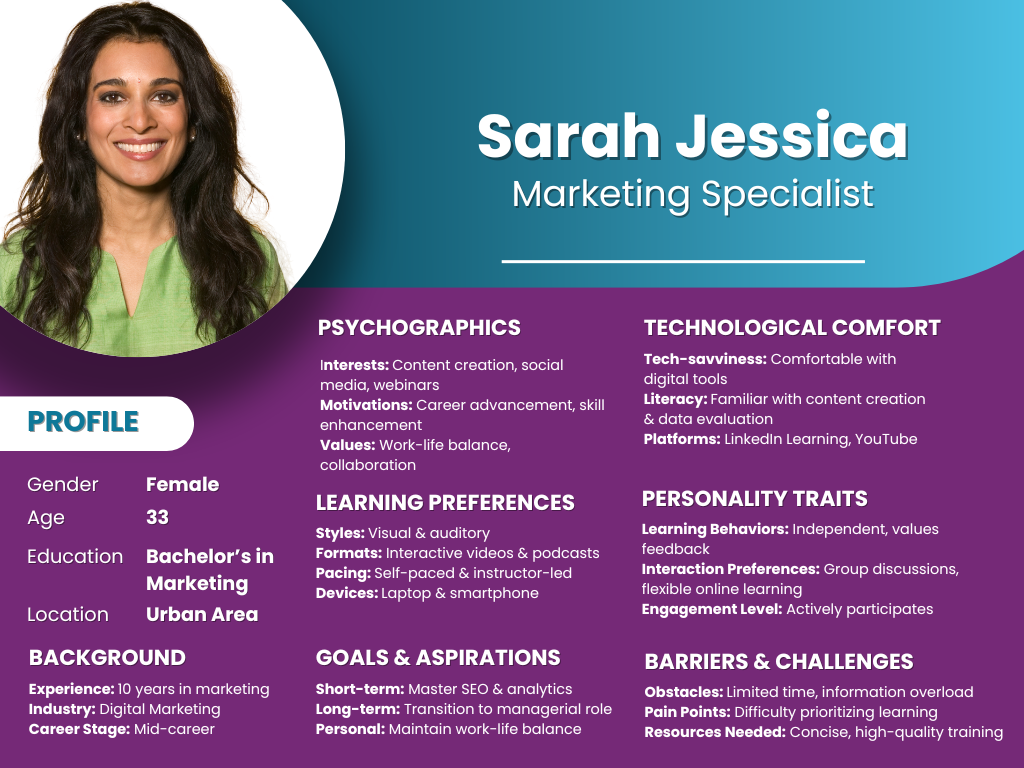
Basic Information
Age: 33
Job Role: Marketing Specialist
Education: Bachelor’s in Marketing
Location: Urban area
Background
Experience: 10 years in marketing
Industry: Digital Marketing
Career Stage: Mid-career
Psychographics
Interests: Content creation, social media, webinars
Motivations: Career advancement, skill enhancement
Values: Work-life balance, collaboration
Learning Preferences
Styles: Visual & auditory
Formats: Interactive videos & podcasts
Pacing: Self-paced & instructor-led
Devices: Laptop & smartphone
Goals & Aspirations
Short-term: Master SEO & analytics
Long-term: Transition to managerial role
Personal: Maintain work-life balance
Technological Comfort
Tech-savviness: Comfortable with digital tools
Literacy: Familiar with content creation & data evaluation
Platforms: LinkedIn Learning, YouTube
Personality Traits
Learning Behaviors: Independent, values feedback
Interaction Preferences: Group discussions, flexible online learning
Engagement Level: Actively participates
Barriers & Challenges
Obstacles: Limited time, information overload
Pain Points: Difficulty prioritizing learning
Resources Needed: Concise, high-quality training
What Are the Benefits of Learner Personas?
Learner personas offer several benefits in favor of training programs:
- Improved Insights: Insights into learner goals and challenges facilitate the creation of specific learning opportunities.
- Learner-Centric Approach: An emphasis on learner preferences as opposed to the organization’s requirements results in greater learner participation.
- Personalized Learning: The use of pathways based on the personae enhances the level of learner engagement.
- Uniformity of Content: Creation of individual personas helps keep focus among all parties involved enhancing collaborative content development.
- Informed Decision-Making: Clear information about learners helps in coming up with feasible goals thus minimizing wastage of resources.
- Evaluation Measures: Personas direct the creation of significant KPIs, enabling focused evaluations.
- Minimum Cognitive Load: Engagement increases because the learned content is not overwhelming to the learners.
- Alignment with Business Goals: Personas make sure that training complements required skills and corporate goals.
- Better Accessibility: Inclusive learning experiences result from early identification of accessibility issues.
- Promoting Innovation: Novel techniques and strategies for delivering training are stimulated by an awareness of the varied demands of learners.
How Do Learner Personas Help Deliver Better Learning Outcomes?
Learner personas are of utmost importance as they allow an accurate and deep understanding of learner’s traits, purpose, and challenges. This deep knowledge gives instructional designers the chance to personalize the content in a way that will be most relatable for the learners and turn an ordinary class into a fun and inviting experience. Organizations can enhance learning outcomes by matching the preferred learning formats of their learners, be it interactive modules, videos, or presentations. This increases engagement and retention rates.
Additionally, learner personas establish consistency across training programs, ensuring that all stakeholders maintain a unified approach. This alignment is thus the most efficient way of organizing the development process as it enhances the overall quality of the training and makes it more relevant and impactful. By focusing on the precise needs of the learners, organizations are able to build training that is not only measurable but also creates a more effective learning environment.
How Can You Build Learner Personas?
As I have highlighted, while the learner personas are a fictional profile, they draw upon real-world users’ data. This data can be collated through a step-by-step approach to create and refine the Learning Personas.
At EI, we use a combination of the following approaches:
Step 1: Have a discussion with:
- Project sponsors.
- L&D teams.
- The Business Unit.
Step 2: Survey/Interview a small group of target learners. If feasible, spend some time with the target user group and observe them.
Step 3: Analysis of past data for projects with a similar mandate to ascertain what worked and what may need to be updated/worked upon to meet the mandate.
At EI, we use a simple two-tiered model to create the learner personas.
We begin with basic cues on demographics that typically include:
- Age.
- Role.
- Region or Geographic location.
- Interests.
- Cultural aspects.
Then, we look at the next tier of cues that typically include:
- Learning mandate/needs (What are they exactly aiming to accomplish through the training or Performance Support intervention).
- Current proficiency and expected gain.
- Motivation factors.
- Preferred device to learn (Smartphone/Tablet, Laptop/Desktop, or the flexibility to work across devices).
- Preferred approach to learn (Microlearning or Macrolearning as well as different formats).
- Preferences for learning strategies (particularly relevant when there are existing training programs).
- Preferred mode of training delivery (prescribed learning path, Personalized path, or customized path).
The value of using Learner Personas is in working with a bigger picture that increases the ability to achieve the learner mandate through the most appropriate learning design.
Best Practices While Creating Learner Personas
A key step in developing effective learner personas is the creation impactful learning programs. Here are key practices to enhance your approach:
- Conduct Thorough Research: Create personas based on data collected from surveys, interviews, and usage analytics to make them a real representation of the learners’ experiences.
- Identify Relevant Characteristics: Define relevant characteristics such as demographics, motives, pain points, and learning styles. Avoid redundant information that do not contribute to the learning process.
- Use Templates: Employ persona templates for consistency and to ensure all critical characteristics are captured across your team.
- Create Multiple Personas: Through the diversification of your target audience, make it possible to develop multiple personas by starting with a few and adding as many as needed.
- Involve Stakeholders: Unite with the team and the industry experts to brainstorm and refine your personas.
- Iterate and Test: After the training period, analyze the feedback to find out what the strengths and weaknesses are, so you can modify your personas for the next projects.
How Do You Use a Learner Persona While Developing Learning Programs?
By leveraging learner personas for the development process, you can develop more targeted and effective learning programs that will adequately address the diverse needs of your audience. Here’s how to use them effectively:
- Identify Target Audience: To begin with, select the types of learners you wish to help. The diverse people you have in your audience will help customize the content for different needs.
- Guide Content Creation: Use personas as a way of meeting particular needs, motivations, and goals of each learner group will effectively correspond to training materials and make the content engaging.
- Foster Engagement: Portray scenarios and examples that characterize the personas. This move makes the learning of concepts more relatable and encourages active participation.
- Plan Assessment Techniques: Create mechanisms through which the assessments can reflect the skills and expectations of the respective personae. The aim is to make sure that the evaluations are impartial and genuinely represent the goals of learning.
- Implement Delivery Methods: The right use of technology available and increasing learners’ access to the learning environment can be best achieved by choosing the method of delivery (like online, in-person, or hybrid learning) based on the preferences and technological proficiency of the learners.
- Encourage Continuous Improvement: Routinely check and refresh your personas with feedback from learners and performance statistics.
For learning experiences to have an impact, audience analysis and learner personas must be integrated. You can create training that genuinely resonates and encourages participation by getting to know the requirements, motivations, and preferences of your learners.
I hope this article will help you craft more effective learning experiences by leveraging the technique of learner personas. Make use of these insights to promote ongoing development and provide quantifiable results that are advantageous to both your business and your learners.

subscribing!
Related articles


.jpg)
.jpg)






.jpg)
