



.avif)

Performance Support Tools: Top 5 Things Your Boss Wants To Know


Summary
Performance Support Tools (PSTs) enable employees to learn and perform simultaneously by providing real-time, on-the-job guidance. This blog explains how PSTs improve knowledge retention, reduce training dependency, and enhance workplace performance through practical use cases and formats.
In this article, through a series of questions, I will provide answers on what Performance Support Tools (PSTs) are and why they must be an integral part of your organization’s learning strategy. I will also share my insights on how they help learners and how they can help address a key challenge that Learning and Development professionals face in terms of increasing knowledge recall, its retention, and application.
What Your Boss Wants To Know About Performance Support Tools
Here are 5 important questions about Performance Support Tools; their answers explain why they must be an integral part of your company’s learning strategy.
Q1. When do learners seek learning?
Dr. Conrad Gottfredson and Bob Mosher’s Five Distinct Moments of Need© very succinctly captures when exactly learners seek learning. According to them, learners seek support in these Five Moments of Need:
- When they are learning an aspect for the first time (New).
- When they want to deep-dive and learn more (More).
- When they want to apply or remember something (Apply).
- When they need to solve a problem or fix something that has gone wrong (Solve).
- When something changes (Change).
While formal training does address the first two learning needs, the use of Performance Support Tools is particularly relevant in meeting the subsequent three needs.
Please refer to my article Improving ROI in eLearning where I have highlighted how an effective Performance Support intervention can increase the application of learning. This has a direct impact on improving ROI in eLearning.
Q2. What are Performance Support Tools and where exactly do they fit in an organization's learning strategy?
Performance Support Tools (PSTs) provide employees with on-the-job tools that make their work a lot easier. Unlike training, these tools are available to support and guide employees as they actually do their jobs. These tools are very easy to find, often directly embedded into the learners’ workflow (Learning Hub) and offer active guidance.
These solutions enable organizations to provide the right amount of task guidance, support, and productivity benefits to learners precisely at the moment of need.
Q3. How do Performance Support Tools help learners?
Performance Support Tools provide an option for employees to learn and work at the same time. They can help an organization to reduce the cost of training while increasing productivity and performance.
From a learner perspective, Performance Support Tools:
- Empower employees to perform tasks with a minimum amount of external intervention or training.
- Save the time spent by skilled performers in helping the less skilled performers on specific tasks.
- Help new team members perform quickly and accurately without losing productive time when training is impractical, unavailable, or constrained.
- Guide new employees through a complex process or task that cannot be memorized.
- Introduce, upgrade, or consolidate new systems (for example, customer relationship management, enterprise resource planning, or tasks in certain call centers where agents must perform using complex systems, processes, or products).
Q4. How can Performance Support Tools offset some of the challenges in learning recall, retention, and application?
In 1885, Herman Ebbinghaus, a German Psychologist, defined the exponential nature of forgetting. As you see from this diagram featuring the “Forgetting Curve”, we forget 80% of what we learned in 30 days!
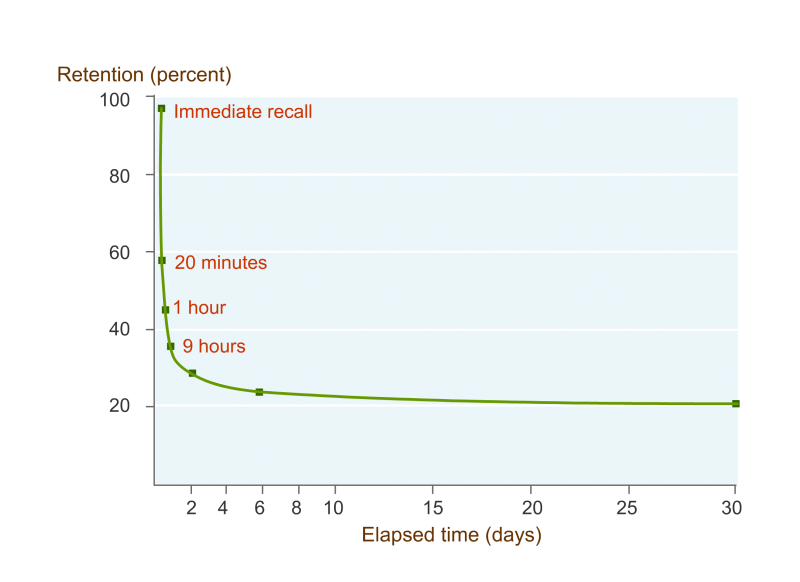
Added to this is an associated challenge that by investing on formal training that would happen for a few days in a year, we cannot expect learners to gain high levels of proficiency in it although baseline proficiency can certainly be achieved.
The real solution lies in creating “Learning as a continuum”. A good way to do this is to identify the areas for formal training and use Performance Support Tools intervention to reinforce it shortly after the formal session. You can then create a “learning path” that has interventions like this during the year. A combination of reinforcement as well as new assets that push application of knowledge on-the-job will help you create a high degree of knowledge recall, retention, and application.
You can refer to my article Top 5 tips for innovative eLearning development where I have shared pointers on how we can change this curve to “retention curve”.
Q5. What are the possible ways to offer Performance Support Tools?
- Mobile Apps
These are among the best forms of Performance Support available today and just like any professional for whom “information” is the key, learners could greatly benefit from mobile app solutions. - Interactive PDFs
You can convert any lengthy document into an interactive PDF with content tagging for easy navigation, richer visual experience, and so on. These make factual and knowledge-based information available to learners quickly and easily. These may include tips, fact sheets, checklists, practical forms, participant guides, processes, and procedures documents. - eBooks
Any document can be converted into HTML5 compatible eBooks accessible through PCs, tablets, and smartphones. These can also be converted as SCORM packages. Again, these can include key takeaways from a training program, participant guides, processes, and procedures documents. - Kinetic Text/Animations
If the content is highly conceptual and difficult to illustrate or the message is nuanced, sometimes showing the text is the best approach. That’s where kinetic text comes in – it’s an engaging, and dynamic way of bringing text content to life. With the option of presenting the content accompanied by a music track or audio narration, kinetic text infuses energy into the text content. It also enables us to highlight the key messages in the text – through the use of color coding, font size, and other effects. - Whiteboard Animations
You can create high impact videos using a creative story with pictures being drawn on a whiteboard along with conceptual graphics and audio. These can be used to teach employees different company policies or demonstrate a new software or product to consumers. - Expert Videos, Webinars/Recorded Webinar
Learners respect experts. Whether it’s a classroom tutor, eLearning guide, or workplace mentor, we are used to listening to and respecting expert views. These can be made more effective by enhancing them visually. The performance of the learners can be tracked by adding Assessments with SCORM packaging. - Webcast/Podcasts
These are short episodes of audio or video that can be downloaded to the learners’ own device. Episodic in nature, webcast/podcasts are the perfect example of a resource built for mobile delivery – brief, targeted, and entertaining; to be watched/listened to while in a train on the way to work or to kill time before a meeting.
View demos of various Performance Support Solutions.
I hope this article addresses the questions you or your boss may have on what Performance Support Tools are and why they must be an integral part of your learning strategy. If there’s more on Performance Support Tools or any other related aspects that you would like to know, do let me know.
Read More:
- Performance Support Tools – Tips And Strategies To Boost Employee Performance
- What Is Performance Support And Why Should You Use Performance Support Tools?
- 3 Examples On How Performance Support Tools Can Supplement Compliance Courses
- How To Boost Your Workforce Performance With Interactive PDFs And eBooks

subscribing!
Related articles


.jpg)
.jpg)





.jpg)