






.avif)

Turn Passivity To Interactivity: How To Use Interactive Videos For Learner Engagement

Summary
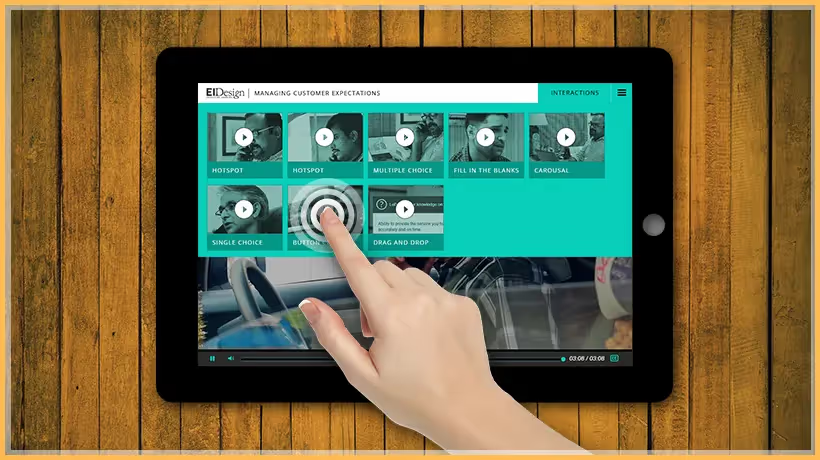
Interactive videos transform passive video consumption into active learning by embedding quizzes, hotspots, and branching scenarios that drive engagement and decision-making. They help improve retention and learner participation by integrating microlearning, gamification, and immersive experiences. This approach enables organizations to achieve higher cognition levels such as application and analysis in digital training programs.
The popularity of videos and increased use of mobile learning or mLearning have led to extensive usage of videos in online training. Even though videos appeal to the learners, they are passive. This article highlights how to use interactive videos for learner engagement by negating that passivity.
Why Use Interactive Videos for Learner Engagement?
Why use interactive videos for learner engagement? Well, videos are one of the most popular media driving the communication space today; and if the numbers are anything to go by, their influence is only going to get stronger in the years to come.
Here are some more stats from Wyzowl’s survey that show just how much video is still growing:
- An impressive 96% of people have watched an explainer video to learn more about a product or service.
- People watch an average of 16 hours of online video per week, which is a 52% increase in the last two years.
- In 2020, 86% of people would like to see more video from brands.
- People are twice as likely to share video content with their friends compared to any other type of content.
These are magical numbers for Learning and Development professionals who are experimenting with ways to leverage on the power of videos and craft learning solutions, especially for learners who would like to learn on mobile devices on the go.
What Makes a Great Interactive Video?
A great interactive video uses interactions purposefully to enhance the learning experience. Thoughtfully placed elements like hotspots, quizzes, and branching scenarios allow learners to actively engage with the content while reinforcing key concepts. These interactions should align with the learning objectives, providing opportunities for learners to explore and understand the material at their own pace.
Equally important is making the video engaging and entertaining. A compelling narrative, dynamic visuals, and interactive challenges can captivate learners and maintain their attention. By letting learners become a part of the story—whether through decision-making, problem-solving, or exploration—the video transforms into an immersive learning experience that keeps them motivated and invested.
Challenges of Passive Videos in Serious Learning
Passivity of videos can weigh down a serious learning experience (hampering the learners’ progress in meeting a specific learning outcome). This challenge becomes even more significant when:
- The run length of the video runs into a few minutes and the learner may find the session to be rather monotonous.
- The learners are required to learn, apply, and analyze (that is, achieve higher levels of cognition).
Benefits of Interactive Videos in eLearning
Interactive videos offer significant advantages over traditional videos in eLearning. They:
- Come with a proven 10X impact compared to normal videos.
- Facilitate pausing at specific instances and introducing learner interactions. This customization lets learners take a decision, making it a more personalized learning experience.
- Ensure that they remain engaged all the way to the end. The frequent interactivities are likely to keep them hooked at regular intervals, resulting in greater learner engagement.
Statistics reveal that on average 47% of the viewers watch a video till the end, which means that a majority (53%) of the viewers lose interest and opt out of the video even before they see the key message. A study found that with interactive videos, 35% of the businesses saw a better conversion rate and 25% reported better business turnaround in terms of revenue.
How Can You Use Interactive Videos for Learner Engagement and Achieve Clear Learning Outcomes?
As I have outlined, usage of interactive videos can create an engaging learning experience that will enable you to move the cognition levels from recall and retention to application and analysis.
At EI, we have created a customizable interactive video framework that allows us to integrate learning interaction levels that closely mimic the interactions of a traditional eLearning or mLearning course. In contrast to the several online solutions, our framework provides a highly interactive solution, which:
- Can be customized further, if required.
- Is designed to work across multiple platforms such as desktops, tablets, and smartphones (iOS and Android).
- Supports AICC, SCORM 1.2, 2004, and TinCan. It can be hosted on Learning Management System (LMS) /Learning Record Store (LRS) or run as a standalone piece on a web server.
- Comes with SCORM related features such as completion, time, resume, and scoring in LMS/LRS.
Types of Interactive Elements You Can Add to a Video
To enhance learner engagement, our framework supports the integration of a variety of interactive elements, allowing you to customize the video experience. These interaction points include:
1. Hotspots

2. Carousel
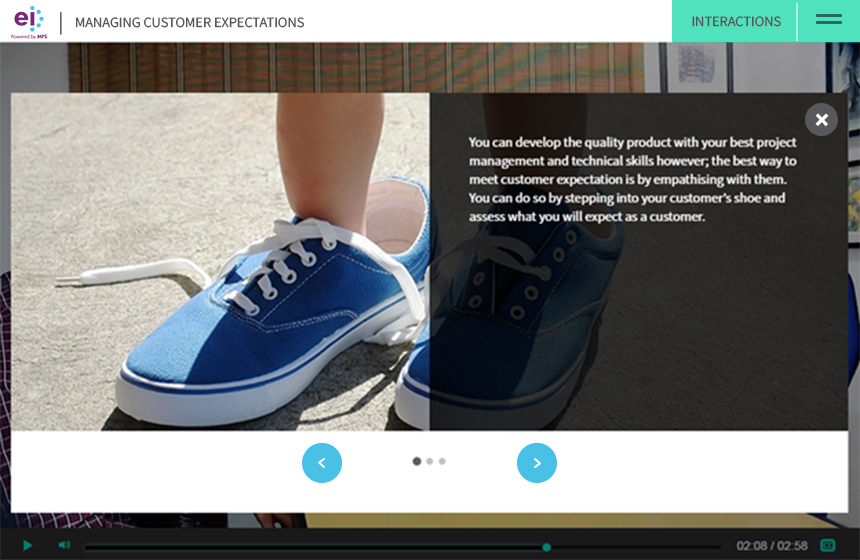
3. Button Click
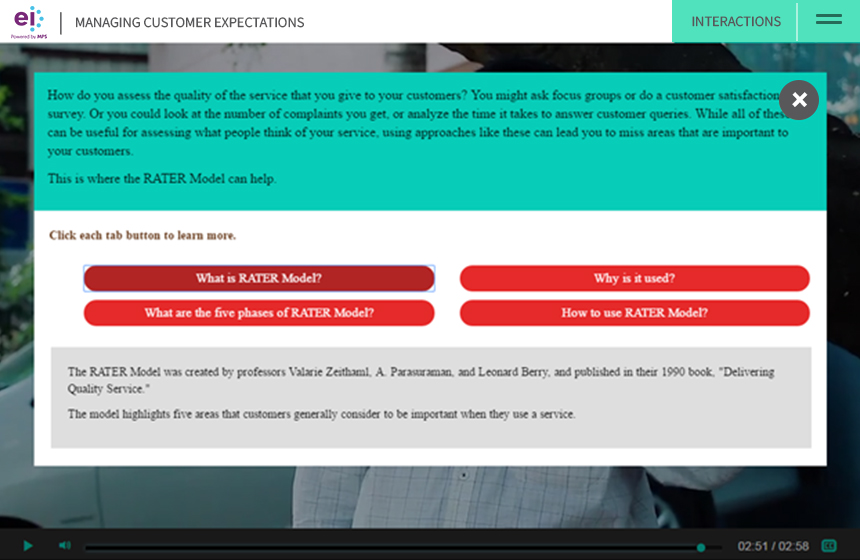
- Drag And Drop
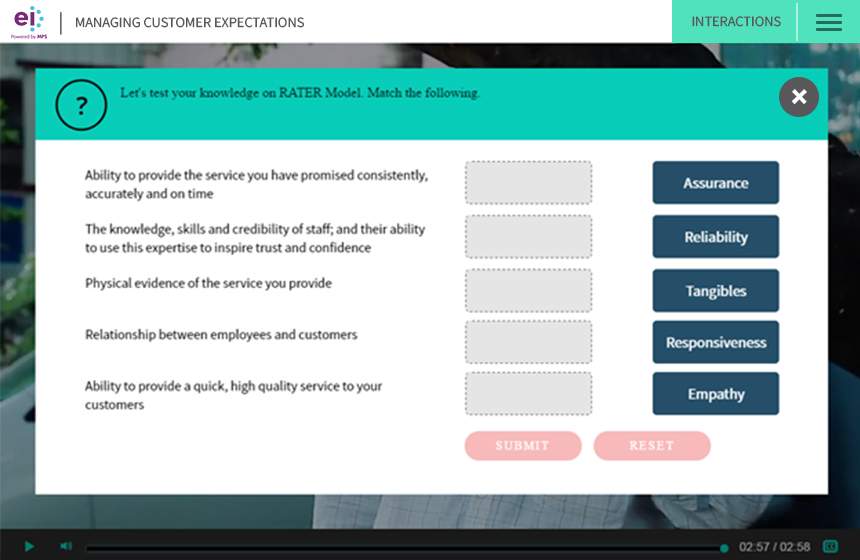
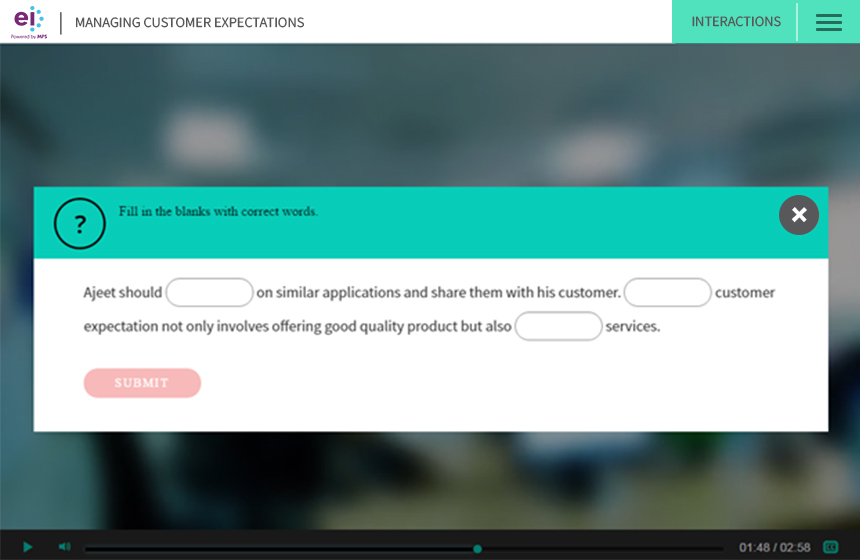
5. Fill In The Blanks
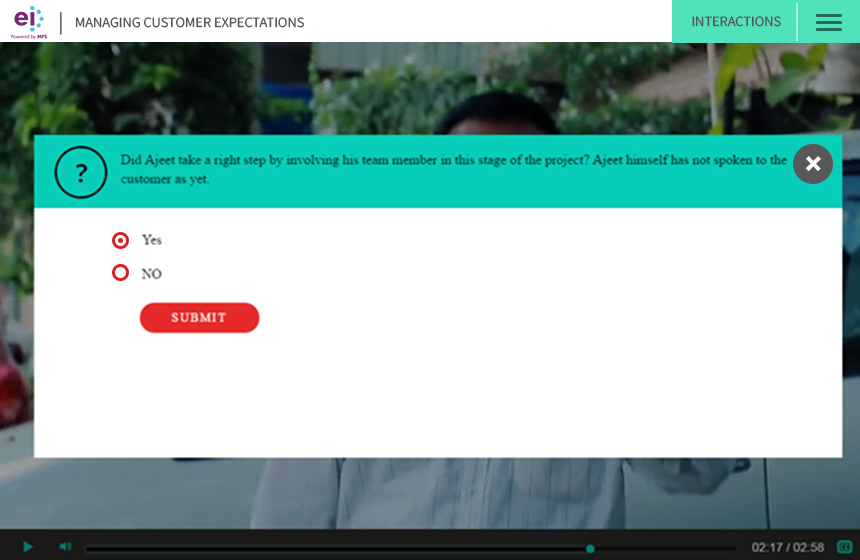
6. Single Choice Assessments
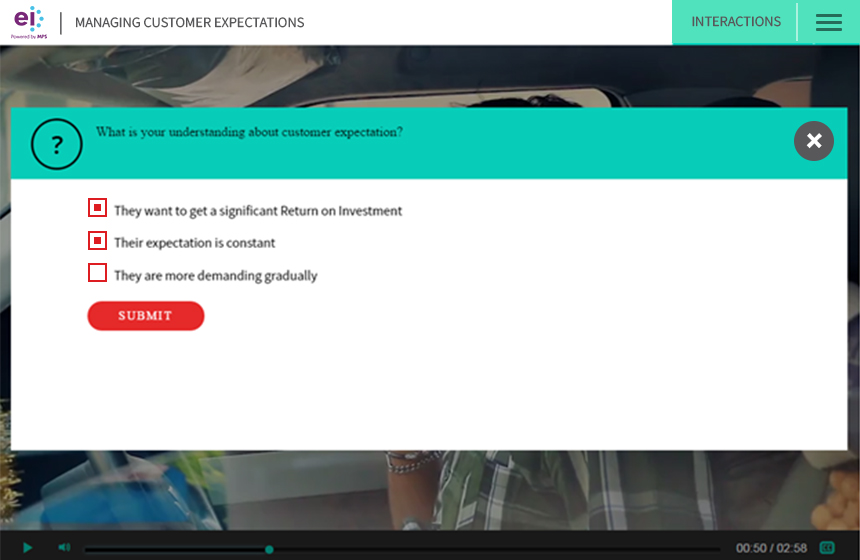
7. Multiple Choice Assessments
Interactive Video Strategies to Drive Learner Engagement
The interactive video based approach can leverage on existing proven strategies like microlearning, scenario-based learning, and gamification.
In fact, you can multiply the impact of interactive videos using the following strategies:
- Microlearning
You can design interactive videos as microlearning nuggets—either individual videos or a series connected in a learning path—allowing learners to consume content in small, digestible segments.
- Simulation Training
You can design realistic, scenario-based simulations that immerse learners in dynamic environments, allowing them to practice decision-making and problem-solving skills without real-world risks. These simulations provide immediate feedback, reinforcing learning and improving retention.
- Gamification
You can integrate elements of gamification in the scores of the assessments (badges or other forms of incentives) to further engage the learners.
- Immersive Learning
Utilizing virtual reality (VR), augmented reality (AR), or extended reality (XR) within interactive videos creates fully immersive learning experiences. Learners can explore 3D environments and participate in real-world simulations, enhancing understanding and skill application.
- AI-Based Roleplays
AI-powered roleplays enable learners to interact with virtual characters and make decisions that influence the outcome, mimicking real-world scenarios and enhancing critical thinking. These roleplays can adapt to the learner’s actions, providing a personalized learning journey that grows with their progress.
I hope this article has helped you understand the learning impact you can create by using the power of interactive videos in your eLearning or mobile learning solutions. You can integrate approaches of microlearning, gamification, and scenarios for decision making to further their impact and achieve the required learning outcomes.

subscribing!
Related articles


.jpg)
.jpg)






.jpg)
