






.avif)

A Practical Guide to Course Development for Corporate Learning Teams


Summary
This guide presents a disciplined 7-phase framework for corporate course development, bridging the gap between instructional design and real-world execution. By prioritizing backward design, clear RACI roles, and continuous evaluation, L&D leaders can build scalable, high-impact learning experiences that align directly with business KPIs.
Every organization depends on learning to drive performance, but many struggle to build courses that truly deliver results. The difference between an engaging, outcome-driven course and one that learners quickly forget often lies in the process behind it.
Course development is that process, a structured approach that turns learning goals into tangible, effective learning experiences. In today’s workplace, where teams are hybrid, skills evolve quickly, and digital delivery dominates, a disciplined course development process ensures learning remains aligned with business needs and learner expectations.
This guide outlines a proven, practical course development process designed for corporate learning and development (L&D) teams. It explains each stage, from analysis to evaluation, and highlights the tools, roles, and quality checks that help learning leaders deliver scalable, high-impact courses.
TL;DR / Key Takeaways:
- Use a seven-phase course development framework that starts with analysis and ends with continuous optimization to keep quality high and rework low.
- Apply backward design first. Lock measurable outcomes and assessments before you build content to protect timelines and ensure impact.
- Treat quality as a system. Add alignment, accessibility, usability, data, and localization checks at each phase, not just pre-launch.
- Define roles clearly with a simple RACI to prevent bottlenecks and accelerate reviews across L&D, SMEs, media, and platform teams.
- Plan for measurement from day one. Instrument xAPI or SCORM, tie learning data to business KPIs, and review results quarterly.
What Is Course Development in a Corporate Context?
Course development refers to the systematic process of designing, building, and deploying training programs that meet specific learning and business objectives. It includes defining learning outcomes, creating assessments, developing digital learning content, and evaluating effectiveness after rollout.
In corporate environments, course development goes beyond content creation. It’s about aligning training programs with strategic goals, improving performance, supporting compliance, or enabling digital transformation.
How It Differs from Course Design
While course design focuses on planning and structuring the learning experience (objectives, flow, assessment strategy), course development involves execution, building materials, incorporating interactivity, conducting reviews, and managing deployment.
For instance, design may specify that employees need to master negotiation skills through scenario-based learning, while development transforms that idea into an actual interactive simulation hosted on the company’s learning platform.
The two work hand in hand, but development ensures design intentions become real, measurable learning outcomes.
Effective course development combines learning science with empathy. Every phase, from planning to post-launch, should account for how people learn, what motivates them, and what barriers they face. Emotionally intelligent course development is both data-informed and human-centered, ensuring knowledge translates into real-world performance.
The Course Development Process: Phases, Activities, and Deliverables
A structured, repeatable course development process helps L&D teams move from concept to launch with clarity and consistency. It minimizes rework, ensures stakeholder alignment, and results in courses that meet learner and business expectations.

Below is a seven-phase framework that adapts best practices from established instructional design models such as ADDIE and Backward Design, but reinterprets them for the fast-paced, outcome-driven world of corporate learning.
Phase 1: Analyze and Align
The process begins by understanding the problem that training must solve. This involves defining learning needs, business objectives, and the success criteria that will determine whether the course delivers impact.
Key activities:
- Conduct learner and task analysis to identify skill gaps and learning needs.
- Interview stakeholders to define expected outcomes and metrics.
- Assess available resources, constraints, and delivery environments.
Deliverables:
- Problem statement and training goals
- Learner personas
- Success metrics and evaluation plan outline
Tip for L&D leaders: Always connect learning objectives to measurable performance outcomes, not just knowledge acquisition. This alignment will guide every subsequent phase.
Phase 2: Design Backward from Outcomes
In backward design, you start with the end in mind: what should learners be able to do by the end of the course? From there, you work backward to define assessments and the content needed to achieve those outcomes.
Key activities:
- Define specific, measurable learning outcomes (using Bloom’s Taxonomy).
- Identify assessment methods that validate skill application.
- Map learning content and activities to each outcome.
Deliverables:
- Outcome matrix linking objectives, assessments, and content areas
- Assessment blueprint (e.g., quizzes, simulations, or on-the-job performance tasks)
- Initial course outline
Corporate courses perform best when outcomes are both business-oriented and learner-centric. For example, “reduce customer complaint resolution time by 20%” ties learning to a visible business result.
Phase 3: Detailed Design
Once outcomes and assessments are clear, the next phase involves designing how the learning experience will unfold, what learners will see, do, and interact with.
Key activities:
- Choose delivery modalities (eLearning, blended, virtual classroom, microlearning, etc.).
- Create detailed storyboards and scripts for each module.
- Plan for accessibility, localization, and mobile responsiveness.
- Integrate feedback checkpoints and review cycles.
Deliverables:
- Design document or blueprint
- Storyboards, scripts, and prototype assets
- Interaction and accessibility plan
At EI, we blend design thinking with learning science to craft courses that connect emotionally as well as cognitively. Our storyboarding frameworks and prototype templates help organizations turn learning goals into interactive, inclusive digital experiences that scale seamlessly across devices.
Also read: How to Adopt a Learner-Centered Design Approach for Your Learning Programs
Phase 4: Develop and Build
This is where the course comes to life. Developers, designers, and subject matter experts collaborate to produce media assets, integrate interactivity, and assemble everything in the chosen learning platform.
Key activities:
- Build content using authoring tools (Articulate 360, Adobe Captivate, etc.).
- Produce multimedia elements such as videos, graphics, and animations.
- Conduct technical testing for navigation, responsiveness, and functionality.
- Integrate analytics or xAPI tracking to capture learner data.
Deliverables:
- Alpha or beta version of the course
- Asset repository and metadata
- Quality assurance report
Tip: Schedule short, iterative reviews rather than waiting until final delivery. Rapid feedback from stakeholders prevents scope creep and ensures alignment with business needs.
Phase 5: Review, Pilot, and Iterate
Before organization-wide rollout, conduct a pilot to validate content quality and usability. Feedback from real learners provides insights that internal reviews often miss.
Key activities:
- Run a small-scale pilot with a representative learner group.
- Gather data on engagement, comprehension, and usability.
- Implement revisions based on pilot results and stakeholder feedback.
Deliverables:
- Pilot feedback report
- Finalized content with approved revisions
- Updated QA checklist
Tip: Document all feedback and resolutions. This record becomes a knowledge base for future course updates and helps maintain consistency across programs.
Phase 6: Launch and Support
After the pilot is validated, the course moves into full-scale deployment. However, a successful launch goes beyond uploading content to the LMS; it involves change management, communication, and ongoing learner support.
Key activities:
- Prepare a detailed launch plan outlining rollout dates, audiences, and success criteria.
- Coordinate with internal communication teams to announce the course and its value proposition.
- Train facilitators or managers to reinforce learning at work.
- Set up help channels and FAQs to assist learners during the rollout.
Deliverables:
- Launch communication kit (emails, posters, banners)
- Manager enablement resources
- Support and troubleshooting plan
Tip: Courses often fail due to weak post-launch engagement. Sustained communication and reinforcement activities, such as weekly challenges or microlearning refreshers, keep momentum high and embed learning into daily workflows.
Phase 7: Evaluate and Optimize
Evaluation is the continuous thread that runs through the entire course development process. After launch, organizations must analyze performance data to determine whether learning objectives and business outcomes were achieved.
Key activities:
- Collect quantitative data from the LMS or LXP (completion rates, time spent, scores).
- Conduct qualitative assessments through surveys, interviews, and manager feedback.
- Map learning data to business metrics (e.g., productivity, quality improvement, reduced errors).
- Identify improvement areas and schedule content refresh cycles.
Deliverables:
- Post-implementation evaluation report
- ROI analysis
- Course improvement backlog for next release
Also read:
- Evaluating Steps to Measure Training ROI
- How to Use Employee Training Metrics to Measure Training Effectiveness and Impact
Roles and RACI for Course Development
A well-defined team structure ensures accountability at each stage. Many organizations underestimate the number of touchpoints required for efficient collaboration. Below is a simplified RACI (Responsible, Accountable, Consulted, Informed) model tailored for corporate course development.
EI recommendation: Maintain a transparent RACI tracker throughout the project lifecycle. It prevents delays, clarifies ownership, and ensures faster decision-making, particularly in large, distributed teams.
Quality Gates and Checklists
Each phase of course development should include specific quality checks to safeguard learning impact. These checkpoints not only improve consistency but also reduce maintenance costs later.
Key quality gates:
- Alignment Check: Ensure learning outcomes, content, and assessments map directly to business goals.
- Accessibility and Inclusivity Check: Confirm compliance with accessibility standards (WCAG 2.1) and inclusive design principles.
- Usability Check: Validate user navigation, flow, and media performance across devices.
- Data and Measurement Check: Verify that the right tracking mechanisms (xAPI, SCORM) are in place for analytics.
- Localization and Update Check: Prepare templates for translation, future edits, and content refresh cycles.
A simple quality scorecard at each phase helps L&D teams benchmark performance and streamline approval.
Practical Timelines and Risks to Watch
Even with a defined process, timelines vary by complexity, resources, and content type. A clear estimation framework helps L&D teams plan budgets and set stakeholder expectations.
Typical Timelines by Phase
Average development time for a mid-sized corporate eLearning course: 8–12 weeks.
Common Risks and Mitigation Strategies
Even with a well-defined framework, several practical risks can slow down or compromise the course development process. Recognizing these challenges early allows L&D teams to manage them proactively rather than reactively.
1. Scope Creep When new requirements are added after development begins, timelines and budgets can quickly spiral. To avoid this, finalize deliverables after the design phase and introduce a formal change-control process for any additions.
2. Limited SME Bandwidth Subject matter experts are often balancing their day jobs with course review responsibilities. Set clear expectations early, schedule review windows in advance, and provide structured feedback templates to save their time.
3. Technology Limitations Unclear technical requirements can lead to poor user experiences or last-minute rework. Test platforms and authoring tools during the planning phase, and validate compatibility with your LMS or LXP before full-scale development.
4. Low Learner Engagement A common pitfall is creating content that meets learning objectives but fails to connect with the audience. Build interactivity and relevance into every module, use storytelling, simulations, and real-world examples to sustain interest.
5. Lack of Measurement Strategy Without a data plan, even the best courses struggle to prove impact. Define success metrics and tracking mechanisms early, ideally during the analysis phase, so you can measure engagement, knowledge transfer, and performance outcomes after launch.
By anticipating these risks, corporate L&D teams can reduce development friction, maintain stakeholder confidence, and ensure courses deliver measurable, sustainable impact.
Tools and Platforms
The right technology ecosystem accelerates course development while maintaining quality. Below are common tools used across phases:
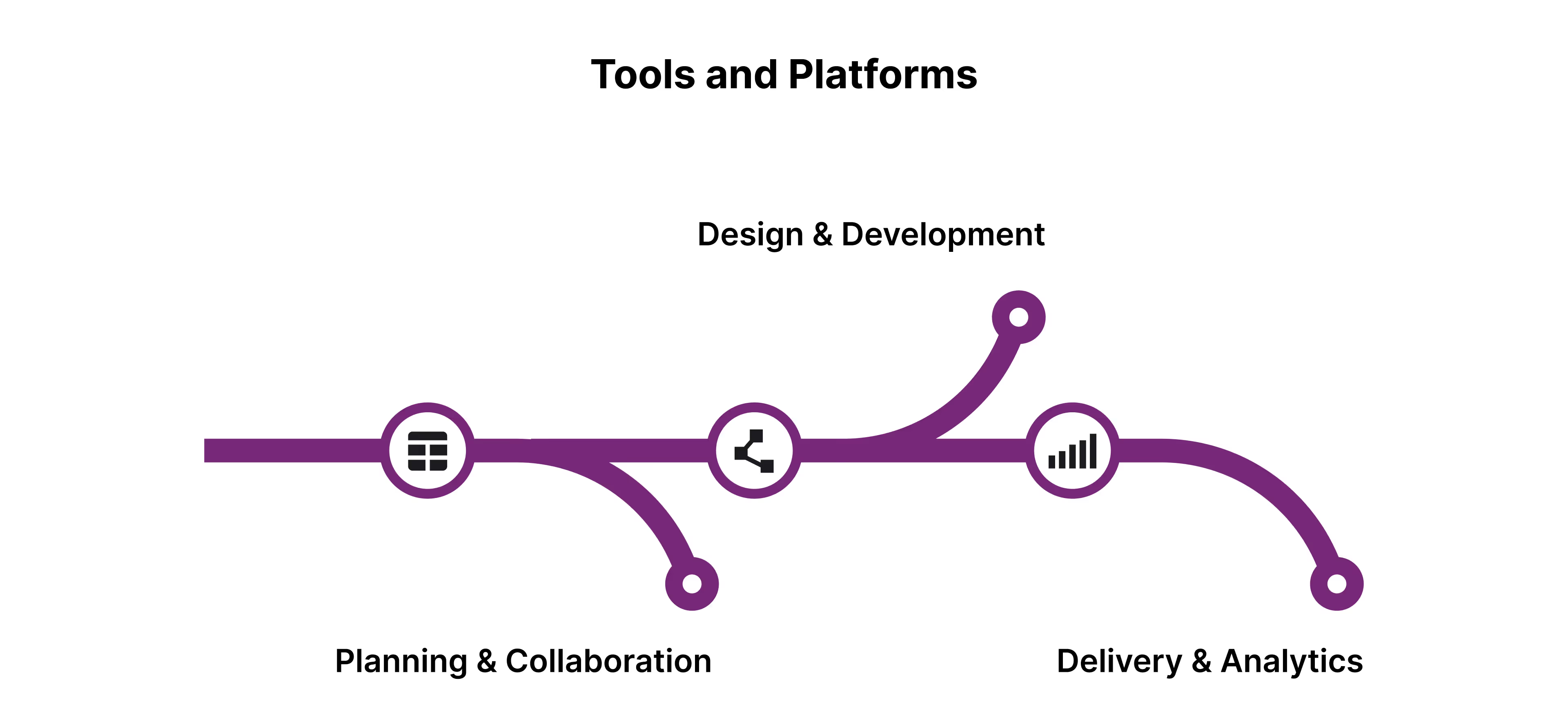
Planning and Collaboration
- Trello, Asana, or Monday.com for project tracking
- Miro or Lucidchart for process mapping
- Google Workspace or Microsoft Teams for documentation
Design and Development
- Articulate 360, Adobe Captivate, or dominKnow | ONE for eLearning authoring
- Vyond or Camtasia for video creation
- Figma or Adobe XD for interface and interaction prototypes
Delivery and Analytics
- Learning Management Systems (LMS) such as Moodle, Docebo, or Cornerstone
- Learning Experience Platforms (LXP) like EdCast or Degreed for curated learning pathways
- Learning Record Stores (LRS) and xAPI dashboards for data analytics
Note: The toolset should serve the strategy, not the other way around. Prioritize interoperability, accessibility, and data capture over visual flashiness.
How EI Helps
Course development isn’t just about content; it’s about building experiences that drive measurable performance outcomes. EI partners with global enterprises to design, build, and manage digital learning solutions that combine emotional intelligence, cutting-edge technology, and measurable impact.
We bring:
- End-to-end course development expertise from learning analysis and outcome design to storyboarding, development, and analytics integration.
- Agile and consultative delivery models that adapt to each organization’s learning culture and maturity.
- AI-powered personalization and data-driven insights that link learning engagement directly to business KPIs.
- Proven experience across industries, including BFSI, healthcare, IT, and professional services — with scalable frameworks for global L&D teams.
Our approach ensures your courses do more than transfer knowledge; they change behavior, elevate engagement, and accelerate business growth.
Also read: Optimize Learning Experiences with Our LMS Expertise
Conclusion
Effective course development goes beyond creating digital lessons; it builds organizational capability through structured, human-centered processes. By combining agile methods, measurable metrics, and continuous improvement, L&D teams can turn every course into a lever for performance and business growth.
At EI, we help organizations build emotionally intelligent learning programs that inspire change and deliver measurable impact. Our course development experts work closely with global L&D teams to align content, tools, and analytics into a single ecosystem that accelerates learning outcomes.
Let’s design your next high-impact learning experience together. Contact EI today→
Frequently Asked Questions (FAQs)
1) What is the difference between course design and course development?
Course design defines the learning outcomes, assessment strategy, structure, and experience flow. Course development executes the plan by building assets, integrating interactivity, running reviews, piloting, and deploying in the LMS or LXP. Design sets intent. Development makes it real and measurable.
2) How long does course development typically take?
A mid-sized corporate eLearning course often takes 8 to 12 weeks, depending on complexity, media needs, stakeholder availability, and review cycles. Pilots, accessibility checks, and instrumentation can add time but significantly improve quality and business impact.
3) Which tools should we choose for course development?
Pick tools that match objectives and tech constraints. Use an authoring suite for base modules, video and animation tools for clarity, and your LMS or LXP for delivery and analytics. Prioritize interoperability, accessibility, and data capture over visual flash alone.
4) How do we measure whether a course works?
Define success metrics during analysis. Track engagement, knowledge checks, and behavior change. Connect these to business KPIs such as productivity, quality, or customer outcomes. Review results after launch and iterate content quarterly.
5) When should we use blended learning instead of pure eLearning?
Use blended when skills require practice, coaching, or social learning. Combine short digital modules for core knowledge with virtual sessions, collaborative activities, or simulations for application and feedback.

subscribing!
Related articles


.jpg)
.jpg)





.jpg)
