






.avif)

DEI Training Guide for HR and L&D Professionals


Many organizations prioritize Diversity, Equity, and Inclusion (DEI) but often view it as primarily HR’s responsibility. This article outlines why DEI needs a mindset change and highlights DEI training strategies to drive that change.
What Is DEI Training?
DEI Training, which stands for Diversity, Equity, and Inclusion Training, is a program designed to enhance awareness and skills related to diversity in the workplace. Its primary goal is to foster a more inclusive and equitable environment for all employees, regardless of their background.
- Diversity: Refers to the representation of different groups in a company, including but not limited to race, gender, age, religion, disability, and sexual orientation.
- Equity: Focuses on ensuring fair treatment, equality of opportunity, and fairness in access to information and resources for all.
- Inclusion: Involves creating a work culture where all diverse groups feel welcomed, respected, and valued.
The training often includes:
- Awareness Building: Educating employees about different cultures, biases, and experiences.
- Skill Development: Equipping employees with tools to communicate effectively and empathetically with a diverse workforce.
- Policy Education: Informing about company policies regarding discrimination, harassment, and equity.
- Behavioral Change: Encouraging a shift in attitudes and behaviors to support a more inclusive workplace.
This type of training is crucial for creating a respectful and collaborative work environment, promoting better teamwork, enhancing creativity, and improving overall employee satisfaction and retention.
Benefits of Diversity Training
Diversity training in the workplace transcends mere procedural steps; it’s a transformational tool that brings a wealth of benefits. By enhancing cultural awareness, it nurtures a deeper understanding and appreciation of diverse backgrounds and perspectives. This, in turn, leads to improved communication, fostering a collaborative environment where innovative ideas and creative solutions thrive. Furthermore, embracing diversity not only leads to better decision-making and increased employee satisfaction but also bolsters the company’s reputation and minimizes legal risks.
Here are the top benefits of diversity training:
- Enhanced Cultural Awareness
Increases understanding and appreciation of different cultures and backgrounds.
- Improved Communication
Breaks down barriers in communication, leading to more effective collaboration.
- Greater Innovation and Creativity
Diverse teams bring unique perspectives, fostering innovation and creative problem-solving.
- Better Decision-Making
A variety of viewpoints can lead to more comprehensive and well-rounded decision-making.
- Increased Employee Satisfaction
An inclusive environment boosts morale and job satisfaction.
- Enhanced Company Reputation
Demonstrates a commitment to diversity, attracting a wider customer base and top talent.
- Reduced Legal Risks
Helps in complying with equal employment opportunities and anti-discrimination laws.
What are the Goals and Objectives of DEI Training?
DEI Training aims to cultivate an inclusive and equitable work environment, with objectives focusing on a set of clear goals. These objectives focus on raising awareness of diversity, equity, and inclusion issues, reducing unconscious bias, and fostering a culture of respect and inclusion. The training is designed to enhance cultural competence, ensure equality in opportunities, support compliance with legal standards, and boost collaborative teamwork by embracing diverse perspectives.
- Promoting Awareness
Raise awareness about diversity, equity, and inclusion issues.
- Reducing Unconscious Bias
Help individuals recognize and mitigate their own biases.
- Fostering Inclusion and Respect
Encourage respect for all individuals and their unique contributions.
- Improving Cultural Competence
Develop skills to interact effectively with people from various backgrounds.
- Creating Equity in Opportunities
Ensure equal opportunities for all employees.
- Facilitating Compliance and Risk Management
Adhere to legal standards and minimize risks related to discrimination.
- Enhancing Team Collaboration
Improve teamwork by embracing diverse perspectives and strengths.
The Importance of Diversity and Inclusion Training in the Modern Workplace
In the modern workplace, diversity and inclusion training is essential, especially for teams operating in hybrid or remote settings. It plays a pivotal role in promoting inclusivity, building virtual cultural competence, enhancing communication, ensuring equitable opportunities, and supporting mental health and well-being. This training addresses the unique challenges of a geographically dispersed workforce, ensuring that all team members feel valued and included, regardless of their location. Here is how DEI training helps create an inclusive, modern workplace:
- Promoting Inclusivity in Remote Settings: Ensures that remote and hybrid work models don’t create or amplify exclusionary practices.
- Building Virtual Cultural Competence: Facilitates understanding and respect among a geographically dispersed workforce.
- Enhancing Communication Across Barriers: Helps overcome communication challenges that can arise in virtual settings due to lack of non-verbal cues.
- Ensuring Equitable Opportunities: Addresses issues of visibility and representation, ensuring remote employees have equal access to opportunities.
- Supporting Mental Health and Well-being: Recognizes and addresses unique challenges faced by remote employees, fostering a supportive environment.
Challenges Organizations Face with DEI Training
Implementing DEI training in organizations faces several challenges, including resistance to change from employees, the inadequacy of one-size-fits-all training programs, and the absence of a long-term DEI strategy. Other significant challenges include difficulties in measuring the effectiveness of training programs, budget constraints, lack of sufficient leadership support, and cultural and language barriers that can hinder the inclusivity and comprehensibility of training for a diverse workforce.
- Resistance to Change
Employees might resist new training due to preconceived notions or discomfort with the subject.
- One-Size-Fits-All Approach
Generic training programs may fail to address specific needs or issues within the organization.
- Lack of Long-Term Strategy
DEI initiatives often lack continuity and long-term integration into company culture.
- Measuring Effectiveness
Difficulty in quantifying the impact and success of DEI training.
- Budget Constraints
Limited resources can restrict the scope and quality of DEI programs.
- Inadequate Leadership Support
Lack of commitment from top management can hinder the effectiveness of DEI initiatives.
- Cultural and Language Barriers
Challenges in creating training that is inclusive and understandable for a diverse workforce.
Types of DEI Training
Various types of DEI Training encompass crucial areas for fostering an inclusive workplace. Each type targets different aspects of diversity and inclusion, from enhancing awareness and reducing bias to developing specific skills for effective communication and legal compliance.
- Awareness and Sensitivity Training
This type of training is essential in educating employees about the variety of cultures, identities, and experiences present in the workplace. It plays a critical role in fostering respect and empathy, leading to better interpersonal relationships and a reduction in cultural insensitivity.
- Unconscious Bias Training
It focuses on identifying and addressing inherent biases that exist within individuals. This training is crucial for ensuring equitable treatment and decision-making in the workplace, ultimately reducing discriminatory practices.
- Inclusive Leadership Training
Aimed at leaders, this training equips them with the skills to create and maintain an inclusive work culture, which is fundamental for a positive and engaging workplace environment.
- Skill-Based Diversity Training
This training emphasizes practical communication and collaboration skills in a diverse workforce. It is vital for leveraging the full potential of diverse teams, enhancing overall performance and creativity.
- Legal and Compliance Training
It covers laws and regulations related to diversity and anti-discrimination in the workplace. This training is important for adhering to legal standards and promoting a safe and fair work environment.
- Cultural Competency Training
This training develops skills for effective interactions with people from various cultural backgrounds, essential in today’s globalized work settings. It improves business relationships and internal multicultural interactions.
- Allyship and Advocacy Training
It encourages understanding and support for marginalized groups within the workplace, creating a supportive environment where all employees feel valued and respected.
How Does Immersive Learning Drive DEI Training Success?
Immersive learning has emerged as a strong tool for making DEI training more impactful. Unlike traditional training formats, immersive experiences such as simulations, role plays, and virtual scenarios allow learners to step into someone else’s perspective and navigate complex workplace situations in a safe, engaging way. This fosters greater empathy, cultural awareness, and behavioral change, which are key outcomes of effective DEI initiatives.
By simulating practical workplace challenges, immersive learning:
- Helps participants experience bias, microaggressions, and exclusion from different viewpoints.
- Encourages reflection and empathy, creating stronger emotional connections.
- Provides opportunities to practice inclusive behaviors without the fear of real-world consequences.
- Reinforces learning through experiential engagement rather than passive consumption.
Applying Immersive Learning Strategies in DEI Programs
To maximize effectiveness, organizations can adopt the following strategies:
- Scenario-Based Learning: Use real workplace situations (e.g., inclusive leadership, handling bias, allyship) to build practical skills.
- Role-Playing and Simulations: Allow learners to switch perspectives (employee, leader, peer) to better understand diverse experiences.
- Interactive Storytelling: Use narratives that represent multiple cultural, gender, and generational contexts.
- Gamification Elements: Incorporate challenges, rewards, and feedback loops to sustain engagement.
- AI-Driven Personalization: Customize learning paths based on individual learner needs and progress.
Why Should DEI Be a Business Strategy and Not an HR Program?
Organizations succeed through integrated business strategies, not isolated plans from functional areas like procurement or HR, or the actions of individuals. However, some aspects of a business transcend individual functional areas because they impact every segment of the business – and Diversity, Equity, and Inclusion (DEI) is one such component. As such, DEI must be a comprehensive business strategy, not just relegated to HR.
DEI has a direct impact on organization-wide talent supply chains – from making the initial decision of hiring, to offering fair promotion choices, to making inclusive growth opportunities available to all employees. Building systemic diversity and inclusivity in these decision-making processes are what consequentially drives business excellence and performance.
However, due to inherent human biases in the workplace, many of which occur subconsciously, DEI doesn’t just happen automatically. This takes an organization-wide paradigm mindset change and using customized DEI training strategies are key to enabling such change in creating positive workplaces.
Embedding Inclusive Leadership and Building Capabilities
DEI training should go beyond expanding awareness to actively building organizational capabilities. Leaders need the tools and accountability to model inclusive behavior and to embed equity into systemic processes such as hiring, promotion, and performance reviews. When DEI principles are woven into leadership routines and organizational systems, inclusion moves from being an initiative to becoming part of how the organization operates.
This systemic approach ensures DEI influence is lasting and structural. It shifts focus from training as a one-off event to capability building: developing leadership behaviors that sustain inclusive practices and cultivating systems that reinforce equity consistently across the organization.
Why Is There a Need to Review DEI in Organizations?
Successful organizations thrive through a diverse set of ideas, thoughts, and approaches. A physically, culturally, ethnically, racially, and temperamentally homogeneous workforce is not likely to represent the diverse environment they operate in. Systemic workplace biases, in hiring, retaining, training, and promotion policies, which stymie diversity and inclusion, become entrenched over time.
This is especially true in hybrid workplaces, where:
- Decision makers (managers, supervisors, leaders) might not always hear, see, or communicate with rank-and-file employees.
- Additionally, because remote team members typically don’t interact (physically) with broader workforce colleagues, their biases are likely to remain ingrained.
In such environments, unspoken biases can erode an organization’s quest toward building equitable and inclusive workforces. It’s only through an objective and impartial review of DEI within the organization, supported by personalized DEI training strategies, that the presence of workplace imbalances might reveal themselves. The path to building an equitable and inclusive workforce often leads to creating a diverse workplace.
What Should Be the Top Objectives of Your DEI Training Strategies?
Although broad-based inclusion remains the primary goal of any good DEI training program, achieving three fundamental outcomes is crucial:
- Mindset Change
Change doesn’t just happen – it requires top-down mindset change to transform an organization’s DEI culture. One of the top outcomes of any training program must, therefore, be paradigm mindset change about DEI, its benefits, and why it’s needed.
- Overcoming Biases
The strategy must consciously aim to train leaders, managers, and rank-and-file employees how to recognize unconscious workplace biases and arm them with strategies to overcome those prejudices.
- Behavior Change
There’s extensive evidence (over 200 studies) showing that DEI is good for innovation, customer service, employee engagement, and long-term growth. However, implementing DEI policies – not just defining them – is how those benefits accrue. And that only transpires through behavioral change, and not just through policy statements. Training must seek to effect that change.
Research shows that without overarching DEI training strategies in place, it’s highly unlikely that organizations can achieve these outcomes.
What DEI Training Strategies Should Organizations Leverage to Change Mindsets, Overcome Biases, and Drive Behavior Change?
A set of customized training strategies is the only way to help overcome biases, change mindsets, and drive behavioral change. However, these strategies are ineffective if developed and deployed as independent, stand-alone programs. To be effective, L&D leaders must consider using a structured, proven DEI Learning and Performance Ecosystem approach as shown here to ensure meaningful mindset change occurs across the organization.
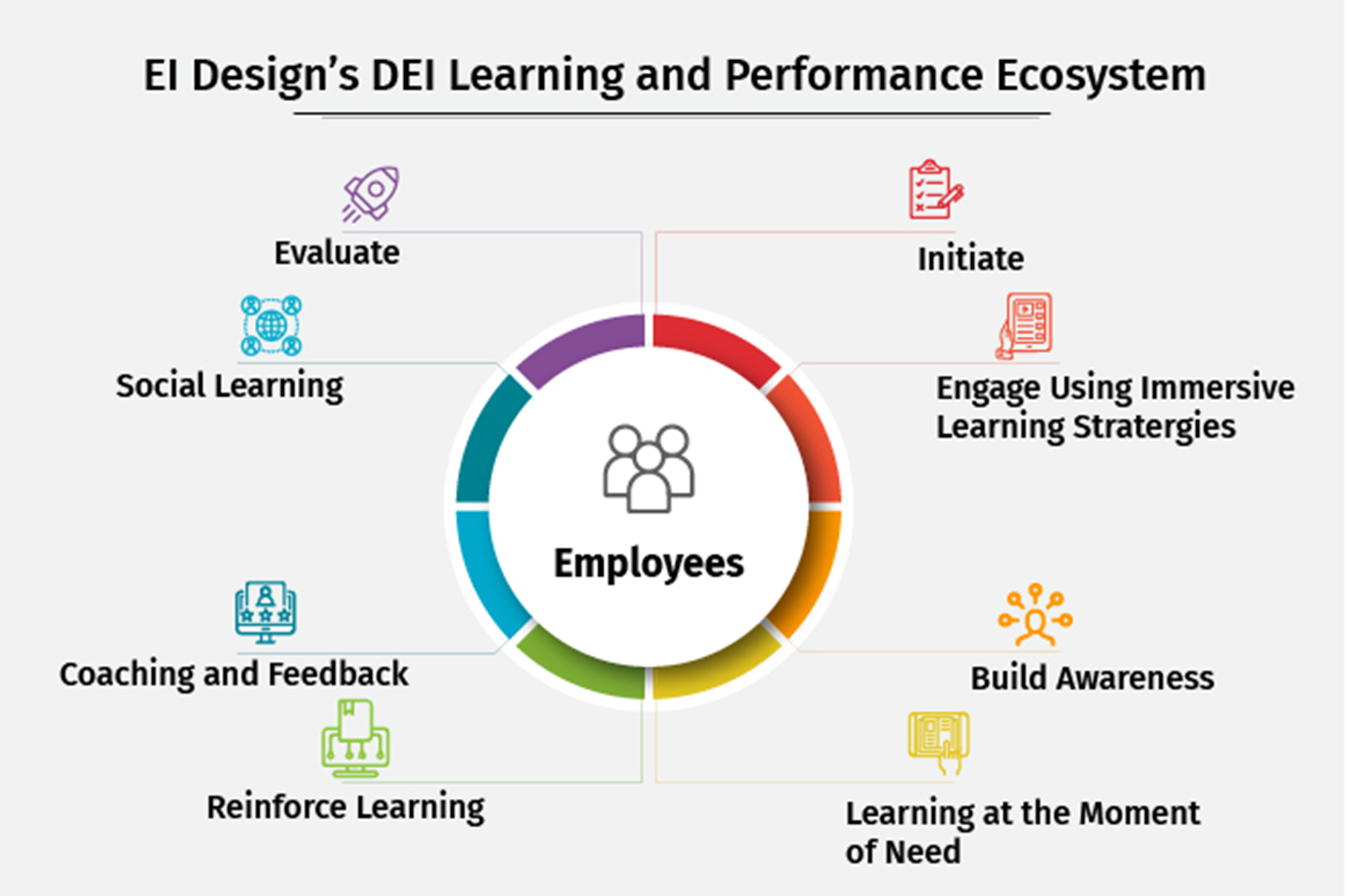
As part of this Learning and Performance Ecosystem, DEI leaders, in concert with L&D professionals, have various training strategies in their toolbox for developing custom-built DEI training.
Creating Awareness and Mindset Change
And that mindset change begins with initiating and creating awareness of the DEI Learning and Performance Ecosystem. Without such an awareness, employees – especially remote employees – won’t know what DEI resources are available to help them deal with their biases. A targeted awareness outreach is therefore key to leveraging the power of your DEI Learning and Performance Ecosystem in driving mindset change.
Reinforcing Learning and Other Job Aids
- Microlearning: The pace of learning, gaps between learning events, and the sheer volume of DEI-related information delivered may result in employees forgetting some of the lessons learned. Microlearning, the practice of reminding and reiterating prior learning through bite-sized content – such as short videos, podcasts, infographics, and PDF documents – is a great tool to battle that Forgetting Curve.
- Job aids: Most employees require specific and timely support at a time of need – when they’re grappling with a challenge on the job. This is especially true with remote and hybrid employees who don’t have access to the same support systems as their on-premises or in-office counterparts. L&D employees can prepare specific job aids and performance support content to help employees change old habits. These may include practice exercises, branching simulations, and how-to videos that employees may access to review and recall learning related to specific DEI challenges they face at the moment.
Coaching, Feedback, and Social Learning
- Blended learning: Blended learning, through a mix of Instructor-Led and Virtual Instructor-Led Training (ILT/VILT), is highly effective for including a cross-segment of the workforce in DEI training, especially remote and hybrid employees. Instructors can use facetime and live interactions to provide feedback, coach, and offer encouragement to participants during in-person check-ins and one-on-one interactions.
- Social learning: Creating diverse social learning circles to facilitate collaboration with other employees, with diverse backgrounds, helps employees understand the importance of diversity. This strategy is especially effective for remote and hybrid workplaces, where the entire organization – comprising employees with diverse backgrounds – isn’t always co-located. Including SMEs and other thought leaders with divergent social, cultural, and ethnic backgrounds, within those social circles, also furthers the goals of DEI training strategies.
Because of the growing number of hybrid workplaces, it’s important that L&D leaders implement these DEI training strategies as blended learning, instead of delivering them primarily as in-person or 100% self-directed training. A blended approach offers DEI coaches the opportunity to also interact with remote learners and gives them (instructors) the chance to address the subconscious biases within that group of employees.
The DEI Learning and Performance Ecosystem, based on the strategies highlighted here, must be part of an iterative process – L&D leaders must continually evaluate quantitative metrics, viz. the impact of these strategies, and then iterate changes to the model based on the assessment of the outcomes accomplished. The DEI Learning and Performance Ecosystem is key to fostering employee engagement. This approach – building awareness, implementing the strategy, assessing the outcomes, and revising the model if required – is critical to shifting mindsets, overcoming biases, and driving behavior change across the organization.
Parting Thoughts
Organizations that view DEI as an “HR thing” are bound to fail in their attempts at building a truly diverse and inclusive workforce. Achieving organization-wide equity and inclusiveness requires a mindset change – one often driven by senior leadership and rooted in customized DEI training strategies.
This article has highlighted several customized DEI training strategies that you can use to facilitate broader inclusion in the workplace, by changing mindsets across the company.

subscribing!
Related articles


.jpg)
.jpg)






.jpg)
