






.avif)

7 Examples of Mobile Learning that Elevate the Hybrid Workforce Learning Experience


Today, Mobile learning is a “must-have” training strategy for the hybrid workforce. In this article, I share mobile learning examples featuring continuous learning and how you can use it for rapid upskilling/reskilling of hybrid employees.
What is mLearning?
mLearning, or mobile learning, refers to an educational approach where learning material is accessed and consumed through mobile devices like smartphones and tablets, facilitating learning anytime and anywhere. This method emphasizes flexibility, convenience, and personalized learning experiences.
Why Is Mobile Learning a ‘Must Use’ Strategy in the Hybrid Workplace?
The integration of mobile learning in today's hybrid workplace is essential. The shift in work culture since the pandemic, with an increase in remote and mobile work arrangements, necessitates a reevaluation of training methodologies. In this new hybrid landscape, mobile learning emerges as a critical component, enabling employees to learn flexibly and "on the go."
This era is also marked by rapid business transformations, making mobile learning a key strategy for the fast-paced upskilling and reskilling of employees. By adopting a Learning in the Flow of Work (LIFOW) model that blends learning with daily activities, organizations can effectively keep pace with evolving business needs. This approach not only benefits employees but also provides valuable insights for L&D professionals and learning managers, who can learn greatly from successful mobile learning implementations.
Why is Mobile Learning a Must-use Strategy?
Mobile learning, evolving from traditional eLearning, is a versatile approach that spans across various devices such as smartphones, tablets, laptops, and desktops. It offers learners the flexibility of engaging in education anytime and anywhere, tailored to their pace and device preference.
Key reasons for its increased adoption include:
- Shift in Learner Demographics: With a workforce increasingly comprising millennials and Gen Z, there's a preference for training accessible on personal devices, especially smartphones.
- Changing Learning Preferences: Modern learners favor immediate, context-specific learning available in their workflow, without the need to navigate complex systems.
- Diverse Device Utilization: Flexibility in choosing the learning device, be it for in-depth courses or quick information nuggets, is a priority for learners today.
- Advancements in Technology: The growth of sophisticated authoring tools and LMS platforms enables the creation of both adaptive and responsive content, suitable for various devices.
The Role of Mobile Learning in Enhancing Employee Engagement and Performance
Mobile learning's effectiveness in a corporate setting hinges on several factors:
- Initial Learner Engagement: Mobile learning excels in making the first impression with its accessibility and ease of use, encouraging higher course completion rates.
- Learning Retention: The use of engaging strategies like microlearning, gamification, and scenario-based learning in mobile formats enhances knowledge retention and application.
- Practical Application: Mobile learning, particularly in microlearning formats, aligns well with the need for on-the-job training and support, allowing learners to access critical information and practice new skills on their preferred devices.
Adopting mobile learning can significantly boost learner engagement, resulting in tangible improvements in employee performance and business outcomes.
How to Leverage Mobile Learning in Corporate Training?
One key advantage of mobile learning, over traditional eLearning or classroom-based training approaches is that it empowers learning “on the go” and permits employees to learn using any device of their choice. That’s why mobile learning needs to be a part of any training strategy for hybrid workplaces.
You can harness the power of mobile learning beyond “anytime, anywhere” to an approach that aligns to learner asks in the changed workplace dynamics as shown here.
- Leveraging mobile learning across the 70-20-10 model.
Many mobile learning examples leverage the 70-20-10 model, developed by Morgan McCall, Robert Eichinger, and Michael Lombardo at the Center for Creative Leadership. In a hybrid work environment, when used effectively, mobile learning can be leveraged across the learning spectrum defined by the 70-20-10 model, including for informal learning – which provides 70% of learning; just-in-time learning, which contributes to 20% of learning to hybrid employees; and formal learning, which rounds up the remaining 10% of corporate learning.
- LIFOW and moment of need learning.
Hybrid employees typically don’t have the level of in-house support that comes with working in the office. The primary objective of LIFOW (Learning in the Flow of Work) is to create an ecosystem of Learn-Practice-Apply. Hybrid learners, who face a work problem, can learn something quickly, apply that learning to the immediate work challenge, and move forward with their work lives. Using just-in-time learning aids can help mobile learners achieve this objective. Hybrid employees can access bite-sized learning content, such as video-on-demand, when faced with an immediate work problem – such as “How to use ‘Search’ in the new LMS.” They can quickly learn and practice that skill, and then apply it to solve the issue at hand.
- Self-directed learning.
The new hybrid work paradigm is characterized by a workforce that’s largely independent (remote) and self-directed. By making bite-sized learning nuggets available to hybrid employees, which are consumable on mobile devices, mobile learning can become an ideal tool to assist those employees to embrace a path of continuous learning. A learner-centric approach to mobile learning will also help self-directed learners create their personalized learning journeys.
- Offsetting the Forgetting Curve and for reinforcement learning.
The fast-paced hybrid work environment means employees must continually learn and apply new knowledge, information, and ideas in their workplace. This leaves room for employees to forget seldom-used processes and procedures. There are many ways through which mobile learning can help offset the Forgetting Curve and assist employees in continually revising and reinforcing previously learned skills, notably through flashcards, cheat sheets, PDF documents, checklists, and so on.
In support of dealing with the challenges of the Forgetting Curve, mobile learning is also a great tool to encourage a culture of continuous learning. This is especially relevant in hybrid workplaces, where remote employees typically can’t access on-demand, in-person peer support.
- Driving deliberate practice.
Practice makes perfect, and deliberate practice, using mobile learning aids and tools, helps extend the effectiveness of formal learning. Trainers can use a range of mobile learning examples, such as simulated exercises, quizzes, and video content, to encourage a culture of continuous practice to hone previously learned skills.
What Strategies Can You Adopt to Enhance the Impact of Your Mobile Learning Programs?
Training leaders can adopt some of the following strategies to augment the impact of their mobile learning programs for hybrid learners:
- Mobile Apps for learning – Many hybrid employees carry their mobile devices 24×7 and use them as work aids. A learning app can push learning nuggets – Tips and Techniques, Thought of the Day, Top 5 Things to Remember – to help remote employees stay on top of what they need to learn.
- Gamification – Because of a greater propensity for distractions and interruptions, it’s easier for hybrid employees to disengage from learning. Gamification, as part of a successful mobile learning strategy, can make learning more engaging and appealing to remote employees.
- Microlearning – Hybrid employees typically work “on the go.” This means they usually access training on mobile devices. Microlearning strategies, using condensed courses, abridged content, and small-footprint learning aids (light on graphics and shorter in length), can help hybrid learners better absorb and apply mobile learning content to the workplace.
- Videos – Make these short and succinct and go easy on the graphics. Video-based mobile learning examples may include summarizing key policies and procedures or offering quick (3 to 5-minute) instructions on how to perform a specific task.
- Social learning – Hybrid employees might not work alongside or at the same time as their colleagues. To bridge that gap, training managers may leverage social media platforms and other moderated social learning opportunities.
mLearning programs must adapt to each organization’s needs. If some of the above strategies don’t work well for your organization, you may leverage others such as Podcasts, Interactive videos, Virtual Reality, Augmented Reality, Infographics, and Simulations to support diverse and modern formats of learning.
What Formats of Mobile Learning Work Better in the Hybrid Workplace?
Not all hybrid workplaces are alike, and not every training strategy is identical. Each has its unique needs and constraints. There are, however, several successful mobile learning formats that L&D leaders may adapt into their own training strategies.
- Podcasts: Create 5-minute daily/weekly podcasts, about topics of workplace interest, that hybrid employees can listen to during work breaks, or while running personal chores.
- Micro-videos: When designed as small-form-factor content, a hybrid learner can quickly download and watch micro-videos. These videos can serve multiple purposes, including as quick job aids, review, and reinforcement learning tools, and as learning content to be watched between meetings or tasks.
- Simulations: These may be in any format – videos, infographics, or 3D content. Hybrid employees can use them to quickly understand critical aspects of a workplace challenge – How to enter a complex sales order; Basics of troubleshooting; What to do before submitting an expense report etc.
- PDF checklists: Hybrid employees can use these checklists as aids in doing less-frequently performed tasks. For example, ensuring they’ve addressed all critical requirements before submitting their annual performance review package.
- “How to…guide”: Great mobile learning formats for this use case may be to supplement other forms of learning content. For instance, typically under-pressure hybrid employees might not have the time to review a 1,000-page QA manual each time they review a client’s credit application. A 1-page interactive flowchart, titled “How to validate credit worthiness…” could quickly lead them through the process. It’s important to note that this format does not supplant the 1,000-page manual. It simply acts as an alternate job aid in expediting a particularly tedious work process.
- Online templates: Because hybrid employees might not work the same shifts or identical hours as fellow teammates, pre-populated templates are good mobile learning formats for training them on new processes and procedures. Trainers may create templates that address frequently encountered work situations and host them online. Hybrid employees may access these resources, either in a time of need, or even peruse them as learning tools, and learn best practices from them.
- Practice quizzes: Design a series of micro-quizzes that employees can access online, anytime, using any device, and from anywhere. For instance, to supplement a course about the new HR System, hybrid employees may test their knowledge using multiple choice quizzes on various topics – Filling Timesheets; Reporting Workplace Harassment; Complying With New Health Mandates.
Use Cases of Mobile Learning Across Various Training Needs
- Compliance Training:
Compliance training often requires regular updates and refreshers. Mobile learning allows employees to access the latest compliance information in real-time, ensuring they are always up-to-date with regulatory standards. This format also supports quick, periodic assessments to reinforce compliance knowledge.
- Sales Training:
Sales teams benefit from on-the-go access to training materials. Mobile learning offers sales professionals immediate access to product updates, market trends, and sales techniques, crucial for their dynamic work environment.
- Leadership Development:
For leadership training, mobile learning provides flexibility for busy executives to engage in learning at their convenience. It supports varied content types like podcasts and videos for leadership insights, encouraging continuous personal and professional development.
- Technical Training:
Mobile learning allows technical staff to access complex training materials and tutorials directly on-site, offering practical, hands-on learning experiences. This is particularly useful for industries like manufacturing or IT.
- Customer Service Training:
For customer service teams, mobile learning can provide immediate access to communication skills training, product knowledge, and customer handling techniques, which is essential for real-time customer interaction.
- Onboarding:
New employees can benefit from the flexibility of mobile learning to undergo orientation and understand company policies at their own pace, making the onboarding process more efficient and engaging.
Examples of Mobile Learning in the Hybrid Workplace
Through 7 examples, I illustrate how mobile learning can help today’s learners at each juncture of their day – at work, during their free time, or over the weekends.
With this approach, you will be able to relate to how easily you can scale your employee training with mobile learning – particularly in the hybrid workplace.
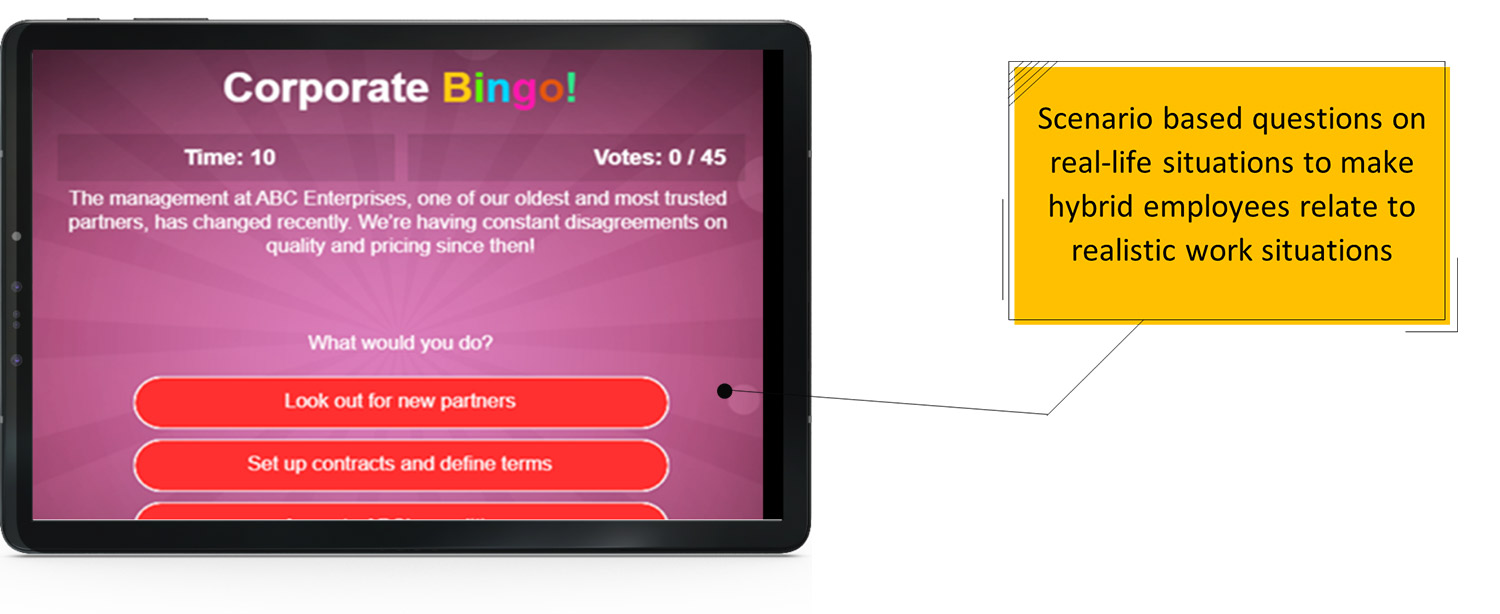
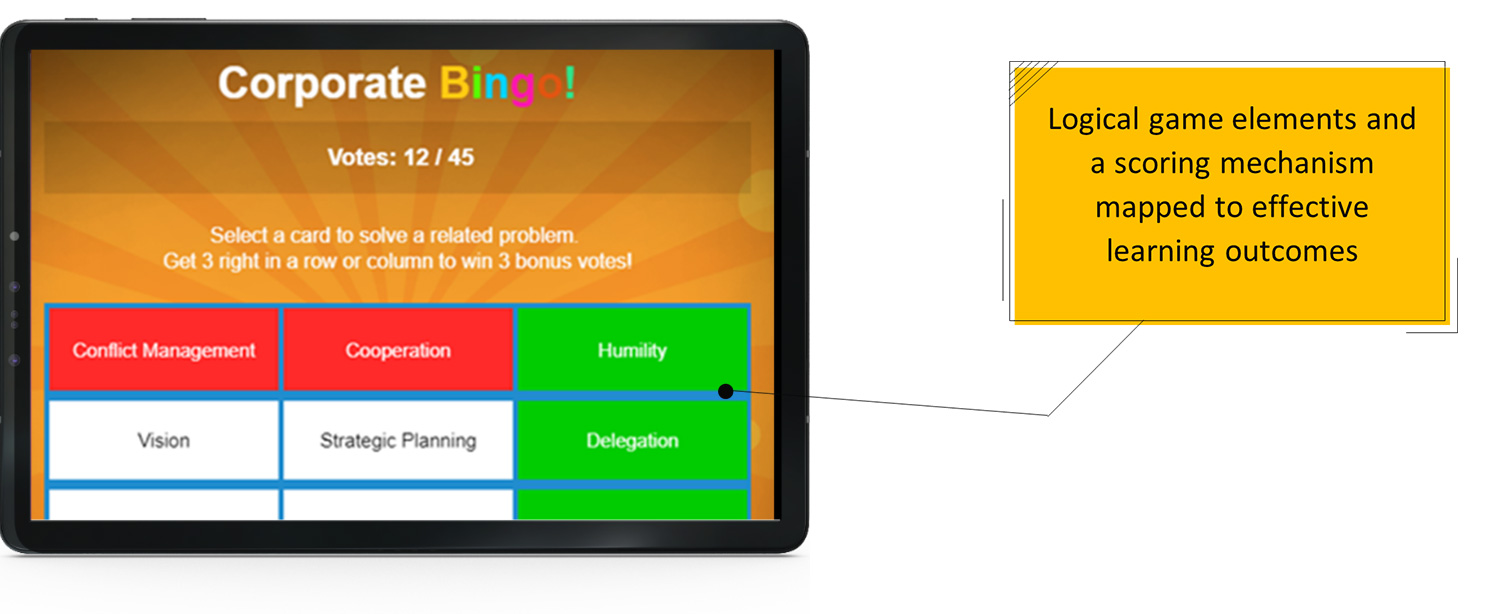
Mobile Learning Example 1 – Engaging Mobile Learning Combined with Gamification for Leadership Training
The purpose was to train learners on key leadership traits using a gamified approach. Just the way in-person leadership trainings can be made impactful with activities and role-plays, online training needs scenarios, gamification, and engaging interactions for real impact.
The approach taken in this example did just that. Here’s how:
- Scenario based questions on real-life situations were used to make hybrid employees relate to realistic work situations.
- Time limits were applied to increase engagement and make the activities competitive.
- Logical game elements and a scoring mechanism were mapped directly to learning outcomes that suited the needs of hybrid employees.
- Rich visuals were used to make the learning engaging and appealing.
- The User Interface was designed to work best for hybrid employees who were “on the go.”
Mobile Learning Example 2 – A Word Game for Cybersecurity Training
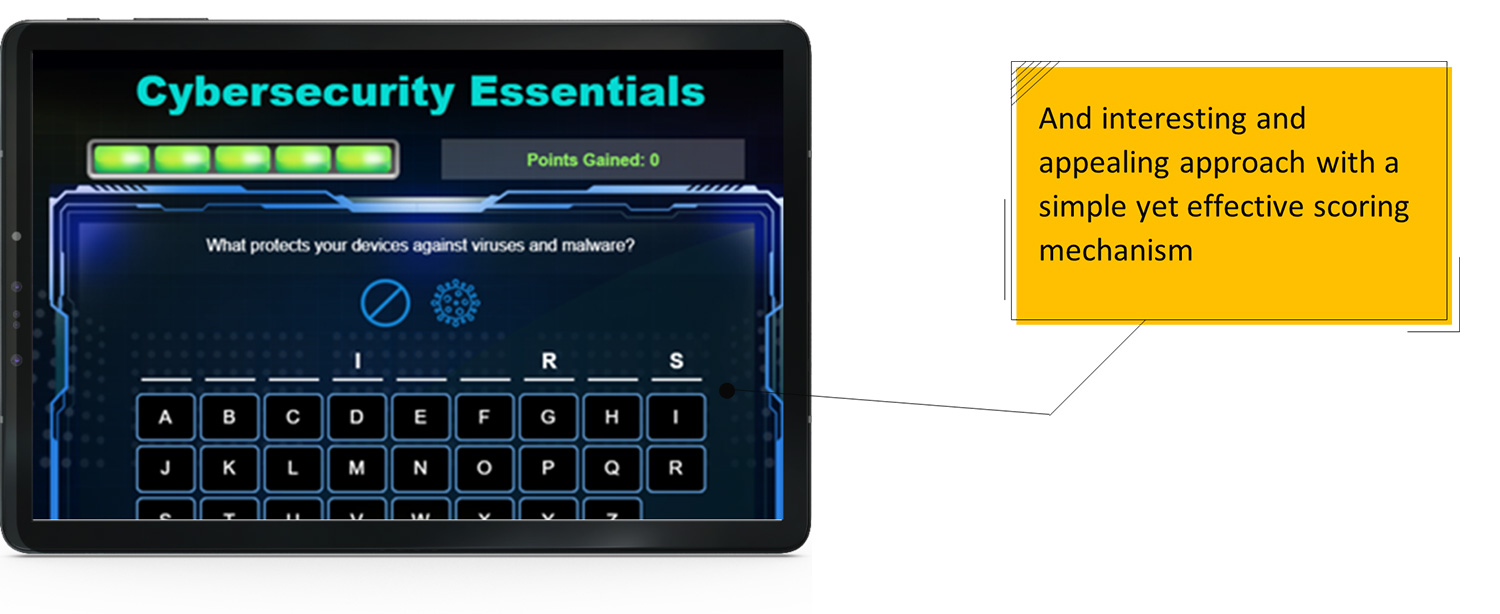
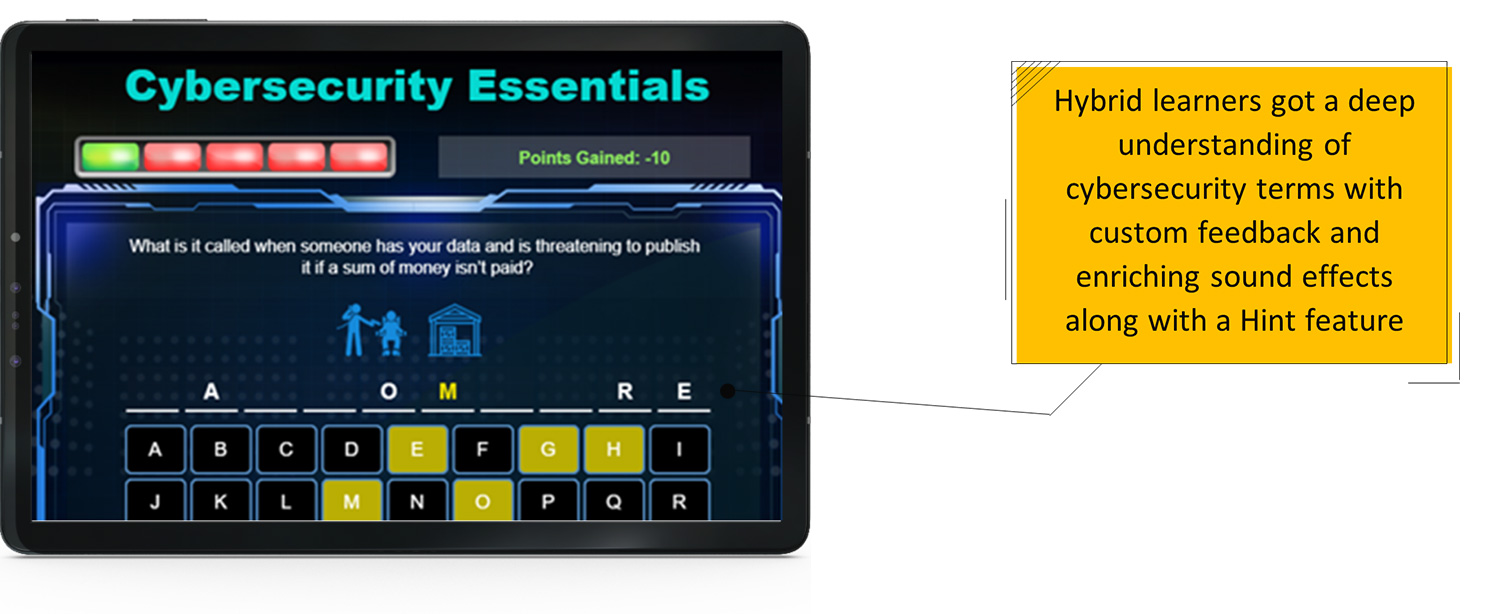
The goal of this training was to help hybrid employees understand key cybersecurity terms. The approach used made the experience interesting and appealing to learners.
Here’s the approach in a nutshell:
- The experience was based on a relatable offline board game, so hybrid employees could quickly relate to it.
- Custom feedback and enriching sound effects were used to enrich learners’ understanding of cybersecurity terms and boost their recall.
- Hints were used to address the needs of hybrid learners with varied levels of expertise.
Mobile Learning Example 3 – Creative Mobile Learning with Gamification for Etiquette Training
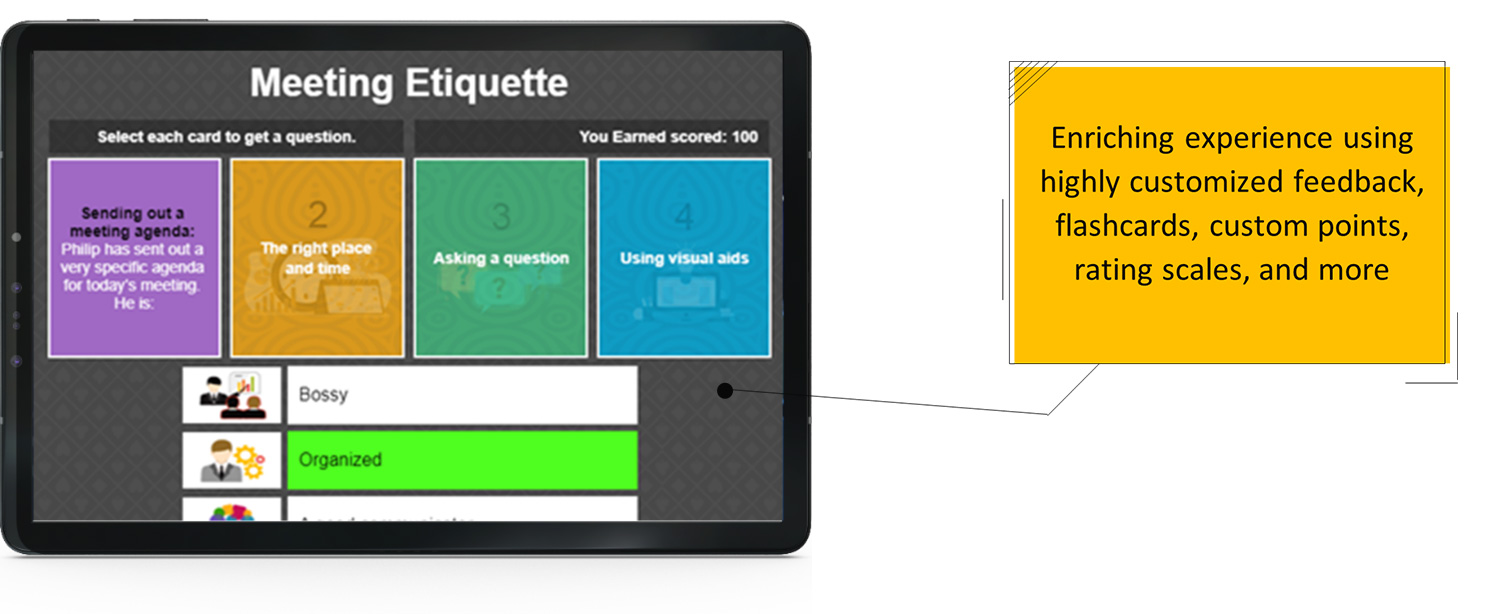
This training was designed to train and evaluate hybrid employees on their knowledge of meeting etiquettes.
Here’s what it entailed:
- An enriching experience created using highly customized feedback, flashcards, custom points, rating scales, and more.
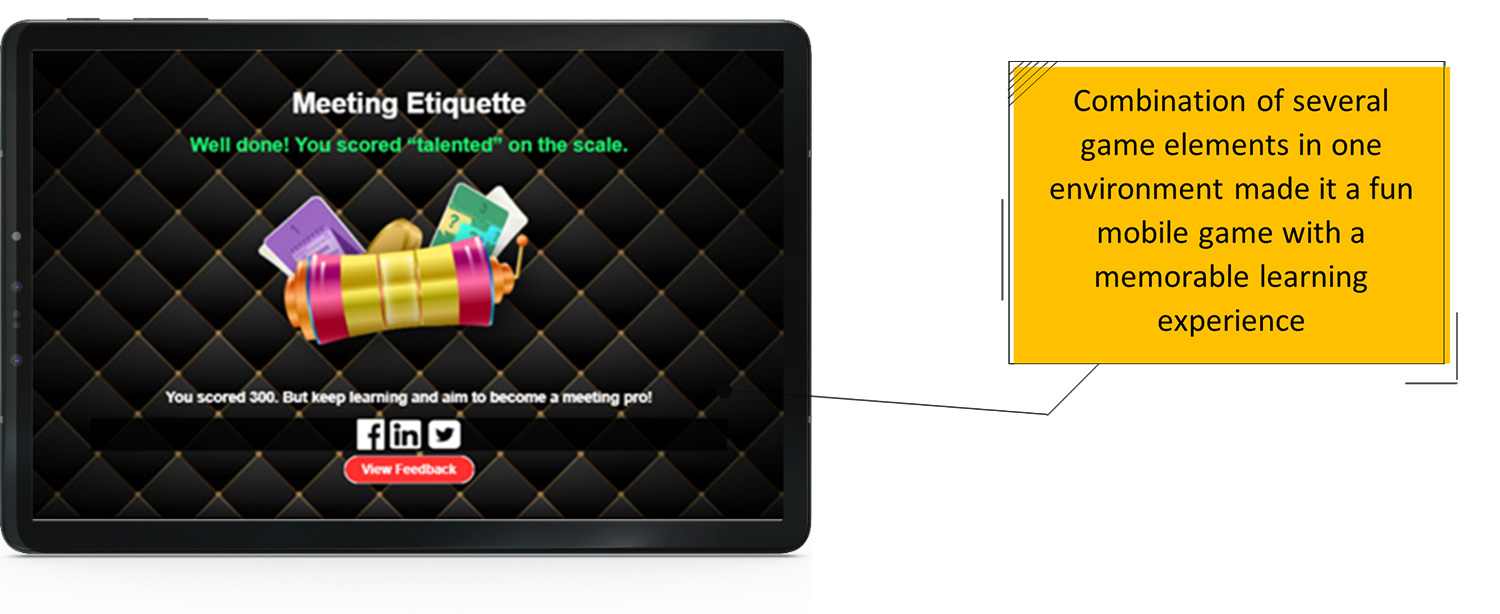
- The combination of several game elements in one environment made it not just a fun game, but also a memorable learning experience.
Mobile Learning Example 4 – Story-based Gamification with Negative and Positive Reinforcements
The requirement was to create an impactful Compliance course that would allow learners to explore the impact of their decisions.
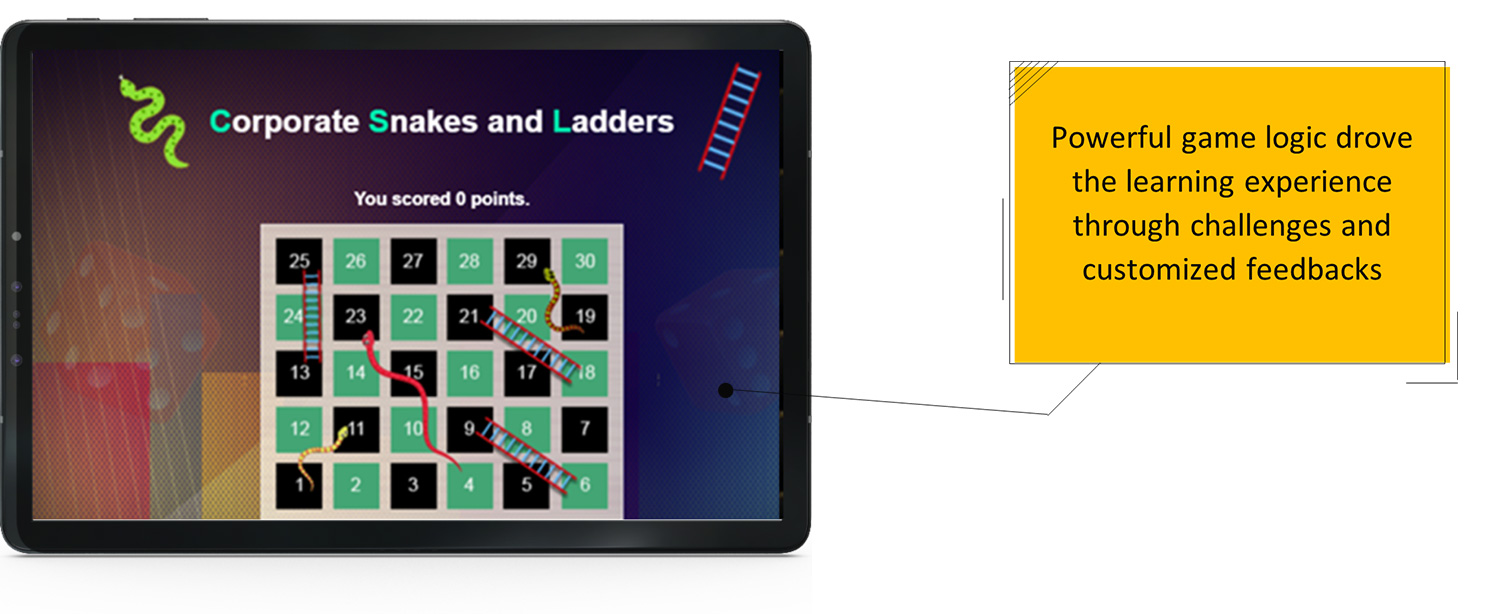
- The approach used a character, a story, and a powerful game logic drove the learning experience through challenges and customized feedback.
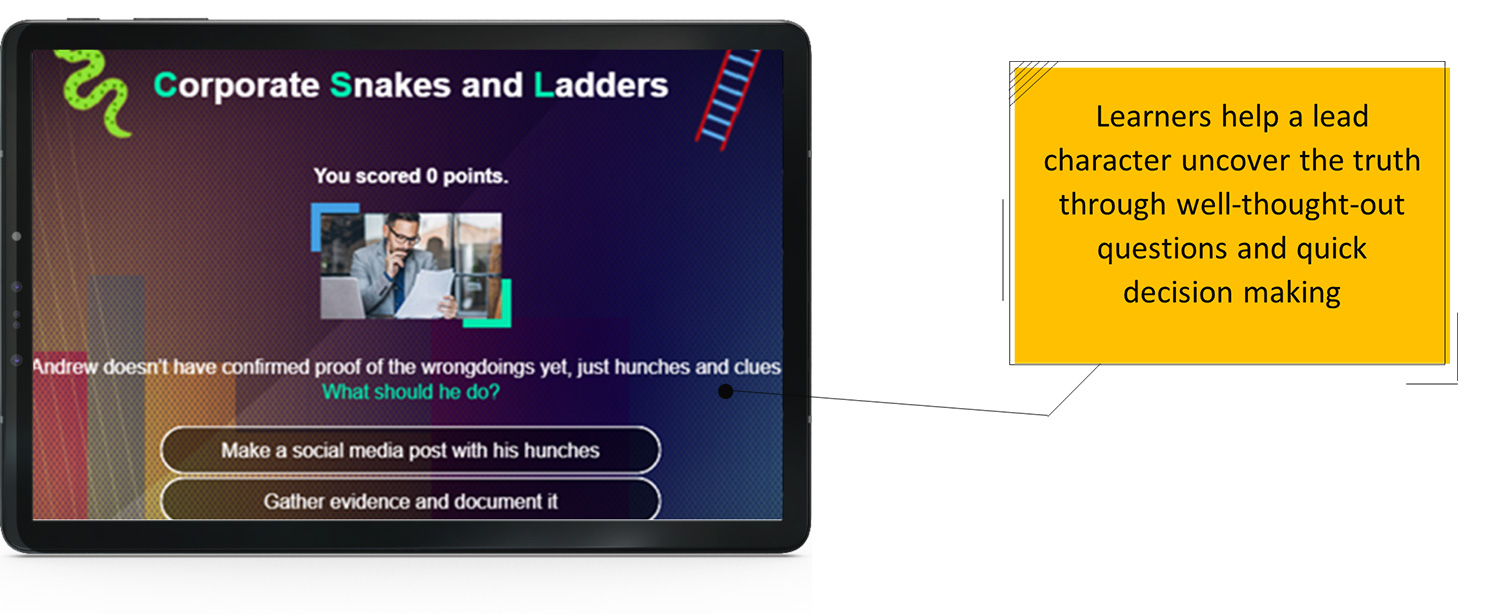
- Learners were made to help a lead character in his journey of uncovering the truth using well-thought-out questions and quick decision making.
- Good decisions took them ahead and bad ones took them a few steps back. This way, constant reinforcements through a story made the learning fun and effective for hybrid employees.
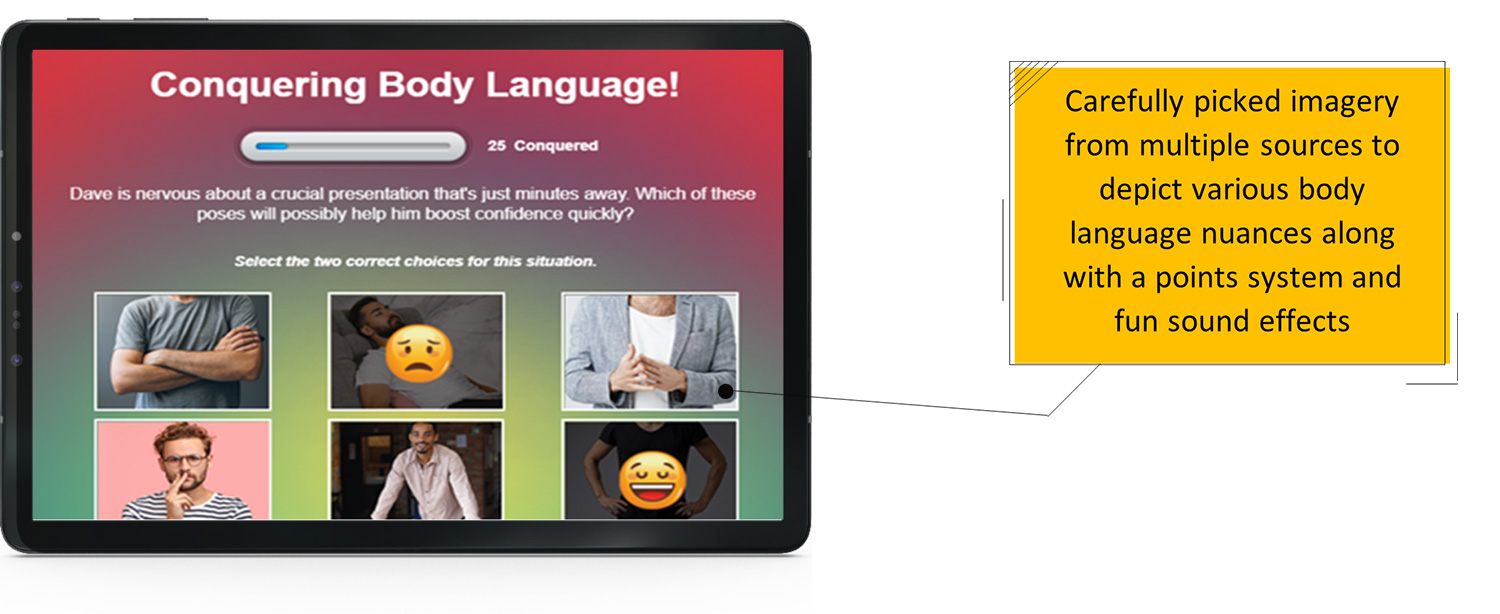
Mobile Learning Example 5 – Learning Through Effective Imagery and Intuitive Game Logic
Here, the requirement was to create a training on effective body language. The approach leveraged the use of imagery and effects to replicate (and even augment) the effect of in-person trainings, thereby fostering a perfect remote learning experience for hybrid employees.
- Carefully picked imagery from multiple sources were used to depict various body language nuances.
- What made the game more engaging was effective game logic, a points system, and fun sound effects.
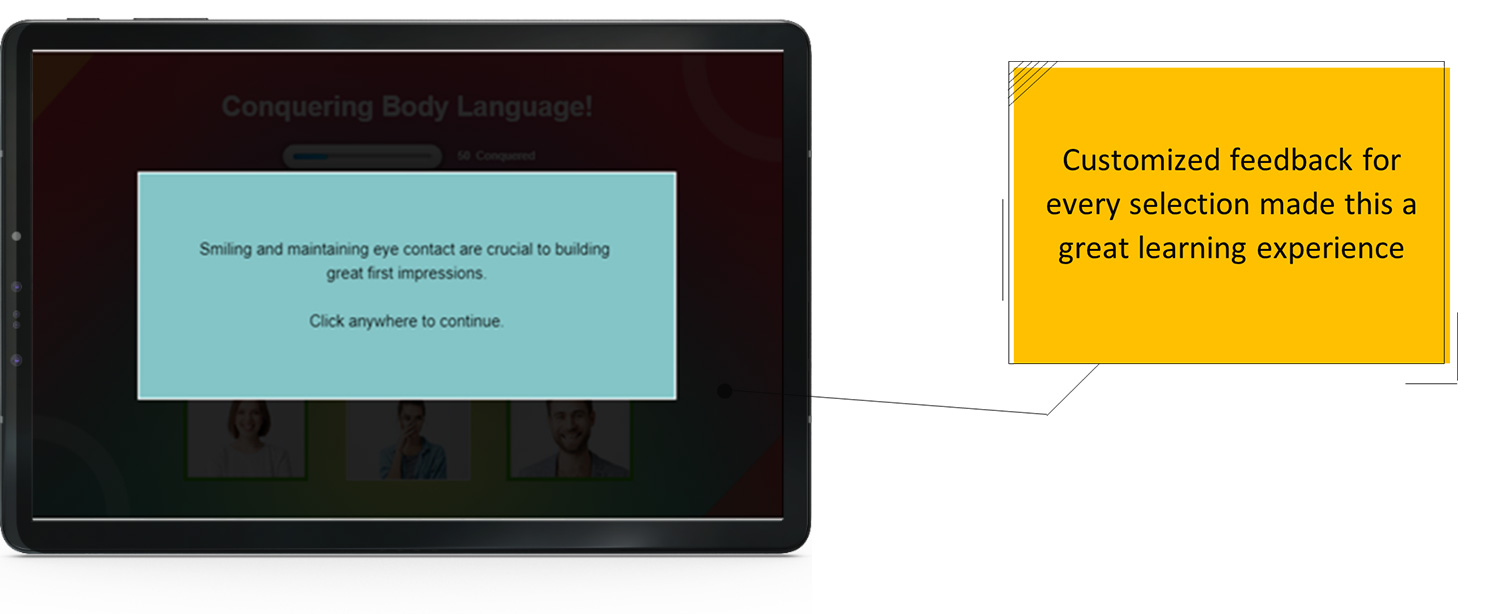
- Customized feedback for every selection made this a great learning experience.
Mobile Learning Example 6 – Leading a Mission with “Clues”
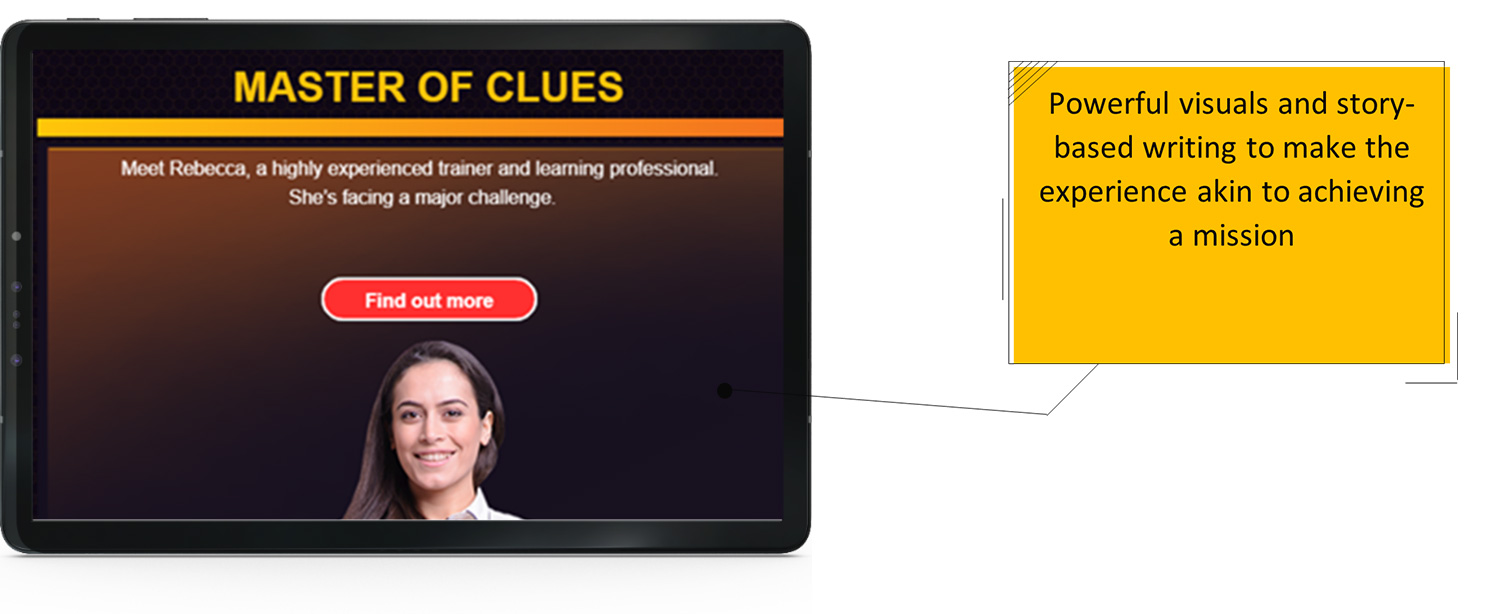
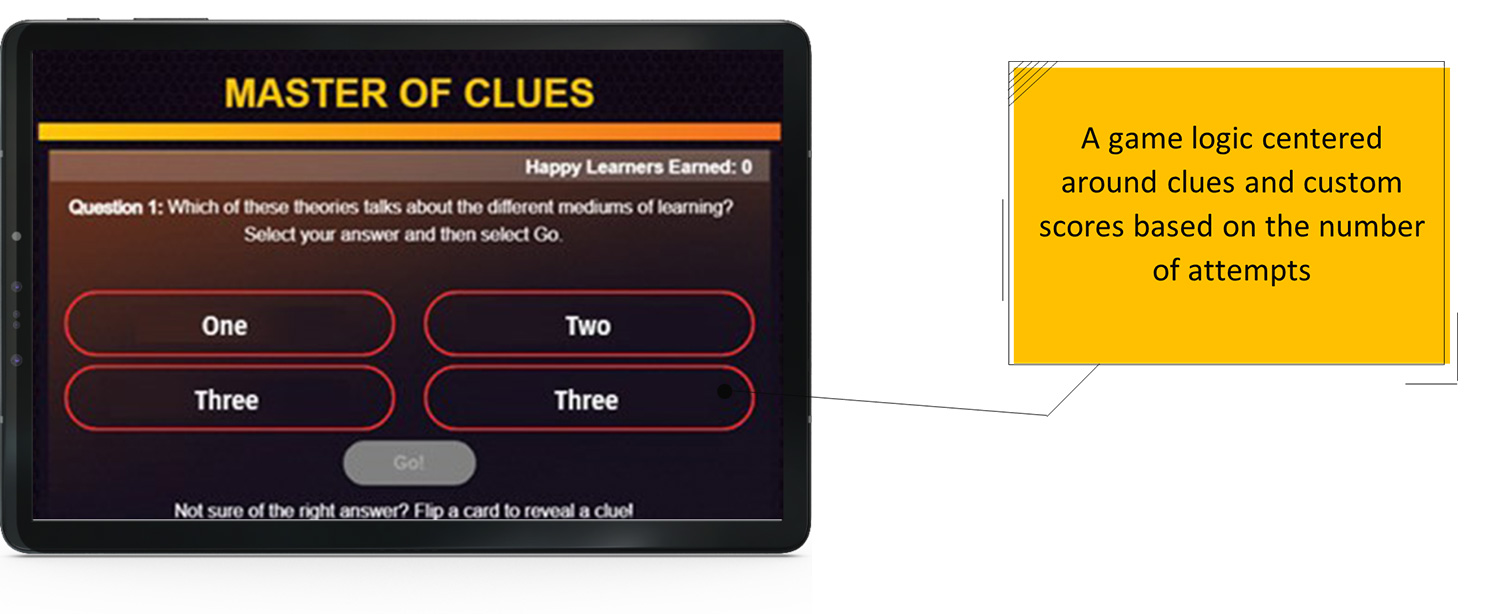
The purpose was to create a gamified learning on eLearning principles and theories to help training managers facilitate learning for a hybrid workforce.
- Powerful visuals and story-based writing was used to make the experience akin to achieving a mission by helping a training manager.
- The game logic was centered around clues and custom scores based on the number of attempts learners took.
- The plot was designed to be strongly relatable for training managers.
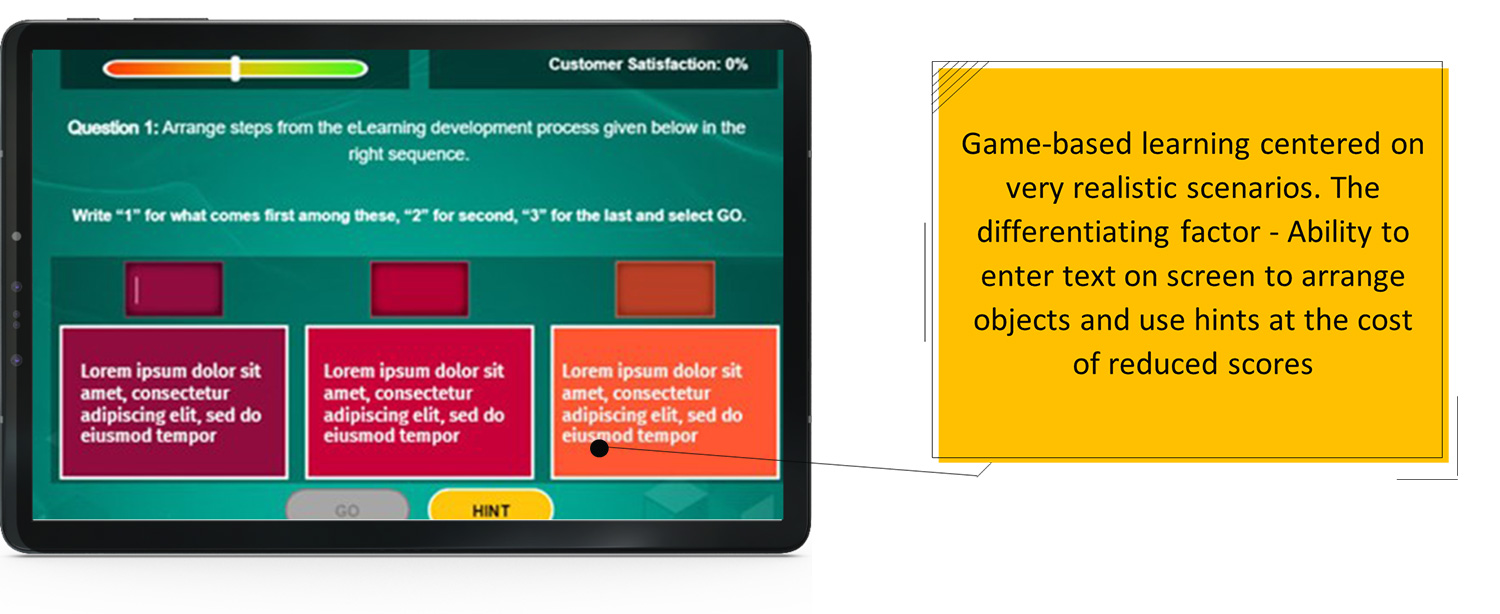
Mobile Learning Example 7 – Getting the Right Sequence!
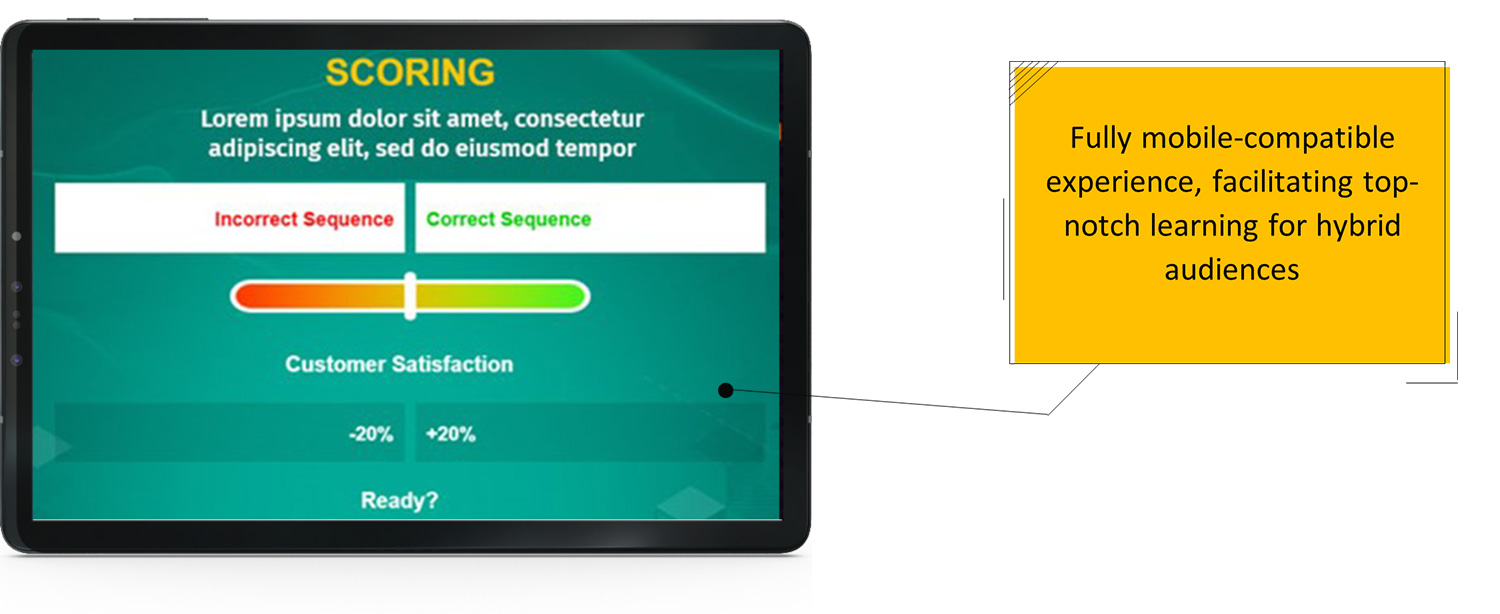
In this course, the learning was focused on teaching the sequence of steps in a process. Learners were asked to rank options from 1 to 3 and given customized scores for their inputs. This approach works great for training hybrid employees with processes and systems, sometimes more effective than an in-person training.
- The game-based learning was centered on realistic scenarios placed within the story of a lead character.
- Decisions taken by learners were also linked to real-life results, like customer satisfaction scores.
- The differentiating factor was the ability to enter text on screen to arrange objects and use hints at the cost of reduced scores. All of this was brought into action through a fully mobile-compatible experience, facilitating top-notch learning for hybrid audiences.
Parting Thoughts
The dynamics of our workplace have changed – with the new hybrid work model now entrenched forever. Employers and L&D specialists must, therefore, respond with appropriate strategies to support remote/hybrid employees. Mobile learning is one such ‘must use’ strategy.
I hope the mobile learning examples showcased here will help you implement them into your overall training strategies and make learning more engaging and effective for the hybrid workforce.

subscribing!
Related articles


.jpg)
.jpg)






.jpg)
