






.avif)

How L&D Teams Can Bridge the Disconnect Between Employee Training and On-the-job Performance


Employee training is often disconnected from on-the-job performance expectations. This article explains what strategies L&D teams can use to maximize knowledge acquisition, practice, and application to bridge that gap.
Why Is There Often a Disconnect Between Employee Training and On-the-Job Performance?
Despite well-designed programs, training often sits apart from the reality of day-to-day work. Employees may learn concepts in controlled, structured environments but struggle to translate them into situations filled with ambiguity, competing priorities, and unexpected variables. Without opportunities to practice, receive feedback, and iterate, new knowledge fades quickly and never becomes embedded in behavior.
Another common gap is misalignment. Training may describe tools or processes without linking them clearly to job expectations, metrics, or business goals. As a result, employees complete courses but do not understand how the learning supports actual performance, and managers do not reinforce it.
Why Should L&D Teams Shift the Focus from Training to Purpose and Performance?
Today’s business environment is moving at such a pace that the most important skill for employers to develop in their workforce is the ability to learn in the flow of work and find ways to creatively apply that new knowledge.
How Can L&D Teams Shift Focus from Training to Performance and Purpose?
To shift from content delivery to performance improvement, L&D teams need to design learning experiences that begin with the desired business outcome. This requires close collaboration with leaders to define purpose, behavioral expectations, and the challenging work conditions employees face. When learning is tied directly to these outcomes, employees understand the reason for the training and see how it affects their own performance.
L&D must also position itself as a performance partner rather than a content producer. This means building a support system that includes coaching, job aids, on-demand help, practice opportunities, and timely feedback. These elements ensure that employees can apply learning continuously and with confidence.
What Are the Persisting Disconnects Between Training and Performance?
Most employee training teams are great at producing and delivering content. In fact, it’s usually not a lack of content that teams struggle with. What they struggle with is creating learning opportunities that drive enhanced employee performance. The other challenge is that while employee training programs should be designed to solve problems, they often simply describe new tools or processes.
L&D teams should not expect traditional employee training solutions to solve the latest problems without considering their impact on actual performance. Current learning solutions present information with little to no opportunity for practice, feedback, or iteration and thus lack true impact to employee performance. Employees are expected to consume decontextualized content in a sterile learning environment and apply it in situations that are often confusing and ambiguous.
Employee performance, when driven by training, should also drive business performance.
Employee training tactics need to align to corporate strategies and goals, developing skills in employees that they can immediately apply on the job. In the past, corporations could hire skills, but as the pace of change continues to accelerate, it’s clear that a robust learning and application program is essential for business success. As L&D teams build training solutions that drive performance, they enable employees to thrive.
How Can L&D Teams Drive Performance with Training?
A shift in strategy is required to drive performance by supporting employee training in a cycle of knowledge acquisition, deliberate practice, and knowledge application.
This should be an iterative process where employees obtain new information, practice what they’ve learned with feedback and coaching, apply what they’ve learned on the job, and then go back for additional learning (and the cycle continues). This creates a succession of continuous and never-ending enhanced performance for employees and outcomes for employers.
In this cycle, learning comes to mean the following things have happened: Employees have acquired new information, practiced it, and applied it.
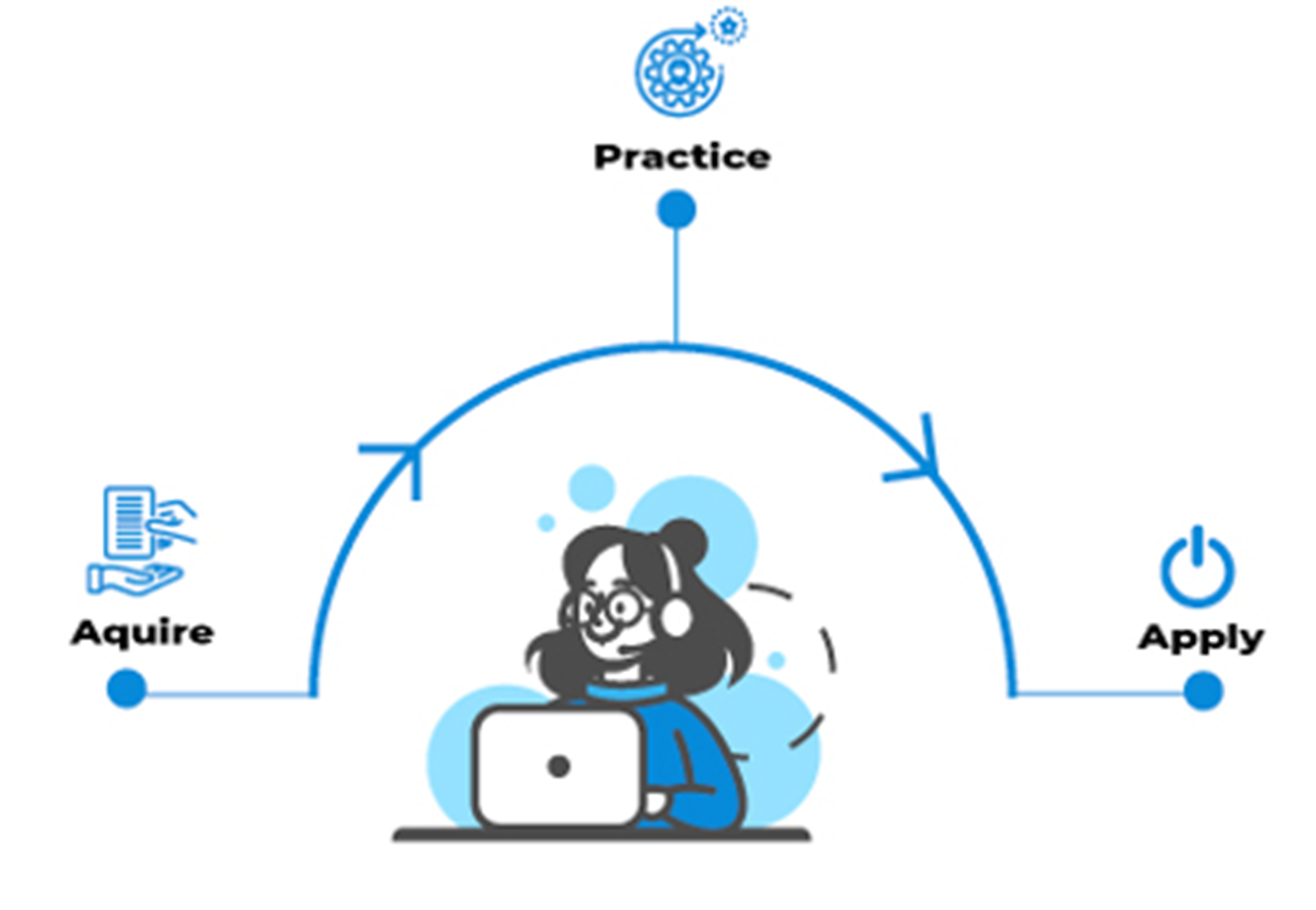
NOTE: Vital to this formula is the practice of coaching. Employees need feedback during the practice and application of new knowledge.
- Without coaching, they won’t know how well they’ve applied what was learned. It also helps flatten the Forgetting Curve, as they’re reminded of what they learned and are coached to consistently reapply.
- This coaching can be provided through self-assessments, formal performance coaches, informal team leads, and managers. eLearning and self-paced training can also include elements of coaching and feedback.
Why Is Coaching Important During Practice and Application Phases?
Coaching accelerates skill adoption by helping employees recognize missteps early, interpret feedback, and adjust their approach. During practice, coaches prevent incorrect behaviors from becoming habits. During application, they help employees navigate work scenarios that are often more complex than training environments.
Regular coaching also builds confidence. When employees know someone is supporting them, they are more willing to experiment, take risks, and practice new approaches. This turns coaching into an important multiplier of training effectiveness.
What Must L&D Teams Do to Drive Employee Performance?
To drive employee performance, employee training teams need to design learning solutions that have clear phases – knowledge acquisition, practice, and application.
Each phase needs robust support and should factor in unique delivery methods and modalities.
Employee training should be viewed as program solutions composed of multiple components so that learners can move from:
- Acquiring new information.
- Practicing what they learned in safe environments with frequent feedback loops.
- Handling gradually higher stake on-the-job situations in which the newly acquired skills can be applied and honed to proficiency.
Phase 1 – Strategies L&D Teams Can Use – During the Knowledge Acquisition Phase
L&D teams can apply the following strategies during the knowledge acquisition phase, depending on the needs of the learners, the nature of the content, and the context in which it will be applied:
- Instructor-led and self-paced content must be broken into easily consumable chunks in training and performance programs. This content should be evaluated so that learners aren’t overwhelmed with huge portions of new information, rendering it impossible to apply in practice situations.
- On-the-job and in the flow of work training and performance support must be leveraged. It is advantageous because employees can rehearse and apply it on the job. This should be supported by close coaching with feedback.
- Job aids, knowledge bases, and training and performance support tools must be available for on-demand learning. They facilitate quick knowledge acquisition because it’s easily categorized in consumable portions. These often include SME-produced content that answer specific questions to novel situations.
Phase 2 – Strategies L&D Teams Can Use – During the Practice Phase
Strategies that support the practice portion of the training and performance cycle include those listed below.
NOTE: It’s important to note that consistent coaching is vital in the practice stage. If incorrectly applied, flawed practice can reinforce negative behaviors just as easily as positive, damaging employee performance:
- Gamification: Using games, L&D teams can challenge employees to apply newly acquired information in familiar as well as novel situations, rewarding correct application and correcting mistakes.
- Practice environments should mimic actual job application as much as possible, using enterprise metrics and KPIs to measure the success of practice. Aligning those practice metrics to enterprise goals and strategies will prepare employees for practical application and execution.
- Practice environments provide a safe place for employees to determine the value of what they’ve learned, experiment in various contextual situations, fail, iterate approaches, and modify application.
Phase 3 – Strategies L&D Teams Can Use – During the Application Phase
The final stage, application, is where the value of effective knowledge acquisition and practice is demonstrated, enhancing employee training and performance. During the application phase of employee training:
- Learners require frequent nudges and reminders to enhance employee performance. These can be provided personally by coaches, team leads, and managers. Digital reminders through automated systems are also effective if used correctly. Be careful that they don’t lose their practical application and become more background noise to employees than effective reminders of correct behavior.
- Employees should be empowered to provide informal feedback up, down, and sideways throughout the chain of command. One of the reasons the founder of Netflix, Reed Hastings, is convinced Netflix has been so successful is the honest and in-the-moment feedback loops provided by all employees. Training and performance are equally enhanced.
- Formal coaches should reinforce and reward correct behavior in real time as employees apply new skills. At the same time, they need to effectively correct flawed behavior in one-on-one situations with employees, reminding them of the application in each unique context employees may encounter.
- Agile sprints (instead of larges-cale waterfall project lifecycles) should be used. They create a process through which employees and teams can quickly evaluate performance and project velocity, making small adjustments in real time, improving process and output as well as training and performance.
What Role Do Nudges and Reminders Play in Supporting Employee Performance Post Training?
Nudges help employees apply new skills at the right moment. These cues support the transition from intention to action by keeping desired behaviors visible. They reduce skill decay and make it more likely that employees act on what they learned. Nudges can be delivered by managers, coaches, or digital systems and work best when they are brief, relevant, and timed appropriately.
When designed well, nudges function as small coaching moments. They support consistent performance, reduce reliance on memory, and help employees develop habits that reinforce new skills.
How Can Agile Sprints Help Improve Training Effectiveness and Employee Performance in Real Time?
Agile sprints help L&D teams refine training more quickly. Instead of waiting for a complete program rollout, L&D can release smaller elements, gather data, observe how employees perform, and adjust based on results. This reduces risk and accelerates improvement.
For employees, agile cycles provide support in shorter intervals. Learners can practice, apply, receive feedback, and refine skills more frequently. This leads to steady performance gains and a smoother transition from training to on-the-job execution.
Parting Thoughts
The most successful firms in today’s economy are those that prioritize learning through knowledge acquisition, practice, and application, enabling them to be as agile and adaptive as possible. The strategies in this article will definitely provide the requisite insights to effectively bridge the gap between employee training and desired on-the-job performance.
To explore further, you can download our eBook on measuring learning effectiveness and creating a positive ROI: How You Can Measure the Learning Effectiveness of eLearning Courses and Create a Positive ROI
Frequently Asked Questions
- How can L&D teams design training that directly supports organizational goals?
They should define the expected outcomes with leaders and map training content to the specific behaviors and tasks needed to achieve those outcomes. - Why do employees often struggle to use what they learn?
They usually lack enough guided practice and feedback. Without repetition and support, new knowledge does not turn into usable skill. - How can managers strengthen training transfer?
Managers can reinforce expectations, give timely feedback, and create chances for employees to try new skills during daily work. - What learning methods improve retention and application?
Short digital content, practice sessions, coaching, and performance support tools work well together and help employees remember and use their learning. - How can L&D teams check if training is improving performance?
They can monitor behavior changes, task quality, fewer mistakes, faster proficiency, and feedback from learners and supervisors.

subscribing!
Related articles


.jpg)
.jpg)






.jpg)
