






.avif)

Understanding the basics of Revised Bloom’s Taxonomy application in eLearning


Summary
By shifting from noun-based categories to verb-based cognitive levels—remember, understand, apply, analyze, evaluate, and create—it helps instructional designers define clearer learning outcomes and build more effective learning architectures.
Introduction
While the usage of Bloom’s Taxonomy (BT) to nail learning outcomes has been used for training over several decades, the Revised Bloom’s Taxonomy (RBT) brings in an added dimension that enables it to be used more effectively to design eLearning.
In this blog, I cover the basics of Revised Bloom’s Taxonomy (in contrast to Bloom’s Taxonomy). Then, I move on to showcase how you can use RBT to design the learning architecture of eLearning courses. Specifically, I’ll discuss how you can use RBT to bring in behavioral change.
Understanding Bloom's Taxonomy
Bloom’s taxonomy is a framework for learning, teaching, and educational accomplishment in which each level is linked to the one below. It is commonly portrayed as a pyramid, akin to Maslow’s hierarchy of needs.
Basic knowledge, or the initial stage of learning, leads to the development of the skills and abilities required to complete the educational process: comprehension, application, analysis, synthesis, and evaluation. Although there are subcategories within each, each stage is on a continuum. The idea behind this is that students would learn the concepts in a given order without leaving any levels out of Bloom’s taxonomy pyramid, starting from the simplest of learning and ending in deeper appreciation of the subject with every level being a stepping stone for the next.
Revised Bloom’s Taxonomy
The revised Bloom’s Taxonomy focuses on enhancing students’ learning outcomes through the use of improved terminology. This revised taxonomy is a modernized iteration of Bloom’s Taxonomy, which was originally developed in 1956 to explore cognitive skills and learning behavior. Benjamin Bloom suggested the initial concept, stating that “education must be increasingly concerned about the fullest development of all children and youth.”
The updated method includes changes in terminology, structure, and emphasis. Nouns like evaluation or synthesis have been replaced by verbs like creating or evaluating. With structure, “creating” rises to the highest level—the region reserved for producing ideas or developing a new point of view. The emphasis has also altered, with the taxonomy aiming at a broader readership and attempting to be more universal.
Exploring the Difference Between Revised Bloom’s Taxonomy and Original Bloom’s Taxonomy
Benjamin Bloom introduced the original taxonomy in 1956 (in his book, The Taxonomy of Educational Objectives: The Classification of Educational Goals) to represent cognitive learning as a six-level hierarchy, with each successive level requiring additional mental processing. These levels are named after uncountable nouns: knowledge, comprehension, application, analysis, synthesis, and evaluation.
In 2001, David Krathwohl presented the Revised Bloom’s Taxonomy, commonly referred to as RBT. Although Dr. Bloom passed away in 1999, Krathwohl had already worked closely with him. The new taxonomy transforms the nouns in Bloom’s Taxonomy into verbs: Remember, Understand, Apply, Analyze, Evaluate, and Create. Additionally, it also switches the last two levels.
What Are the Changes that Were Made to Bloom’s Taxonomy to Create the Revised Bloom’s Taxonomy?
Bloom’s Taxonomy was revised by Lorin Anderson and others. This is reflected as following two changes:
- Changing the nouns to relevant verbs.
- The verbs’ order modified (the last two levels were switched).
The revised structure is depicted in the figure. Alongside is Bloom’s Taxonomy for easier reference.
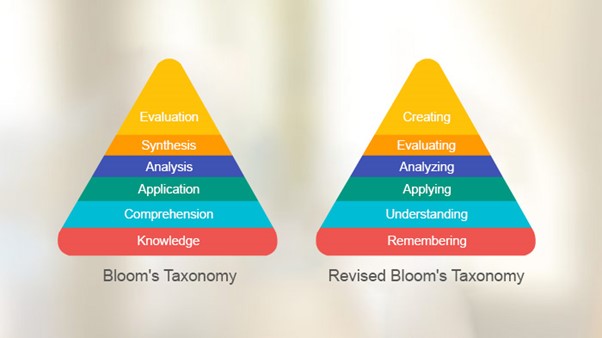
Let’s see both these revisions in detail.
- Remembering: Recall information and exhibit the memory of previously learned material, information or knowledge (could be facts, terms, basic concepts or answers to questions).
- Understanding: Demonstrate understanding of facts and ideas by organizing, comparing, translating, interpreting, giving descriptions and stating the main ideas.
- Applying: Use information in new or familiar situations to resolve problems by using the acquired facts, knowledge, rules and techniques.
- Analyzing: Examine and slice information into portions by understanding causes or motives; make inferences and find evidence to support generalizations.
- Evaluating: Express and defend opinions through judgements about information, authenticity of ideas or work quality, according to certain criteria.
- Creating: Organize, integrate and utilize the concepts into a plan, product or proposal that is new; compile information together in a different way.
Example of Bloom’s Taxonomy
Consider the following scenario: A college student must draft an essay to assess their communication abilities. To complete the task, students must be able to use the Bloom's taxonomy levels listed below:
- Remember:
Take advantage of existing knowledge and many sorts of communication skills needed in everyday life.
- Understand:
Analyze how various communication approaches might enhance assignment writing.
- Apply:
Use an academically credible communication theory that aligns with their unique communication style.
- Analyze:
Identify appropriate communication styles for varied contexts, audiences, and purposes.
- Evaluate:
Assess the communication process from a broad perspective and identify current difficulties.
- Create:
Create an innovative framework to characterize one's communication style.
Verbs in Bloom's Taxonomy
Bloom’s action verbs are utilized to construct learning outcomes. Here’s an overview of each layer in Bloom’s Taxonomy system.
- Remember implies retrieving information from long-term memory, such as recalling the stages of mitosis. Learning outcome verbs associated with this level include ‘cite,’ ‘define,’ and ‘label.’
- Understand means demonstrating understanding of a certain topic or information, such as describing why a chemical reaction happens. This level’s learning outcome verbs include ‘compare,’ ‘differentiate,’ and ‘paraphrase.’
- Apply refers to the application of classroom principles to other academic or non-academic settings, such as utilizing a math formula to calculate a suitable budget. This level’s learning outcome verbs include ‘examine,’ ‘experiment,’ and ‘solve.’
- Analyze means finding shared characteristics between concepts and applying critical thinking to identify patterns and connections, such as distinguishing between collective and individualistic cultures. Learning outcome verbs include ‘classify,’ ‘identify,’ and ‘integrate.’
- Evaluate entails reasoning using the educational facts and criteria provided to them, such as justifying a fictitious court verdict. This level’s learning outcome verbs include ‘conclude,’ ‘consider,’ and ‘rank.’
- Create, the last level of the updated Bloom’s Taxonomy model, entails combining distinct pieces to make a thorough final result, such as producing a book of short stories based on literature concepts covered throughout the course. Learning outcome verbs for this level include ‘compile,’ ‘generate,’ and ‘modify.’
These verbs refer to the cognitive process and knowledge that students work with. For instance, a verb falling under the ‘remember’ category might require students to recall how to perform CPR, while a verb in the ‘create’ category might prompt them to formulate an effective project workflow.
How Can Revised Bloom’s Taxonomy (RBT) Be Used in Designing eLearning Courses?
The learning architecture of the eLearning course is crafted using RBT.
RBT guides the creation of an online learning solution based on the kind of knowledge and the level of cognitive/affective complexity of the course. The process of mapping the course creation to RBT ensures the learning experience is crafted as per an accepted and ratified framework. It also allows more time to craft an engaging online learning experience.
Application of RBT
- During the initial phase of a project life cycle, appropriate Revised Bloom’s verbs are applied to write the Terminal Learning Outcomes (TLOs) and the Enabling Learning Outcomes (ELOs) of the course.
- Once the TLOs and ELOs have been determined, the RBT also guides in determining the presentation style for individual frames in the content.
NOTE: The second aspect is the significant value-add that RBT provides to create eLearning courses. We can tag the content to various content types (Fact, Principle, Process, Procedure and so on). Looking at the nature of the content, we can identify how it should be presented in the online format (as static information, an interactive frame or a knowledge check that reinforces learning or validates the required cognition level).
Can Revised Bloom’s Taxonomy (RBT) Be Used to Create or Impact Behavioral Change?
The Affective Domain addresses interests, attitudes, opinions, appreciations, values and emotional sets.
If your aim is to bring about a behavioral or attitude change through the learning, then structure the information to progress through the levels of the Affective domain, as shown here:
- Receiving: Focus of attention and simple response to stimuli
- Responding: Active participation and reaction
- Valuing: Ascribing a value to an object, phenomenon or concept; ranges from acceptance to commitment
- Organizing: Bringing together different values, resolving clashes among them and starting to build an internally consistent value system
- Internalizing: Acquiring a value system that has governed the learner’s behavior for a sufficiently long time
Please refer to the table that lists the action verbs corresponding to the Affective Domains that can be used to create the learning objectives in eLearning courses.
I hope this article provides you insights into Revised Bloom’s Taxonomy (RBT), in contrast to Bloom’s Taxonomy (BT), and explains how it is more effective in creating the learning architecture of eLearning courses.

subscribing!
Related articles


.jpg)
.jpg)






.jpg)
