






.avif)

5 Examples of Virtual Reality in Corporate Learning

Summary
Explore five practical examples of how virtual reality is transforming corporate learning across safety, compliance, technical training, and performance development. This article shows how immersive learning helps employees practice real-world decisions, build confidence, and improve workplace readiness.
Introduction
Every day, employees step into situations where a split-second decision or a small oversight can make a consequential difference. The question is how we prepare them for moments they may have never encountered before. Traditional training can describe a scenario, but it rarely captures the pressure or subtle details employees face when they experience it in practice.
The Case for Virtual Reality in Learning
Virtual Reality in corporate learning offers a practical way to bridge that gap. By immersing learners in interactive, three-dimensional environments, it allows them to explore, make decisions, and practice skills in realistic contexts. Learning becomes active, memorable, and rooted in experience.
Moving from reading about a concept to practicing it directly can greatly improve how well learners understand and apply new skills. This makes learning more actionable, giving employees the opportunity to rehearse key tasks and strengthen their performance through repetition and high-value feedback.
Why Virtual Reality Is Raising Learning Effectiveness
Unlike conventional approaches that rely on passive participation, VR training solutions give learners a sense of presence and engagement that helps build mastery. Immersive learning experiences consistently enhance learner focus, strengthen skill recall, and support more confident on-the-job performance. By placing learners directly inside a scenario, VR promotes deeper concentration, more active involvement, and a stronger emotional connection to the task at hand.
Organizations that adopt VR often observe better preparedness among employees, fewer performance errors, and a workforce that feels more motivated and capable. These outcomes contribute to a learning environment where capability development is practical, relevant, and aligned with workplace expectations.
Where Virtual Reality Creates the Greatest Impact
Organizations are integrating Virtual Reality in corporate training across multiple domains, from technical and safety programs to leadership and compliance development. The technology is particularly valuable when:
- Safety and precision are critical.
- Consistency in delivery is required.
- Access to real environments is limited.
- Soft skills rely on emotional engagement.
- Performance data needs to be measurable.
Making Virtual Reality Work in Corporate Learning
Integrating VR into learning programs is most effective when treated as a strategic initiative rather than a one-off experiment. The starting point should always be the learning need, not the technology itself. Organizations must identify specific capability gaps or performance challenges where VR can make a tangible difference, typically in areas that involve complex procedures, situational judgment, or behavioral change.
Designing for experience and feedback is equally important. The most effective VR environments are not passive simulations but interactive learning spaces where participants make decisions, observe outcomes, and refine their responses in real time. Scalability and accessibility are also crucial. With modern web-based VR platforms and mobile compatibility, organizations can balance immersion with reach and cost efficiency. Finally, linking VR modules to an existing learning management system ensures that performance data, completion rates, and learner insights feed directly into the broader learning ecosystem.
When grounded in clear learning objectives and connected to business outcomes, VR moves beyond novelty to become a sustainable driver of organizational capability.
5 Examples of Virtual Reality in Corporate Learning
1. A Global Biotechnology Company: Promoting Ergonomic Awareness
Business Context: A biotechnology firm aimed to improve workspace ergonomics and reduce strain-related injuries through employee training with VR. Many employees were unaware of how everyday posture habits contributed to long-term discomfort, making awareness training essential.
Solution: A WebVR-based environment reproduced office setups where learners could identify ergonomic risks and make corrections with step-by-step guidance. The simulation allowed them to test different workstation adjustments, observe the impact, and learn how small changes improved comfort and alignment.
Impact: Employees demonstrated better ergonomic awareness and healthier workplace habits. Managers also noticed fewer manual corrections were needed, as employees proactively applied their learning to daily routines.
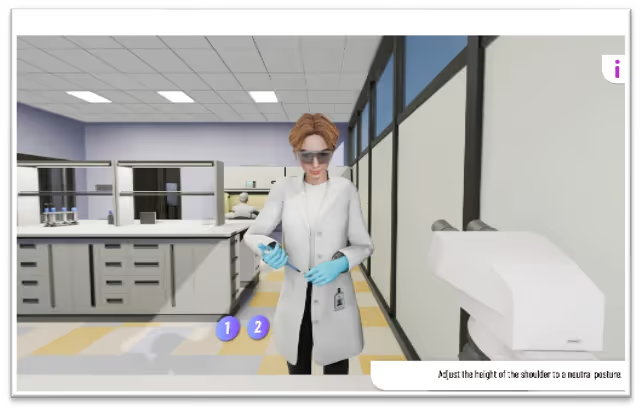
Learning Insight: VR makes behavioral change measurable by converting awareness into active skill practice and allowing learners to repeatedly apply what they have learned in workplace conditions.
2. A Global Aerospace Manufacturer: Strengthening Ethical Decision-Making
Business Context: The company wanted to improve how employees responded to ethical and reporting dilemmas using immersive corporate learning methods. These situations often involved emotional nuance and competing pressures, which traditional training struggled to convey.
Solution: A dialogue-based VR experience simulated practical workplace situations where learners made choices through branching conversations. They could observe how colleagues reacted, assess the consequences of different responses, and revisit scenarios to improve their judgment.
Impact: Thousands completed the training, reporting greater confidence and understanding of compliance procedures. The immersive format helped employees reflect on their decisions and practice responding to sensitive topics with clarity and empathy.
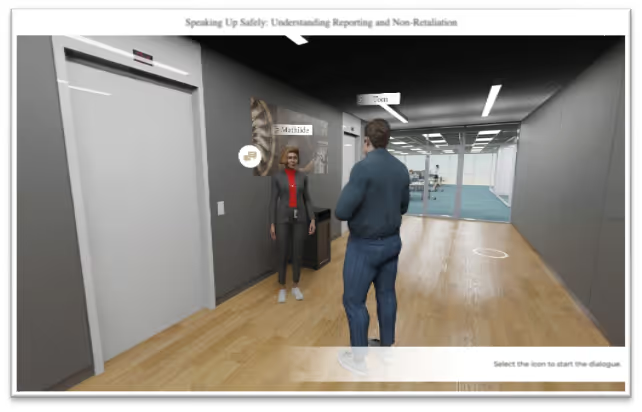
Learning Insight: Scenario-driven VR learning experiences help employees practice nuanced conversations, reflect on the impact of their choices, and build stronger ethical judgment through repeated exposure to operational dilemmas.
3. A Global Health Organization: Laboratory Safety Training
Business Context: The organization needed to train lab staff worldwide on safety procedures without access to physical high-containment facilities. The critical nature of the work required consistent training, yet learners often practiced in environments that lacked real-life risk conditions.
Solution: A browser-based VR lab simulation allowed learners to explore, identify hazards, and practice corrections interactively. The module replicated a detailed lab environment, enabling learners to test their reactions to spills, equipment failures, or procedural missteps without any physical danger.
Impact: Consistent safety standards across countries, with higher retention and reduced training costs. Teams reported better preparedness, and supervisors observed fewer procedural errors during live operations.
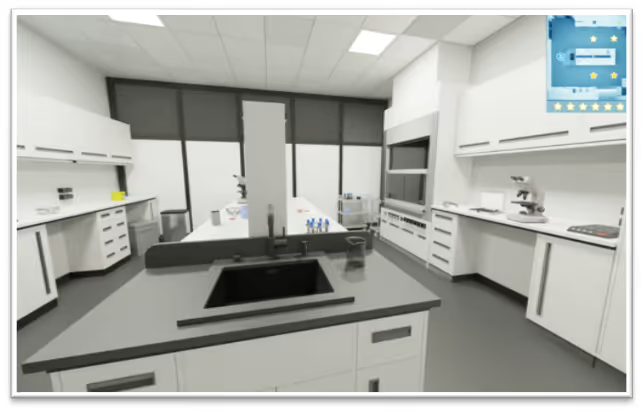
Learning Insight: Virtual reality learning experiences strengthen procedural accuracy by letting learners identify risks, correct mistakes, and internalize safety protocols in an environment that mirrors critical lab conditions without the associated hazards.
4. A Leading Transportation Provider: Preheating System Training
Business Context: A transportation company needed to train maintenance staff on preheating systems safely and efficiently. These systems were complex, and hands-on access was limited, leading to delays in skill development and inconsistent understanding of procedures.
Solution: A headset-based VR module used a 3D digital twin of the real system for step-by-step interactive training and real-time feedback. Learners could operate components, troubleshoot errors, and repeat procedures as often as needed without disrupting ongoing operations.
Impact: Faster onboarding, reduced operational disruptions, and safer skill transfer. Technicians were able to practice in a controlled environment, gaining confidence before handling the actual equipment.
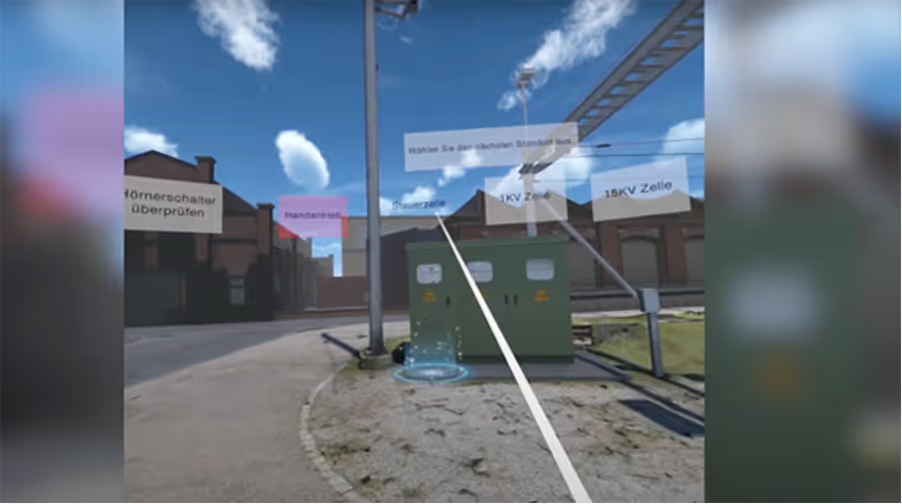
Learning Insight: Digital twins combined with workplace simulation training enable technicians to master technical procedures by practicing complex steps repeatedly, building confidence and precision before working on actual equipment.
5. A Global Consumer Goods Company: Driving Safety and Performance
Business Context: The company aimed to strengthen the defensive driving skills of its logistics workforce through VR training solutions. Drivers regularly faced unpredictable road conditions, and traditional training did not provide enough exposure to challenging scenarios.
Solution: A VR driving simulator recreated varied terrains and hazard scenarios, providing instant feedback on driver actions. Learners practiced handling sudden obstacles, poor weather, and complex traffic conditions, helping them build stronger situational awhttps://www.liberateglobal.com/blogs/top-strategies-to-leverage-virtual-reality-in-training?query=Virtual+Reality+in+corporate+learningareness.
Impact: Fewer incidents, improved awareness, and higher driver confidence across regions. Supervisors reported measurable improvements in decision-making and hazard anticipation during live routes.
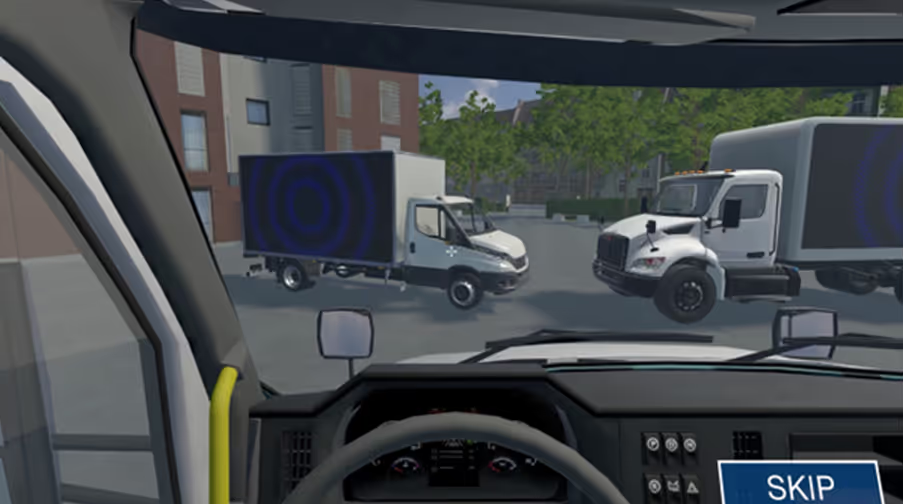
Learning Insight: Experiential VR learning environments help drivers internalize safe practices by exposing them to challenging road scenarios and providing immediate feedback, reinforcing quick, confident decision-making in real driving conditions.
Overcoming Barriers to Adoption
Despite its benefits, many organizations hesitate to implement VR due to perceived cost, infrastructure, or complexity concerns. However, these barriers are increasingly manageable with thoughtful planning. While initial investment can be higher than that of conventional eLearning, pilot projects are an effective way to demonstrate value before scaling.
Another challenge lies in maintaining the content lifecycle. Training content must evolve with new processes or technologies, and building modular VR experiences allows teams to update scenarios without rebuilding entire programs. Learner adoption is also key. Employees may need time to adjust to new formats, so orientation sessions, clear objectives, and technical support are essential to ensure comfort and confidence.
Finally, evaluating success is about more than engagement metrics. Organizations can measure the return on investment by tracking key performance indicators such as error reduction, shorter onboarding time, improved safety compliance, and higher productivity. With the right planning, VR becomes a practical and scalable part of an organization’s learning architecture.
Final Thoughts
Virtual Reality in corporate learning is giving organizations a practical way to build capability through realistic practice. When employees can explore scenarios, respond to challenges, and refine their skills in a safe environment, they develop the confidence and readiness needed for workplace demands.
VR supports deeper learning by combining immersion with repetition and timely feedback, enabling employees to build accuracy and sound judgment over time. As organizations continue to adapt to evolving skill requirements, VR offers a versatile and future-ready approach to developing talent and strengthening performance across roles and functions.
Frequently Asked Questions
- What kinds of corporate training work best with VR? Technical, safety, compliance, and soft-skill programs benefit most, especially where hands-on or situational practice is required.
- Does VR training require special equipment? Not always. Many solutions run in web browsers or on mobile devices, while headsets add deeper immersion.
- How can organizations measure VR learning success? Progress and performance can be tracked via LMS integration using SCORM or xAPI standards.
- Can VR training be scaled globally? Yes. VR modules can be distributed digitally across locations, ensuring consistent and updatable experiences.
- Is Virtual Reality training cost-effective? While development costs are higher upfront, VR delivers long-term savings through reduced travel, risk, and time-to-competence.

subscribing!
Related articles


.jpg)
.jpg)





.jpg)

